


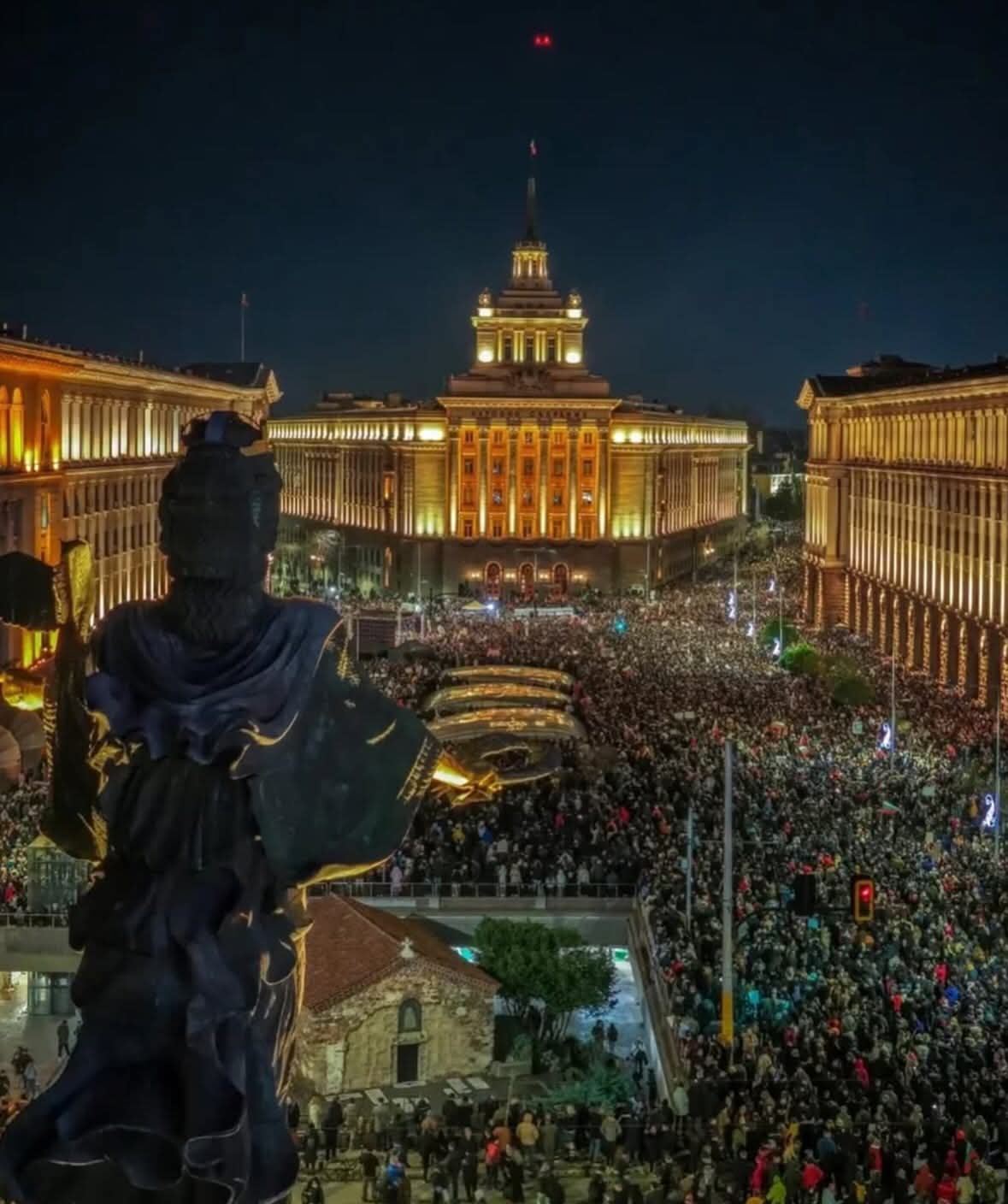
Tens of thousands of Bulgarians have taken to the streets in the country’s biggest demonstrations in years, signalling a widening crisis for the minority coalition government as anger grows over proposed tax hikes, low living standards and entrenched corruption.
Monday’s rallies, centred on Sofia’s National Assembly square and echoed in at least a dozen other cities, follow a week of mounting protests against the draft 2026 budget. Organisers estimated the Sofia crowd at around 50,000, an unusually high turnout for a country of 6.4 million, underlining the scale of frustration.
Protesters waved Bulgarian and EU flags and projected the words “Resign” and “Mafia” onto government buildings. Banners reading “Generation Z is coming” underscored the youth-led character of the mobilisation.
Budget backlash taps into broader discontent
At the core of the unrest is the government’s plan to raise social security contributions and increase taxes on dividends—measures that critics say would disproportionately burden workers and small businesses in the EU’s poorest member state.
Prime Minister Rosen Zhelyazkov promised last week to withdraw the draft budget and propose a new version, but the reversal has not calmed the streets. Many demonstrators accuse the government of trying to push the budget through without proper debate and see the episode as part of a wider governance problem.
Bulgaria is consistently ranked among the EU’s most corrupt states. Only Hungary scores worse on Transparency International’s corruption index. For many protesters, the budget dispute has become a proxy for years of anger over perceived impunity, political patronage and weak rule of law.
Clashes highlight volatile mood
While the main demonstration in Sofia remained peaceful, smaller groups clashed with police late on Monday, throwing rocks, bottles and firecrackers. Garbage containers were set on fire and a police van was damaged, according to local media. At least ten people were arrested and two police officers injured, the Bulgarian News Agency reported.
Several party headquarters were vandalised, further illustrating the depth of political frustration.
President Rumen Radev, an independent and frequent critic of the government, called for calm but also demanded the Cabinet resign, saying “there is only one way out: resignation and early elections.”
Economic uncertainty ahead of euro adoption
The protests come at a sensitive moment: Bulgaria plans to join the eurozone on January 1, 2026. The European Central Bank has warned that inflation could spike after adoption of the single currency, raising concerns among citizens already hit by rising prices.
Critics argue the original budget, with higher spending and increased payroll contributions, risked fuelling inflation further and deepening social inequality.
For many Bulgarians—especially younger urban voters—the protests appear to be evolving into something larger than a debate over fiscal policy. The central grievance is the belief that Bulgaria has failed to shake its reputation for corruption nearly two decades after joining the EU.
A test of the government’s survival
The minority coalition, formed by GERB, the Bulgarian Socialist Party and the populist ITN party, now faces its most serious challenge. Even if the budget is revised, analysts say the political damage may be difficult to reverse.
With early elections increasingly likely, Bulgaria risks entering another cycle of political instability. The country has held six elections in the past four years, and the latest unrest highlights the entrenched dissatisfaction fuelling that volatility.
For now, the scale of Monday’s rallies suggests a shift in public mood—with a new, younger generation pushing for accountability and deeper reform in one of the EU’s most troubled democracies.