


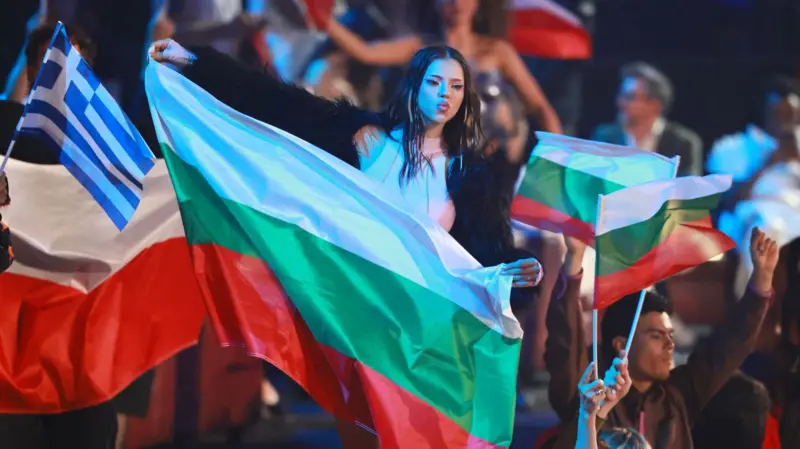
Bulgaria won the 2026 Eurovision Song Contest in Vienna on Saturday night, securing its first victory in the competition in nearly two decades, while the United Kingdom finished last after receiving no points from the public vote.
Bulgarian singer Dara triumphed with her song “Bangaranga,” collecting a total of 516 points in one of the most politically charged and closely watched Eurovision finals in recent years.
Israel finished second with 343 points, despite protests and boycott calls surrounding its participation because of the ongoing war in Gaza. Australia, Denmark, France and Finland rounded out the top contenders after strong jury performances.
The contest, held in Austria’s capital to mark Eurovision’s 70th anniversary, brought together 25 finalists in a spectacle mixing pop music, theatrical performances, elaborate choreography and political undertones that increasingly define Europe’s largest live television event.
For Bulgaria, the victory marks a major cultural moment and a rare soft-power success for a Balkan country often absent from Europe’s mainstream entertainment spotlight. Bulgarian media and fans celebrated Dara’s win as a historic breakthrough for the country’s music industry.
The performance of “Bangaranga,” blending electronic beats with Balkan-inspired rhythms and high-energy staging, emerged as a favorite among both juries and television audiences across Europe.
Meanwhile, Britain endured another disappointing night.
The UK entry, musician Sam Battle — known online as “Look Mum No Computer” — received only one point from the professional juries and zero points from the public vote, placing Britain at the bottom of the scoreboard once again.
The result revives long-running debates in the UK over why the country continues to struggle in Eurovision despite being one of the competition’s biggest financial contributors and automatically qualifying for the final each year as part of the “Big Five.”
British commentators described the outcome as the country’s worst result since 2021, when the UK received “nul points” overall.
This year’s contest unfolded against a backdrop of geopolitical tensions and protests over Israel’s participation, with some viewers and activists calling for a boycott similar to previous controversies involving Russia before its exclusion from Eurovision following the invasion of Ukraine.
Crowds gathered across Vienna throughout the week for the final, which featured performances ranging from orchestral ballads and electro-pop to heavy synth rock and traditional folk influences.
Eurovision has increasingly evolved beyond a music competition into a reflection of Europe’s political mood, identity debates and shifting cultural alliances. Voting patterns are often scrutinized for regional loyalties, diaspora influence and political symbolism as much as musical quality.
The contest’s organizers have repeatedly insisted Eurovision remains a non-political event, although geopolitical tensions have frequently shaped public debate surrounding the competition.
Bulgaria’s victory now means the country is expected to host the 2027 Eurovision Song Contest, an event likely to attract hundreds of millions of viewers worldwide.