


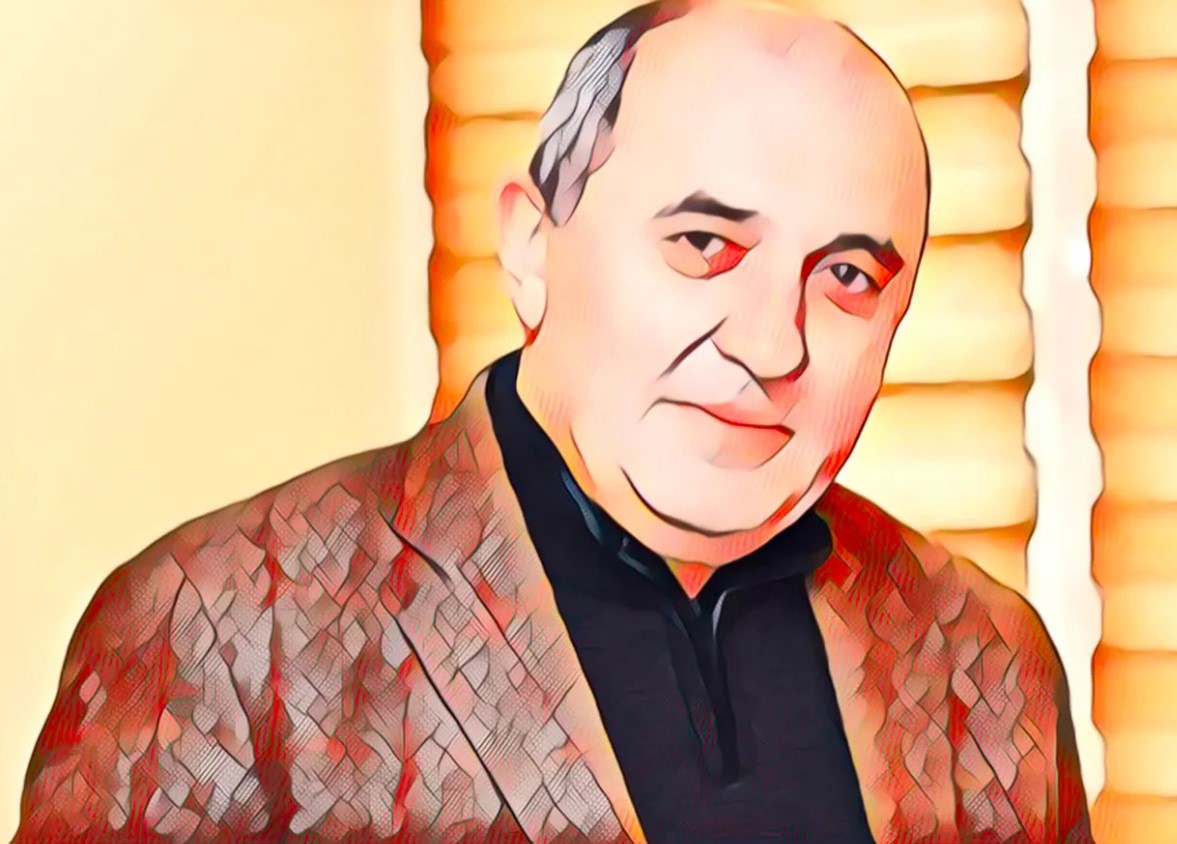
“I do not make any prior plan for the novel I am going to write. I begin knowing very little or nothing about what will happen to the character. Thus, I enter a process, which often lasts for years, where I myself discover what my imagination tells me about the character’s adventures. It is therefore a joyful magic, which ends when I put the final full stop and hand the manuscript over to the publisher. As for the published books, that is, previous writings, they often give me pleasure, but not happiness.”
(This interview was taken from the magazine “Symbol”, published in Pristina.)
Interviewed by: Eronita Kqiku
In your early writings, especially poetry, we often see patriotic motifs. Was the situation of Albania what first motivated you to write and later serve your country in various positions?
Your question implies a maturity and awareness that I did not have when I began writing poetry. I was an adolescent. The reason I started writing verses around the age of 16 was much more ordinary: I wanted to impress a girl. She, understandably, soon left my life, but she left me with the magic of poetry. As a teenager, I did not yet have the clarity to understand Albania’s real condition. That clarity came gradually over the years.
The Albania reflected in my early poems mirrors my folkloric upbringing, received in family and school. At that age, the homeland was not yet a geographical, political, economic, or social reality. It was rather a kind of fetish in my immature imagination. This could have led me to die for it, but not to think concretely about how to serve it in daily life.
What is inspiration for you?
Ah, what is inspiration? I do not have a clear definition. It is a mental and spiritual state that overtakes me from time to time, without my control. Based on my experience, I feel close to the definition of Gabriel García Márquez, who says that inspiration appears only at the moment when the idea of a new work is born in the writer’s mind. Everything that follows is work.
Inspiration is a spark that ignites unexpectedly, but it can quickly fade if it is not followed by work. Many talents are lost because people lack the will to work. Honoré de Balzac said that talent is long labor — and that labor requires strong determination.
What distinguishes a writer from historians and biographers?
In English, all who write are called “writers”. But in Albanian culture, a writer is someone who creates from imagination — fiction. Historians and biographers deal with facts.
Literature today sometimes leans toward factuality, but the presence of facts alone does not make a work documentary. Everything depends on how the author uses them.
What do you think about retranslation?
Language evolves, and translations age. Therefore, retranslation is necessary. However, it should be done for philological reasons, not randomly.
For example, Don Quixote was retranslated, even though it had strong earlier translations by Fan Noli and Petro Zheji. Such decisions require careful cultural judgment.
Is literature a space of absolute freedom?
The author, narrator, and character have different roles, but the author can never fully leave the text. Freedom of expression depends on the writer’s courage and worldview, not on social or political roles. The greatest limitation is self-censorship.
Writer vs politician: whose burden is heavier?
From my experience, using language fully is harder than running an institution. A writer cannot rely on orders.
However, the writer and politician are not in competition. They complement each other in protecting national identity — provided that the politician understands what that identity means.
Can Albanian literature survive globalization?
Albanian literature has always been open to intercultural dialogue. Preserving roots and engaging globally are complementary.
However, “preserving roots” must not lead to provincialism. True writers express the deepest pain of their people while making it universal.
Why is interest in books declining?
Technology has changed reading from “learning” to “informing”. This reduces curiosity for deeper knowledge. Combined with a materialistic lifestyle, it weakens the connection to books.
What does international readership mean to you?
Foreign readers help writers understand their own work better. When a book enters another literary culture and is critically received, it gains a new life.
For example, my novel “Vera pa kthim” received very different interpretations in Italy — from both leftist and Vatican perspectives — something I had not anticipated.
Is language a powerful tool for society?
Yes. Language is the most powerful tool to influence people and society. For Albanians, it is the core element of national identity.
During the regime of Enver Hoxha, language was intentionally impoverished to weaken identity. The consequences are still visible today.
What brings you more happiness: what you have written or what you will write?
Writing itself is a joyful magic — a process of discovery that can last years. That is what brings happiness. Published works bring satisfaction, but not the same joy.