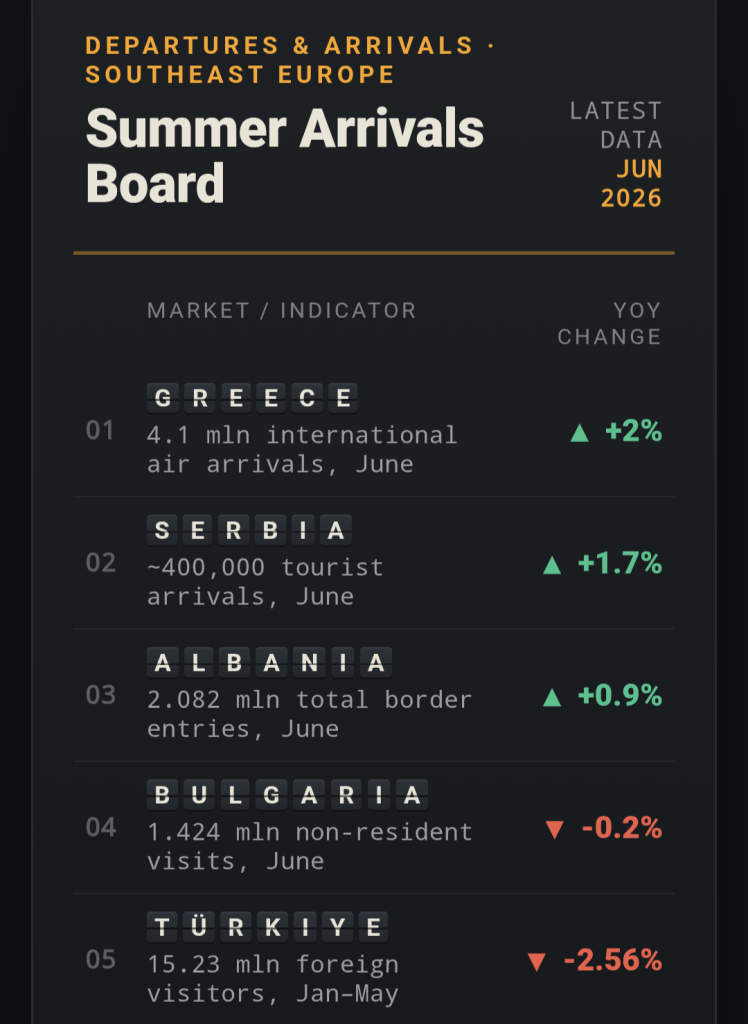
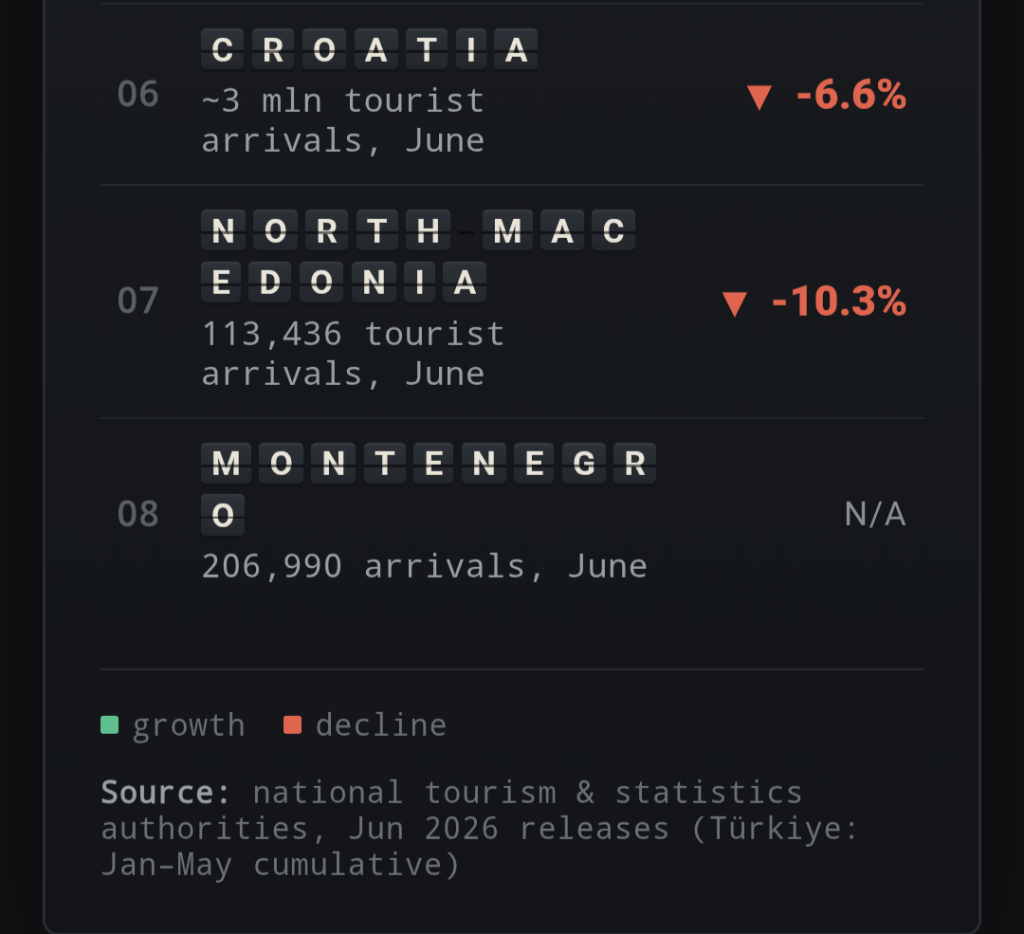
Tourism across the Balkans delivered a mixed performance in June, with Greece and Serbia maintaining growth while Croatia and North Macedonia recorded declines, highlighting an increasingly uneven start to the region’s crucial summer season.
The figures show no single Balkan tourism trend. Mediterranean destinations continue to attract millions of international visitors, while smaller Western Balkan markets are competing for a growing regional and European travel market.
Differences in national statistical methodologies mean the figures are not always directly comparable. Some countries count tourists staying in registered accommodation, while others publish border crossings or international air arrivals. But year-on-year changes provide a broader indication of the direction in which individual markets are moving.
Türkiye Enters Summer Under More Pressure
Türkiye, by far one of the largest tourism markets spanning the Balkan and Mediterranean region, entered the summer with weaker international visitor numbers than a year earlier.
During the first five months of 2026, the country received about 17.61 million visitors, including 15.23 million foreign visitors and 2.38 million Turkish citizens residing abroad.
Foreign visitor arrivals were 2.56% lower than during the same period of 2025. Germany remained Türkiye’s largest source market, sending about 1.84 million visitors, up 5.44%.
The decline came as geopolitical tensions weighed particularly on some Middle Eastern and Iranian source markets.
There were also signs of pressure on the accommodation industry as the season progressed. June hotel occupancy was reported at about 52.2%, compared with 57.8% a year earlier, although this indicator is not directly comparable with border arrivals.
Greece Maintains Its Momentum
Greece, the largest tourism market in the broader Balkan region, continued to expand.
International air arrivals reached around 4.1 million in June, about 2% more than in the same month of 2025.
During the first six months of the year, Greece recorded 10.7 million international air arrivals, up 3.8%, according to INSETE data.
The figures suggest Greece entered the peak summer season with international demand still growing despite already operating at a far greater scale than most neighbouring markets.
Croatia Retreats After Strong Tourism Years
Croatia, another regional tourism heavyweight, moved in the opposite direction.
Around 3 million tourist arrivals and 13.5 million overnight stays were registered in commercial accommodation during June.
Arrivals fell 6.6% from June 2025, while overnight stays declined 6.1%.
Foreign visitors accounted for around 91% of all overnight stays, leaving Croatia highly exposed to fluctuations in international demand.
Despite the decline, the sheer volume of Croatian tourism remains far above that of the Western Balkan economies.
Serbia Posts Moderate Growth
Serbia was among the Balkan markets recording positive June results.
The country registered around 400,000 tourist arrivals, up 1.7% year-on-year.
Overnight stays reached 1.142 million, an increase of 2%.
Serbia’s performance is notable because, unlike Greece, Croatia and Montenegro, it does not have an Adriatic or Mediterranean coastline and depends more heavily on city breaks, cultural tourism, events, spas, mountains and regional travel.
The June figures suggest that demand remained resilient as the summer season began.
Montenegro Remains One of the Most Foreign-Dependent Markets
Montenegro registered 206,990 tourist arrivals and 793,956 overnight stays in collective accommodation in June.
Foreign tourists generated around 91% of all overnight stays, placing Montenegro alongside Croatia among the Balkan markets most heavily dependent on international visitors.
The figures also illustrate the country’s considerable tourism intensity relative to its small population.
However, the data available here do not provide a directly comparable year-on-year growth rate for June, making it difficult to place Montenegro clearly among the month’s regional winners or losers.
Albania Continues to Attract Heavy Cross-Border Traffic
Albania remained one of the region’s busiest destinations in June. A total of 2.082 million Albanian and foreign citizens entered the country, up 0.9% from June 2025, according to INSTAT.
The figure covers all border entries by Albanian and foreign citizens and therefore should not be compared directly with registered tourist arrivals in hotels and other accommodation establishments.
This distinction is particularly important because Albania has been among the fastest-growing Balkan tourism destinations in recent years.
Official accommodation data for June have not yet been released. INSTAT is scheduled to publish them on Aug. 17, meaning Albania’s performance can then be compared more accurately with Croatia, Serbia and North Macedonia.
The latest accommodation indicator, for May, showed that the number of visitors staying in Albanian tourist establishments increased 12.4% year-on-year, suggesting the country entered the summer season with considerable momentum.
North Macedonia Records Sharpest Decline Among Available Comparable Markets
North Macedonia had a difficult June.
The country registered 113,436 tourists, down 10.3% from 126,415 a year earlier.
Foreign arrivals fell even more sharply, declining 13.3% to 87,618 from 101,046.
Domestic arrivals increased 1.8% to 25,818 but were unable to compensate for weaker international demand.
Total overnight stays fell 8.9% to 221,608, while overnight stays by foreign visitors declined 12% to 156,854.
Among the Balkan countries for which comparable year-on-year accommodation figures are available in this dataset, North Macedonia recorded a steeper decline in arrivals than Croatia.
Its first-half performance was considerably more stable, however.
North Macedonia recorded 518,035 tourists in January-June, only 0.5% fewer than a year earlier. Foreign tourist arrivals increased 0.3% to 396,633, while total overnight stays fell 1.5% to 965,852.
That suggests the sharp June contraction may represent either a temporary monthly fluctuation or an early warning of weaker summer demand.
Bulgaria Almost Flat
Bulgaria recorded 1.424 million visits by non-residents in June, just 0.2% fewer than a year earlier.
Around 744,469 were trips for holidays and recreation, while 420,700 were transit journeys, equivalent to 29.5% of all non-resident visits.
The figures therefore cannot be directly compared with tourist arrivals in registered accommodation in Serbia, Croatia, Montenegro or North Macedonia.
Nevertheless, they suggest that overall international movement into Bulgaria remained broadly stable.
Regional travel also remained significant. Some 33,934 Bulgarian residents travelled to North Macedonia during June, while Bulgaria recorded 27,500 visits by residents of North Macedonia.
A Balkan Tourism Market Moving at Different Speeds
The available June figures show three broad trajectories across the region.
Greece and Serbia were growing. International air arrivals in Greece increased by around 2%, while Serbian tourist arrivals rose 1.7% and overnight stays increased 2%.
Bulgaria was broadly stable. Non-resident visits slipped just 0.2%.
Croatia and North Macedonia contracted. Croatian arrivals fell 6.6%, while North Macedonia recorded a sharper 10.3% decline.
Montenegro continued to register substantial tourism volumes for its size, but the available figures do not allow the same year-on-year comparison.
The contrast is particularly visible between some neighbouring markets. While Serbia’s arrivals increased 1.7%, North Macedonia’s declined 10.3%. Greece’s international air traffic continued expanding while Croatia experienced a sizeable fall in registered accommodation.
Balkan Tourism Moving at Different Speeds
Among the available June indicators, Greece and Serbia were expanding, with international air arrivals in Greece rising around 2% and tourist arrivals in Serbia increasing 1.7%.
Albania’s overall border entries increased 0.9%, although the country’s June accommodation statistics are still pending. Bulgaria was broadly stable, with non-resident visits down only 0.2%.
At the other end, Croatia recorded a 6.6% decline in tourist arrivals and North Macedonia fell 10.3%, including a 13.3% drop in foreign tourists.
Türkiye’s first-five-month figures meanwhile point to a more difficult start to 2026, with foreign arrivals down 2.56%.