


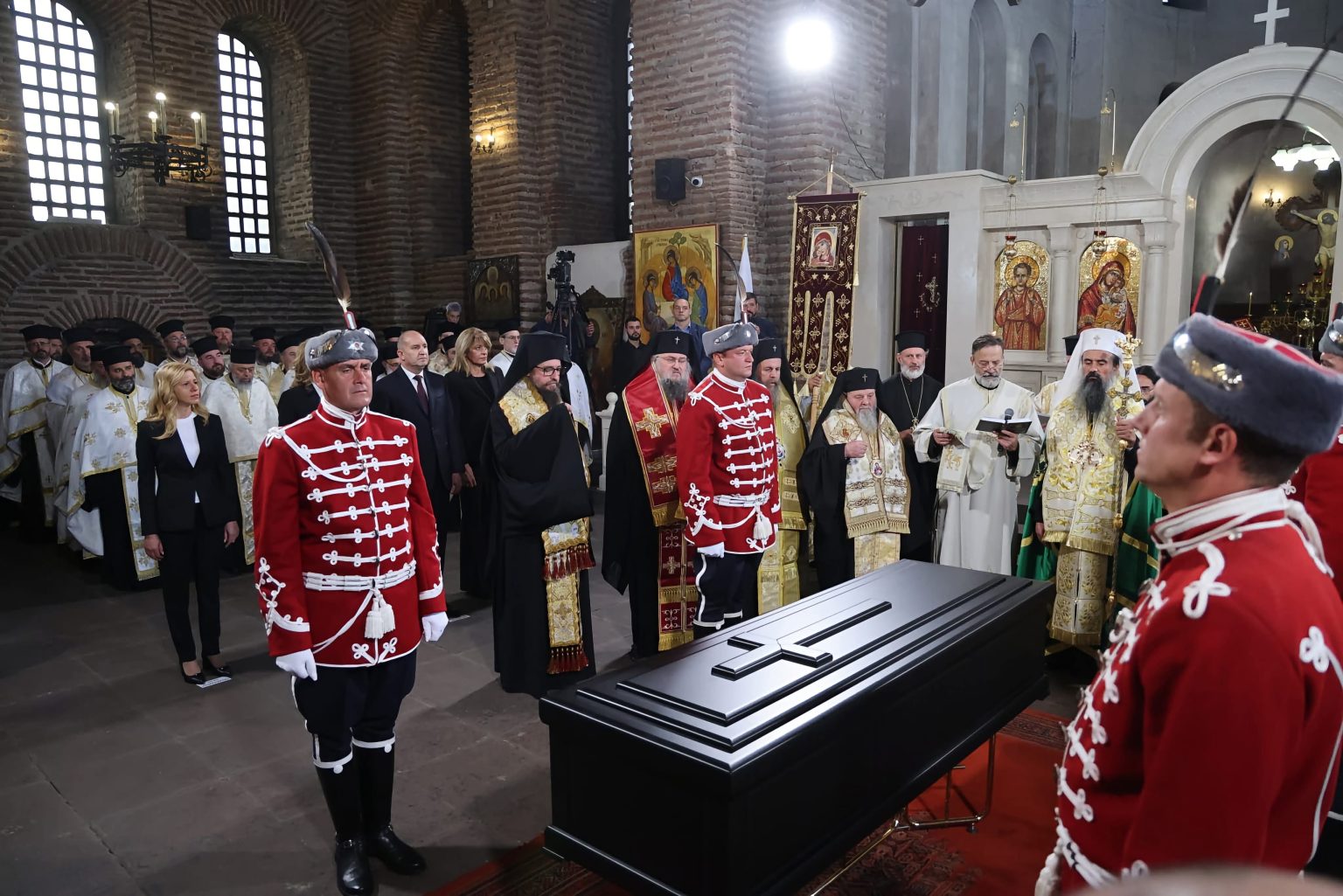
More than a century after religious treasures were removed from monasteries in northern Greece, Bulgaria has returned 53 historic artefacts in an agreement involving the remains attributed to medieval ruler Tsar Samuel. The exchange marks a significant development in Greek-Bulgarian cultural relations, while reopening questions about the region’s contested historical heritage.
ATHENS, Oct. 11 (BalkanView) — Greece has unveiled 53 religious and historical artefacts returned by Bulgaria after 109 years, completing a major cultural heritage agreement under which Athens transferred remains attributed to medieval ruler Tsar Samuel to Sofia.
Greek Culture Minister Lina Mendoni presented the collection, which includes Byzantine and post-Byzantine religious objects dating from the 16th to the 19th centuries, describing the items as works of exceptional historical, artistic and ecclesiastical importance.
The agreement represents a significant step in resolving a century-old dispute over religious treasures removed from churches and monasteries in the region of Macedonia during the First World War.
It also highlights the continuing sensitivity of medieval Balkan history, particularly the legacy of Tsar Samuel, whose empire and identity occupy an important place in the historical narratives of Bulgaria and North Macedonia.
What Bulgaria returned to Greece
The collection includes religious icons, processional crosses, an episcopal throne, church vessels, vestments, reliquaries and other objects used in Orthodox Christian worship.
Among the most valuable pieces are two pairs of 16th-century liturgical fans made from gilded silver and decorated with enamel.
According to Mendoni, the objects are particularly significant because of their craftsmanship and their connections to historic religious institutions in northern Greece.
One pair originated from the Monastery of St John the Baptist, while another is associated with the ecclesiastical authorities of Serres and Nigrita.
The collection also includes a silver covering for an icon of St John the Baptist, decorated with scenes from the saint’s life.
Its return will allow the original religious artwork at the Monastery of St John the Baptist to be restored more completely.
Other objects include a wooden door decorated with mother-of-pearl and bone, ceremonial crosses, a lectern and reliquaries.
One reliquary bears the date March 25, 1821, a date of particular importance in Greek national history because it is associated with the beginning of the Greek War of Independence.
The artefacts originated mainly from the Monastery of St John the Baptist, the Monastery of Panagia Ikosifinissa and churches in the Serres region. One object came from Naoussa.
Greek authorities intend to return the items to their original religious institutions.
A dispute dating back to the First World War
The treasures were removed during the period of Bulgarian military occupation in parts of the region during the First World War.
According to the Greek Ministry of Culture, Bulgarian forces took religious objects, manuscripts, vestments and early printed books from monasteries and churches.
The 1919 Treaty of Neuilly, signed after Bulgaria’s defeat in the war, established obligations concerning the return of cultural property.
An initial restitution took place in May 1923, when Greek Byzantinist Georgios Sotiriou received a consignment of manuscripts and religious objects from Bulgarian authorities.
The shipment reportedly included 259 manuscripts and 62 objects and printed works.
However, many other items remained outside Greece.
Some were held in Bulgarian collections, while others subsequently appeared in exhibitions or on the art market.
Renewed attention to the issue during the 1990s led to further discussions, but a comprehensive settlement remained elusive.
The latest agreement has now enabled the return of another substantial group of religious artefacts.
Tsar Samuel at the centre of the exchange
The agreement also involved the transfer to Bulgaria of human remains attributed to Tsar Samuel, the medieval ruler who governed a powerful Balkan state between 997 and 1014.
Samuel’s rule extended across large parts of the Balkans, including territories within present-day North Macedonia, Bulgaria, Greece and Albania.
His historical legacy remains politically and culturally sensitive.
Bulgarian historiography generally regards Samuel as a Bulgarian ruler, while North Macedonian historical narratives have traditionally emphasised his connection to the medieval state centred in the territory of present-day North Macedonia.
The remains attributed to Samuel were discovered in Greece in the 20th century and subsequently kept by Greek institutions.
Mendoni defended the decision to transfer them to Bulgaria, rejecting criticism that Greece had weakened its position in negotiations over cultural property.
She said the remains had been transferred to the Museum of Byzantine Culture in 2012 after previously being held in academic custody.
According to the minister, their return helped secure an agreement that brought substantial benefits to Greek cultural and religious institutions.
The exchange illustrates how historical artefacts can become part of contemporary diplomacy in a region where interpretations of the medieval past continue to influence national identities.
Greece seeks the return of more artefacts
Athens does not consider the latest restitution the end of the process.
Mendoni said the agreement provides a framework for further research into Greek religious and cultural objects still held in Bulgaria.
Greek specialists are expected to gain access to inventories, catalogues and collections to identify additional items and establish their origins.
The next phase is expected to begin in late October or early November, in cooperation with Bulgarian authorities.
However, the process could prove complicated.
Historical inventories are often incomplete, and some objects were removed more than a century ago, making their original ownership and provenance difficult to establish.
Mendoni acknowledged those challenges but said Greece would continue its efforts.
Cultural diplomacy in a region of contested history
The restitution comes against the background of longstanding historical disputes in Southeast Europe, where medieval rulers, religious institutions and cultural artefacts often feature in competing national narratives.
Greece and Bulgaria, both members of the European Union and NATO, have developed extensive political and economic cooperation despite disagreements over aspects of their shared history.
The latest agreement demonstrates how governments can negotiate the return of cultural property while pursuing broader bilateral cooperation.
For Bulgaria, the transfer of remains attributed to Tsar Samuel carries considerable historical and symbolic importance.
For Greece, the return of the 53 religious treasures restores objects to institutions from which they were removed more than a century ago.
For the wider Balkans, the agreement provides an example of how cultural heritage disputes can be addressed through negotiation, even when interpretations of the past remain contested.
The next test will be whether the two countries can extend that cooperation to additional manuscripts, religious objects and historical collections whose provenance remains disputed.