


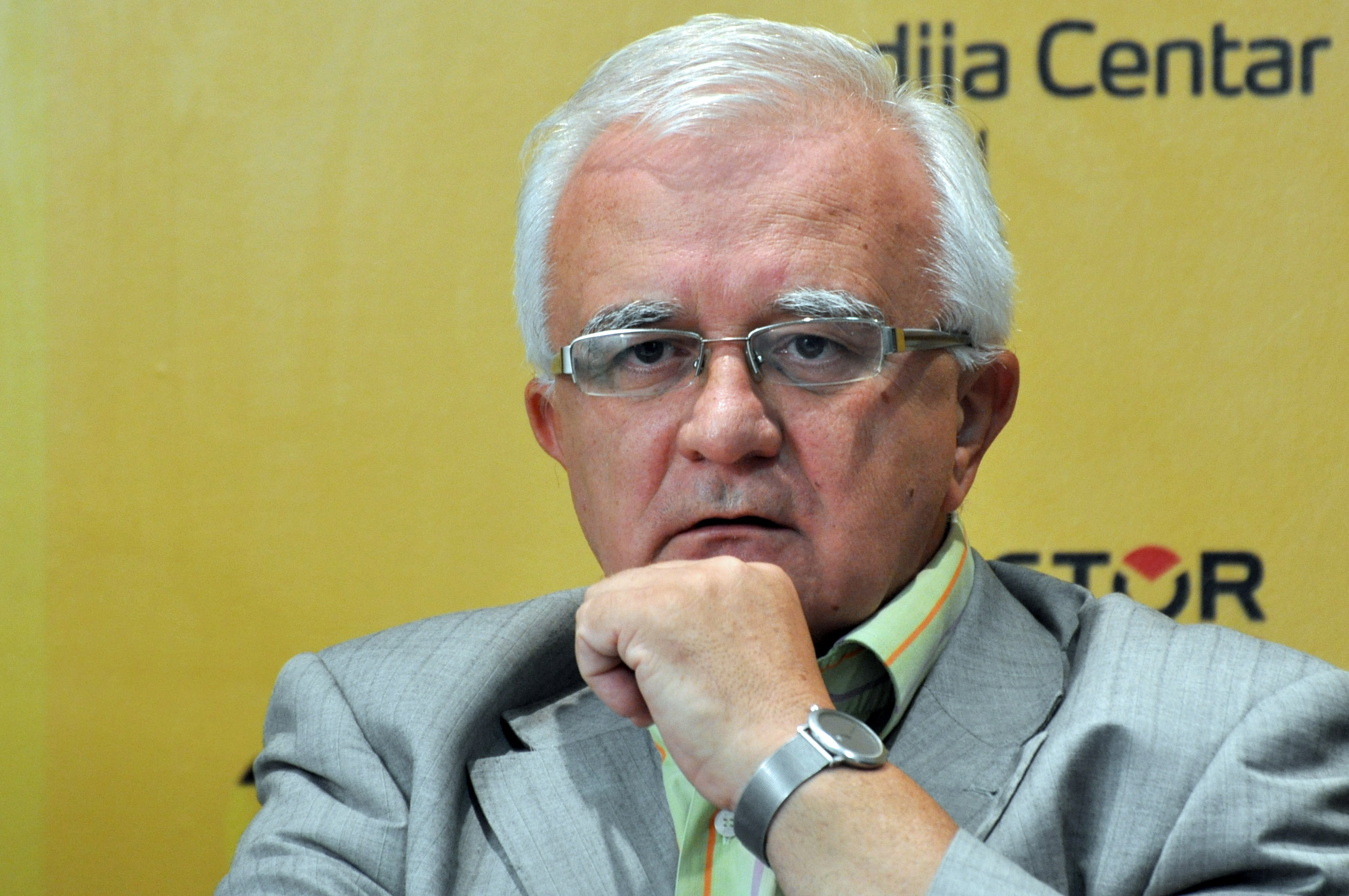
Serbia is confronting a critical political crossroads more than 25 years after the October 5, 2000, democratic transition, with President Aleksandar Vučić, a long-dominant figure on the political scene, at the center of a deepening crisis. In an extensive interview with Inbox7.mk, Dušan Janjić, President of the Forum for Ethnic Relations in Belgrade, analyzed Vučić’s political maneuvers, populist strategies, and the mounting domestic and international pressures shaping Serbia’s future.
Janjić described the growing unrest across the country, pointing to anti-government protests, rising social tensions, and the increased activism of students and civil society groups as evidence of structural societal discontent. “For those of us living in Serbia, it is clear that we are in a period of deep political and social crisis,” Janjić said. “Time for a peaceful and democratic resolution is running out, and the primary responsibility lies with the Serbian authorities, led by Vučić.”
He highlighted the risks stemming from endemic corruption, organized crime, and weak institutional governance, warning that these factors could destabilize both Serbia and the wider region. Citing Croatian Prime Minister Andrej Plenković’s remarks at the Bled Strategic Forum about potential unrest in Serbia, Janjić agreed that Serbia risks becoming an unstable environment for business and investment.
Vučić, Janjić said, is “the most dynamic actor in driving the crisis,” yet he also has the capacity to facilitate a peaceful resolution. From the Kosovo dialogue initiated by Vučić in 2017 to recent domestic challenges, Janjić pointed to an absence of long-term strategy and institutional capacity as central weaknesses of the current administration. Mistakes ranging from mismanagement of local Serbian community institutions to confrontations with NATO and paramilitary units have eroded both credibility and governance effectiveness.
Janjić warned that Serbia’s political trajectory remains uncertain. While Vučić continues to consolidate power through ideological and populist strategies, including the formation of the “People’s Movement for State Defense,” there are risks of prolonged crisis, political stagnation, and potential escalation into violence. “Twenty-five years after October 5, Serbia faces a choice: change or conflict,” he said. “The old question—how to overcome Milosevic’s legacy—demands a new answer.”
On the role of civil society and student activism, Janjić emphasized that these groups are the only actors currently possessing unquestionable moral and political legitimacy. He cited student demands for justice and transparency following events in Novi Sad and their calls for early elections as key drivers of societal pressure for reform.
Janjić also critiqued the role of external actors. He noted that international engagement—including from the EU, the U.S., Russia, and China—has often prioritized geopolitical, economic, and security interests over supporting sustainable democratic reform in Serbia. “From their perspective, Vučić and Serbia are seen as a platform for foreign influence, with mixed incentives and limited accountability,” he said.
Looking ahead, Janjić advocated for immediate measures to stabilize the country, including de-escalation of security forces, enforcement of accountability for corruption, and the establishment of oversight mechanisms for intelligence and law enforcement agencies. He proposed the creation of a National Security Agency to safeguard democratic institutions, the rule of law, and national security, coupled with a roundtable mechanism for peaceful political dialogue.
“Any alternative to a peaceful, electoral resolution—whether continued crisis, authoritarian consolidation, or armed conflict—would result in the loss of human life, capital, and time for reform,” Janjić said. “Ultimately, all key actors must come to the table and reach an agreement for Serbia’s future.”
Janjić concluded that Serbia’s post-Vučić trajectory will determine whether the country emerges as a functioning democracy or slides into authoritarianism. He warned that without strategic reforms, Serbia risks remaining a peripheral state lagging behind both regional and European development benchmarks.