


Founded in 2001 to expand access to Albanian-language higher education and promote ethnic integration, South East European University has produced more than 16,000 graduates. Its anniversary celebrations honoured economist and former rector Abdylmenaf Bexheti.
TETOVO, North Macedonia, Nov. 20, 2026 (BalkanView) — South East European University (SEEU), established during one of the most turbulent periods in North Macedonia’s recent history, marked its 25th anniversary on Friday with a ceremony celebrating its transformation into a multilingual academic institution and its contribution to interethnic cooperation.
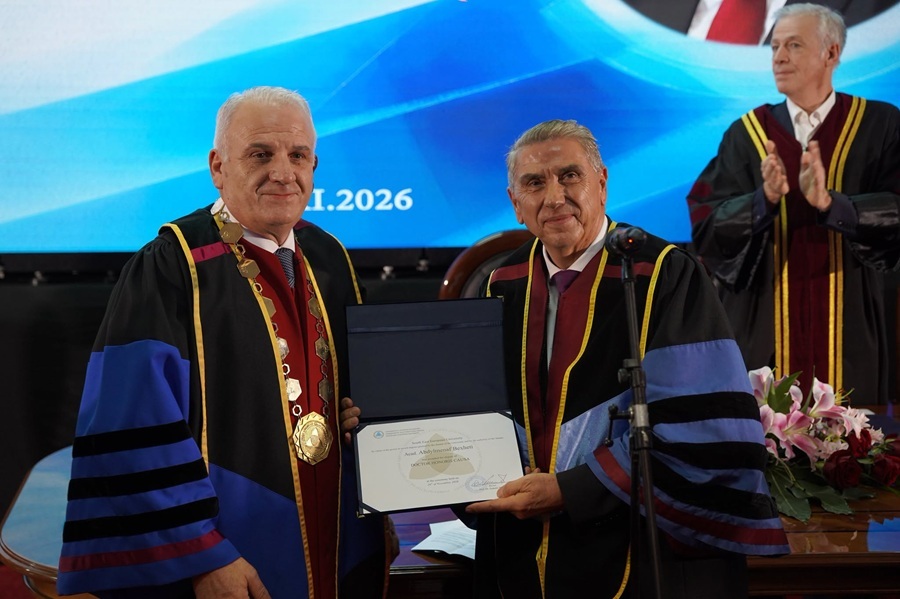
The university awarded its honorary doctorate, Doctor Honoris Causa, to economist and academic Abdylmenaf Bexheti, recognising his role in establishing and developing the institution, including his service as dean, vice-rector and rector.
Founded in 2001, when access to higher education in the Albanian language was a major political and social issue, SEEU was conceived as an institution that would expand educational opportunities while promoting inclusion, academic excellence and cooperation among different communities.
A quarter of a century later, the university has produced more than 16,000 graduates and has become an established part of North Macedonia’s higher education system.
A university born during a period of conflict
SEEU Rector Sadudin Ibraimi said the university’s founders had sought to address the demand for Albanian-language higher education without creating an institution exclusively for one ethnic community.
Instead, they envisioned a university open to everyone, built around academic quality, diversity and inclusion.
That founding mission remains relevant today, Ibraimi said, as universities face growing demands to prepare students for technological change, economic competition and increasingly international labour markets.
The rector said SEEU had celebrated its 22nd graduating generation this year, with alumni now working in public institutions, businesses and academic organisations in North Macedonia and abroad.
He also highlighted the university’s expanding role beyond traditional teaching.
Its Career Centre connects students with employers, while its Business and Innovation Centre supports entrepreneurship. A Future Skills Centre helps students prepare for changing employment requirements, and the university’s Legal Clinic provides free legal assistance to citizens.
Ibraimi said the establishment of faculties in Health Sciences and Technical Sciences reflected the university’s efforts to respond to emerging social and economic needs.
OSCE: Education is essential to lasting stability
Christophe Kamp, the OSCE High Commissioner on National Minorities, said SEEU demonstrated how higher education could contribute to political stability and social cohesion.
Referring to the vision of former OSCE High Commissioner Max van der Stoel, Kamp identified two closely connected objectives behind the university’s creation: providing high-quality education and strengthening stability through interethnic understanding.
He stressed that students should have opportunities to study in their mother tongue while also developing proficiency in the state language and other languages.
Such an approach, he said, supports full participation in society and encourages communication across community boundaries.
Kamp described universities as places where young people encounter different perspectives, develop friendships and build mutual understanding.
His remarks highlighted the broader significance of SEEU’s founding, which took place in the same year as the armed conflict in North Macedonia and the signing of the Ohrid Framework Agreement.
Dutch ambassador highlights European future
Dutch Ambassador Özlem Canel said SEEU had played an important role in preparing new generations for North Macedonia’s European future.
She welcomed the university’s efforts to develop digital innovation and European partnerships, saying these initiatives, combined with its commitment to inclusion, could help graduates navigate an increasingly complex society and labour market.
Canel recalled the vision of Max van der Stoel and the international partners involved in the university’s establishment.
Creating a university during a period of political and ethnic tensions, she said, represented a long-term investment in human capital, trust and opportunities for future generations.
Her remarks underscored the international dimension of SEEU’s development, which has relied on cooperation among local institutions and European partners.
University board chairman calls for continued cooperation
SEEU Board Chairman Klaus Tochtermann described the university as an institution built on connecting people and communities.
He said academic excellence, openness, diversity and cooperation had guided its development since 2001.
Beyond providing knowledge and qualifications, the university had become a place where different perspectives could meet, trust could develop and students could learn to cooperate, he said.
Tochtermann thanked academic, administrative and technical staff, students, alumni and domestic and international partners for their contributions over the past 25 years.
He said the university’s future would depend above all on the quality and dedication of its people.
Abdylmenaf Bexheti receives honorary doctorate
The anniversary ceremony’s central event was the presentation of an honorary doctorate to Abdylmenaf Bexheti, an economist and former SEEU rector who has been associated with the institution since its earliest years.
Fejzullah Krasniqi, president of the Academy of Sciences and Arts of Kosovo, introduced Bexheti and praised his contribution to economic research, institutional leadership and higher education.
Krasniqi said Bexheti’s career combined practical experience, scientific research and university management.
He identified three central dimensions of his work: academic knowledge, institutional responsibility and commitment to university education.
Following the presentation of the candidate and the reading of the university Senate’s decision, Rector Ibraimi formally conferred the honorary doctorate.
Bexheti described the recognition as an exceptional honour and a tribute to a shared institutional and academic journey spanning 25 years.
From 900 students to more than 16,000 graduates
Recalling the university’s beginnings, Bexheti said SEEU opened its first classrooms with approximately 900 students across five faculties.
At the time, he taught in two of its largest programmes, Business Administration and Public Administration.
He said more than one-third of the university’s current academic staff were former students from its earliest generations — an indication, in his view, of the institution’s capacity to develop its own academic leadership.
Bexheti also reflected on his successive roles at SEEU.
He served as the first dean of the Faculty of Business and Economics, the first vice-rector for Financial Planning and Development, a member of the University Board and later rector for two terms.
During that period, he said, he contributed to the university’s establishment, institutional consolidation, academic transformation, internationalisation and efforts to improve educational quality and competitiveness.
Bexheti dedicated the honour to the university’s founders, former leaders, professors, staff, students, alumni and domestic and international partners.
He also thanked his family for their support throughout his academic career.
A quarter-century of institutional change
The anniversary brought together academic, political and institutional representatives from North Macedonia and the wider region.
Among those attending were representatives of the academies of sciences and arts of Kosovo and North Macedonia, political leaders Ali Ahmeti and Zijadin Sela, the mayors of Gostivar and Debar, and representatives of several universities.
Institutions represented included the University of Tetovo, Mother Teresa University, Ss. Cyril and Methodius University, St. Clement of Ohrid University, and IBC Mitrovica.
The ceremony also featured performances by artists Besarta Murtezani and Shkëlzen Baftiari.
For SEEU, the anniversary marked more than a milestone in institutional history.
Established to address a sensitive educational and political challenge, the university now faces a different set of priorities: maintaining academic standards, adapting to technological change, strengthening its links with employers and preparing graduates for an increasingly competitive European environment.
Its first 25 years reflect the role education can play in expanding opportunity and bringing communities together in a country where language, identity and access to public institutions have long shaped political debate.