


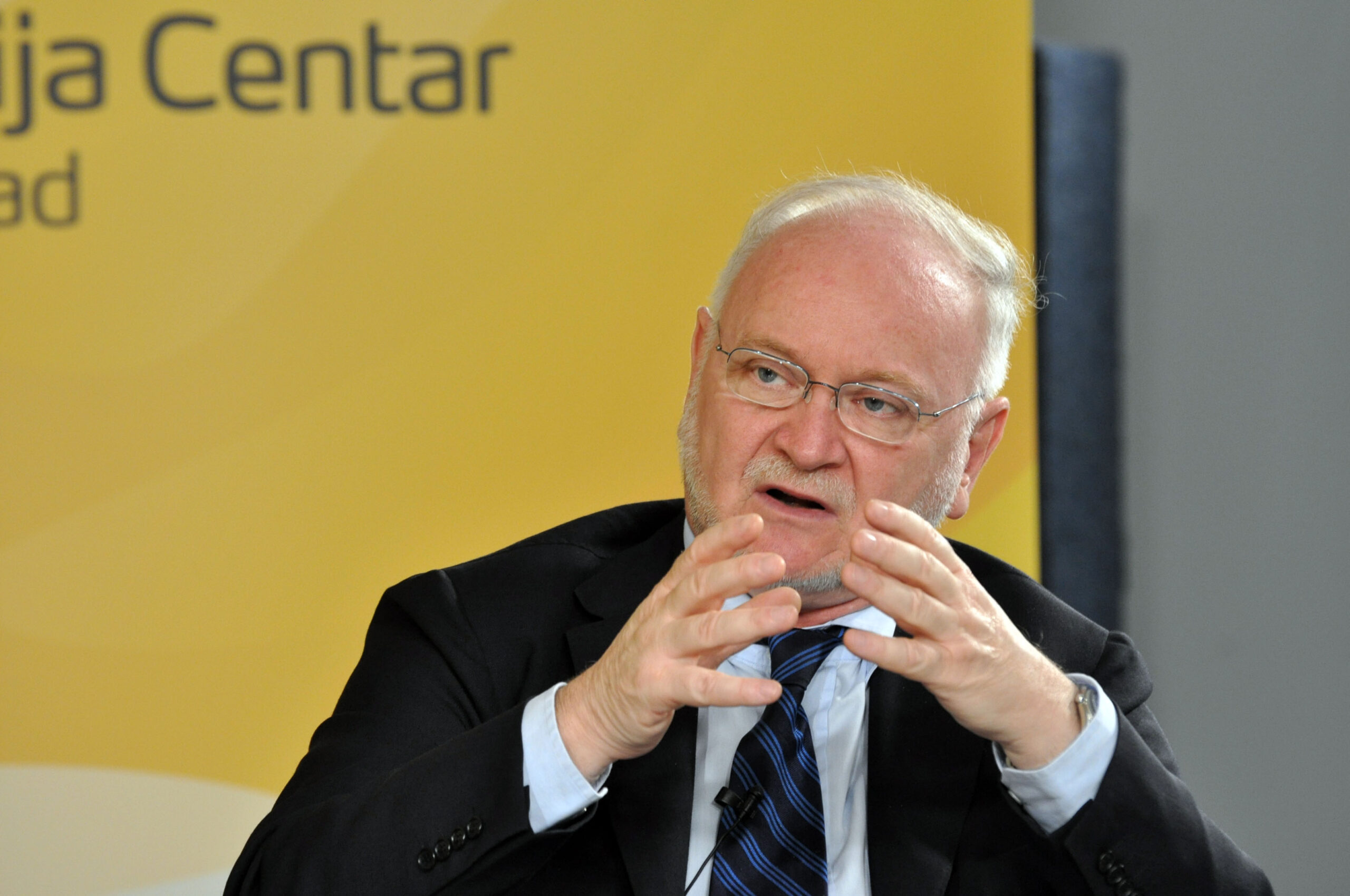
For Žarko Korać, a retired University of Belgrade professor and prominent figure in Serbia’s academic and political life, the victory of the Student List marks a historic turning point. But as the country prepares for a new political chapter, he warns that dismantling the system built during Aleksandar Vučić’s 14 years in power will be among the most formidable challenges facing the incoming government.
For Korać, a change of government in Belgrade represents more than a political rotation. It is an opportunity for Serbia to move beyond a system of governance that, in his view, has penetrated virtually every segment of society, from the media and judiciary to the security services.
A psychologist, university professor and former Serbian deputy prime minister, Korać belongs to a generation of intellectuals who were part of the democratic transformation that followed the overthrow of Slobodan Milošević in October 2000.
More than a quarter of a century later, he sees parallels between that period and the victory of the Student List. Yet the enthusiasm surrounding political change is accompanied by significant uncertainties: what policies will the new government pursue, how will it confront Vučić’s legacy, and will Serbia’s international orientation change?
In an interview with BalkanView, Korać discusses Belgrade’s future relations with the European Union, Russia and China, the prospects of the so-called “Serbian World”, and Kosovo – the issue on which he expects the least change.
Interview by Seladin Xhezairi
BalkanView: Following the overthrow of Slobodan Milošević on October 5, 2000, and the assassination of Zoran Đinđić in 2003, the fall of Aleksandar Vučić’s government would undoubtedly represent the most significant political event of the new century in Serbia. How do you view the triumph of the Student List?
Žarko Korać: Through two years of resistance, perseverance and ingenuity, the Student List succeeded in turning the election into a referendum on Vučić’s rule. This is similar to the fall of Milošević’s regime in 2000.
At this moment, we have only Vučić’s Serbian Progressive Party (SNS) and the Student List in parliament, which is unique. There are no other parties because voters opted either for the Student List or for the SNS.
Even minority parties lost voters, so, for the first time, the Alliance of Vojvodina Hungarians (SVM), the party representing Hungarian voters in Serbia, has only three members of parliament.
Interestingly, Shaip Kamberi, who represents Albanians from the Preševo Valley, is the only one to have secured an additional parliamentary seat alongside his own, bringing their representation in parliament to two.
BalkanView: In which direction will Serbia’s political ship sail, both domestically and in terms of foreign policy?
Žarko Korać: It is very difficult to predict what policies will be pursued by the government elected by members of parliament from the Student List. Their programme is very general, unclear in some parts and even contradictory.
What is certain is that the aggression, corruption and darkness of Vučić’s regime will not be repeated. That is over.
Things will certainly improve in the region because Serbia will no longer play the role of the “big brother”, as Vučić did so aggressively.
Relations with Europe will improve, although it is not yet clear how much relations with Russia will change. This is one of the key issues for the continuation of Serbia’s European integration process.
BalkanView: In your view, what problems and challenges will the new government face?
Žarko Korać: The government will face the extremely difficult task of dismantling Vučić’s corrupt system. During his 14 years in power, that system penetrated virtually every segment of society.
The process must begin with the media and the judiciary.
The new government also faces the task of undertaking a serious reform of the security services, which were heavily misused for Vučić’s political objectives. This may even involve abolishing the existing services and re-establishing them with new personnel.
BalkanView: How will the new opposition respond to all this, given that Vučić remained in power for such a long period?
Žarko Korać: Vučić and his party will be the only opposition in parliament, and Vučić will lead his parliamentary group.
They will have a substantial presence, with 104 members of parliament out of a total of 250, and I would not underestimate their ability to obstruct parliamentary proceedings.
BalkanView: What do you expect the new government’s approach to European integration – not to mention Euro-Atlantic integration – to be? And how will it approach Russia and China, without excluding Turkey?
Žarko Korać: I believe the policy of sitting on “four chairs” – the EU, China, Russia and the United States – introduced by former President Boris Tadić, will be significantly weakened because the new government will have too many domestic problems to address.
It will improve relations with the EU and probably cool relations with Russia somewhat.
China’s involvement has been primarily economic, but Serbia no longer has the money for those major projects.
We still need to establish the extent of Serbia’s external debt and what agreements have been signed.
Unfortunately, Serbia is dependent on Russia for its energy needs. Russia is the majority owner of NIS, Serbia’s oil company.
The room for economic and political manoeuvre is very limited.
BalkanView: What will happen to the so-called “Serbian World”?
Žarko Korać: In my opinion, the so-called “Serbian World” will suffer the biggest blow.
Vučić, as Vojislav Šešelj’s best pupil, was obsessed with the idea that Yugoslavia’s borders were not absolute. This was one of the ideas that led to the bloody wars of the 1990s.
It is unlikely that Milorad Dodik will receive as warm a welcome in Belgrade as he did in the past. That relationship will not disappear, but it will change.
The forthcoming reform of the state security service will also prevent extensive interference in Montenegro’s internal affairs.
BalkanView: Kosovo, of course, remains a separate issue. Do you expect progress towards the normalisation of relations, or will everything continue as before?
Žarko Korać: I saw that Kosovo’s Prime Minister, Albin Kurti, expressed hope that the new government might recognise Kosovo.
That will almost certainly not happen.
There are many reasons for this, not least because it would bring the government into open conflict with the Serbian Orthodox Church, which greeted the students’ victory with considerable coldness.
Let us not forget that, during a visit to Moscow almost a year ago, Patriarch Porfirije declared that a “colour revolution” was taking place in Serbia, effectively equating the student protests with Ukraine’s political separation from Moscow.
Relations with Kosovo will probably remain unchanged. This is where I expect the least change.
However, Kurti faces an interesting problem: all the Serb members of Kosovo’s parliament are from Vučić’s list.
Whether any of them will change their political allegiance remains to be seen.