



Albania, Bosnia and Herzegovina and North Macedonia face projected population declines of more than 50% by the end of the century, threatening economic growth, pension systems and the long-term viability of communities across the Western Balkans.
SKOPJE, Nov. 13, 2026 (BalkanView) – The Western Balkans could lose nearly half their population by the end of the century, according to United Nations demographic projections, exposing a long-term economic and social challenge that threatens to overshadow the region’s ambitions for European Union membership.
The six Western Balkan economies, with a combined population estimated at around 16.7 million in 2025, could be home to just 8.5 million people by 2100 under the medium scenario of the UN’s World Population Prospects 2024.
The projected decline of approximately 8.2 million inhabitants reflects the combined effects of low fertility, population ageing and migration, trends that have reshaped much of southeastern Europe since the collapse of communism and the conflicts of the 1990s.
Albania, Bosnia and Herzegovina and North Macedonia face the steepest projected losses in the region, with each potentially losing more than half its population.
The projections are not inevitable outcomes. They depend on assumptions about future fertility, mortality and migration. But they illustrate the scale of the demographic challenge confronting governments already struggling with labour shortages, uneven economic development and the departure of skilled workers.
A region shrinking faster than Europe
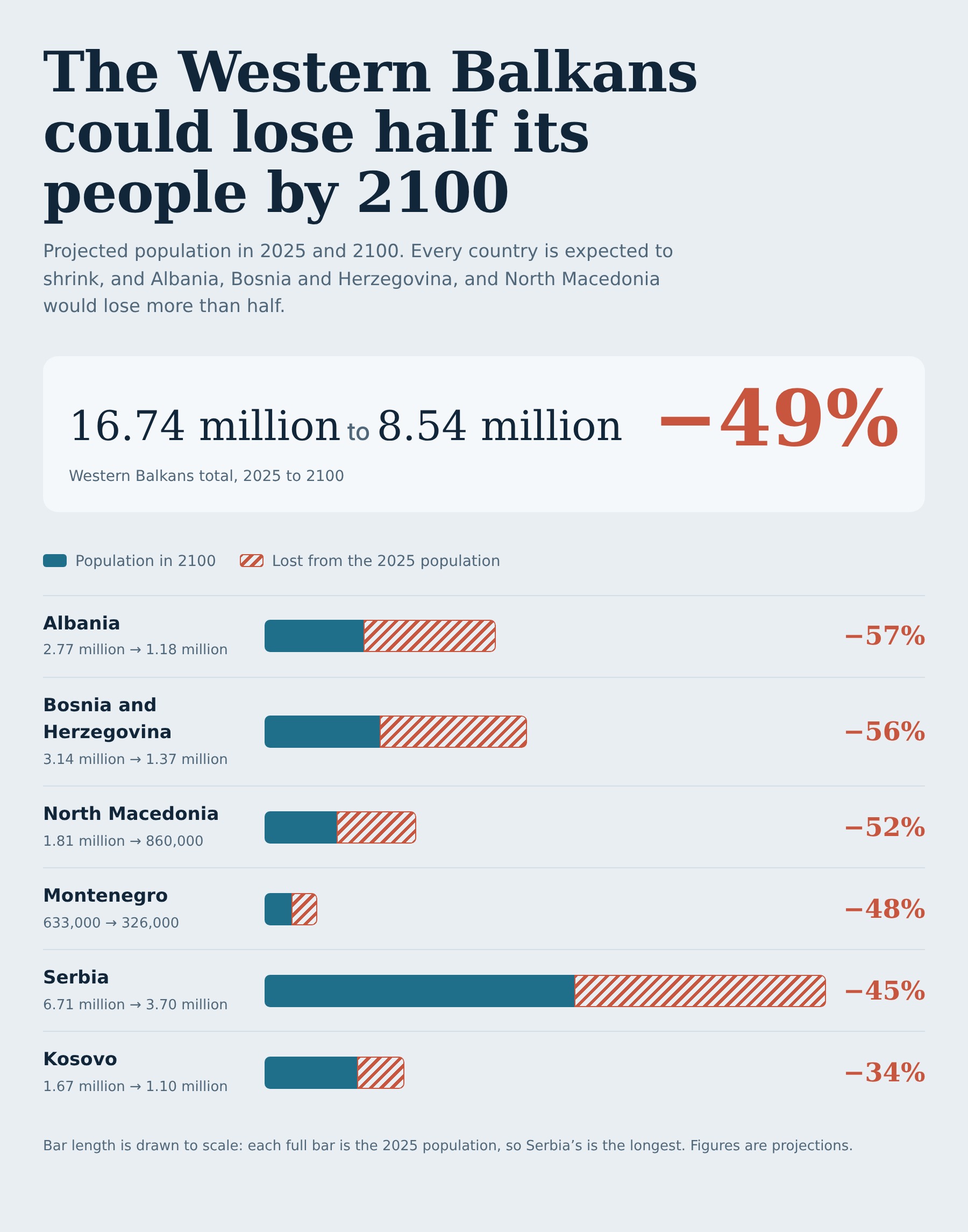
Albania’s population could decline from an estimated 2.77 million in 2025 to around 1.18 million in 2100, a reduction of approximately 57%, according to the UN’s medium projection scenario.
Bosnia and Herzegovina could see its population fall from 3.14 million to 1.37 million, a decline of around 56%.
North Macedonia faces a similarly dramatic contraction, from approximately 1.81 million inhabitants to 860,000, representing a decline of about 52%.
Montenegro, the smallest of the six Western Balkan economies, could lose nearly half its population, falling from around 633,000 to 326,000.
Serbia, the region’s largest economy and most populous country, faces the biggest projected loss in absolute numbers. Its population could fall from approximately 6.71 million to 3.70 million, a reduction of about 45%.
Kosovo, which has historically had one of Europe’s youngest populations, is also projected to experience a substantial demographic contraction, from around 1.67 million to 1.10 million, or approximately 34%.
The demographic outlook is considerably more severe than that of the European Union as a whole.
Eurostat’s latest long-term population projections, EUROPOP2025, show the EU’s population declining from approximately 451.8 million in 2025 to 398.8 million by 2100, a reduction of 11.7%.
Although the UN and Eurostat use different projection models and assumptions, the figures suggest that the Western Balkans’ demographic contraction could be roughly four times as severe in percentage terms.
Even EU membership offers no demographic guarantee
Population decline is not confined to countries outside the European Union.
Several eastern and southeastern European member states are also projected to experience substantial demographic losses.
Latvia’s population could shrink by 33.9% by 2100, Lithuania’s by 33.4% and Poland’s by 31.6%, according to Eurostat.
Greece faces a projected decline of 30.1%, Bulgaria 28%, Croatia 27% and Romania 24.3%.
Italy, one of the EU’s largest economies, could lose approximately 24% of its population.
The experience of Croatia, Bulgaria and Romania illustrates that EU membership alone does not necessarily reverse demographic decline.
Free movement within the bloc can create opportunities for workers and businesses, but it can also facilitate the departure of younger and more highly educated people from lower-income member states towards wealthier economies.
For the Western Balkans, European integration could therefore present both an opportunity to accelerate economic convergence and a challenge in retaining the workers needed to sustain domestic growth.
The economic cost of a disappearing workforce
The most immediate economic consequence of demographic decline is a shrinking working-age population.
A smaller labour force could constrain economic growth, reduce the pool of skilled workers available to businesses and weaken the tax base needed to finance public services.
Western Balkan economies already face difficulties in matching workers’ skills with employers’ needs, while migration has reduced the availability of professionals in sectors such as healthcare, engineering, construction and information technology.
The demographic projections suggest these pressures could intensify.
The region’s economic development model, which has often relied on relatively low labour costs to attract foreign investment, may become increasingly difficult to sustain as the supply of workers contracts.
Governments could face pressure to accelerate automation, improve productivity and invest in education and training to compensate for the decline in workforce numbers.
Labour shortages could also encourage greater immigration, potentially transforming countries that have traditionally been sources of migrant labour into destinations for foreign workers.
The extent to which immigration could offset population losses would depend on economic opportunities, wage levels and governments’ ability to integrate newcomers.
High unemployment, yet not enough workers
The demographic challenge is complicated by an apparent contradiction: several Western Balkan economies continue to record relatively high unemployment despite shortages of workers in particular industries.
In the second quarter of 2026, unemployment stood at 12.2% in Bosnia and Herzegovina and 11.3% in North Macedonia, according to national labour force surveys.
Montenegro recorded 9.1%, Albania 8.3% and Serbia 7.2%.
By comparison, the EU’s unemployment rate stood at 6.2% in September 2026, according to Eurostat.
The figures cover different reporting periods and are not fully harmonised, but they indicate persistent difficulties in connecting available workers with employment opportunities.
The challenge is particularly pronounced among young people.
Youth unemployment reached 32.9% in Bosnia and Herzegovina and 28.8% in North Macedonia in the second quarter of 2026, compared with 15.5% across the EU in September.
Serbia’s youth unemployment rate stood at 22%.
The combination of youth unemployment and labour shortages points to structural problems, including mismatches between education and labour market demand, regional disparities and differences between the wages and working conditions available at home and abroad.
For young people, the decision to leave is not necessarily driven by unemployment alone. Higher salaries, career opportunities, institutional stability and confidence in the future can also influence migration decisions.
For governments, the challenge is not simply to create more jobs, but to create jobs that offer sufficient incentives for people to remain.
An ageing population and growing pressure on public finances
Population decline is likely to be accompanied by a rising proportion of elderly residents, creating additional pressure on pension systems and healthcare services.
As the number of working-age people falls relative to the number of retirees, governments may struggle to maintain existing pension arrangements without increasing contributions, extending working lives or finding alternative sources of revenue.
Healthcare systems could face rising demand for age-related services while simultaneously dealing with shortages of medical professionals.
These pressures could be particularly acute in countries where public finances are already constrained and where doctors, nurses and other healthcare workers have opportunities to migrate to wealthier European economies.
A declining population does not automatically translate into lower public expenditure.
Maintaining roads, hospitals, schools and other infrastructure across sparsely populated areas can become more expensive on a per-person basis.
The demographic transition could therefore force governments to reconsider how public services are organised and financed, particularly outside major urban centres.
Empty villages and shrinking cities
The consequences of demographic decline are unlikely to be distributed evenly.
Capital cities and major economic centres may continue attracting residents from smaller towns and rural communities, even as national populations shrink.
This could deepen regional inequalities.
Villages and smaller municipalities may face declining school enrolment, shortages of healthcare services and difficulties maintaining local businesses and public infrastructure.
In some areas, population loss could undermine the economic viability of entire communities.
The effects could extend beyond the economy.
Depopulation may weaken local cultural institutions, reduce the availability of community services and place greater responsibility on families caring for elderly relatives.
For countries with complex ethnic and regional identities, such as North Macedonia and Bosnia and Herzegovina, demographic changes could also have implications for political representation and the distribution of public resources.
However, national population projections do not establish how individual ethnic communities or municipalities will evolve. Such conclusions would require more detailed demographic data.
Can European integration reverse the trend?
The Western Balkans’ demographic outlook poses a strategic question for the EU’s enlargement policy.
Montenegro and Albania have advanced in accession negotiations, while North Macedonia, Serbia, Bosnia and Herzegovina and Kosovo face varying political and institutional obstacles.
Yet demographic pressures affect all six economies, regardless of their position in the accession process.
The EU’s Growth Plan for the Western Balkans aims to accelerate economic convergence through investment, reforms and gradual integration into parts of the European single market.
Improved infrastructure, stronger institutions and greater economic opportunities could help reduce some of the incentives for emigration.
But the experience of existing EU member states suggests that accession cannot, by itself, guarantee demographic recovery.
Countries may need to combine economic reforms with policies that support families, improve housing affordability, expand childcare services, strengthen education and encourage the return of citizens living abroad.
Greater confidence in public institutions and more predictable economic opportunities could also influence decisions about whether to remain in the region, return from abroad or establish families.
The effectiveness of such policies would depend on their implementation and on broader economic and social conditions.
The limits of demographic forecasts
Long-term population projections should be interpreted with caution.
The UN’s medium scenario is based on assumptions about future birth rates, life expectancy and migration. Changes in any of these factors could significantly alter the population outlook over the next 75 years.
Differences between international estimates and national census data also complicate comparisons.
Albania, for example, has reported a resident population considerably below some international demographic estimates, reflecting differences in statistical methodologies and population baselines.
The projected percentage decline should therefore be interpreted within the same UN statistical series rather than calculated by combining national census figures with international projections.
Similarly, Eurostat’s projections for EU countries and the UN’s projections for the Western Balkans are useful for illustrating broad demographic trends, but they do not constitute a fully harmonised European ranking.
What remains consistent across the projections is the direction of change: much of southeastern Europe faces a substantial contraction of its population unless demographic trends shift.
A race against demographic decline
The Western Balkans have spent decades pursuing political stability, economic development and European integration.
The next several decades could present a different challenge: sustaining economic and institutional development with significantly fewer people.
A region of approximately 16.7 million inhabitants today could shrink to around 8.5 million by the end of the century under the UN’s medium scenario.
That would mean fewer workers, fewer consumers and potentially fewer taxpayers supporting an ageing population.
For governments focused on accession negotiations and short-term political competition, demographic decline presents a challenge extending well beyond electoral cycles.
European integration may help create the conditions for stronger economic development, but the region’s ability to retain its population will depend substantially on the opportunities it can offer at home.
The central question facing the Western Balkans is no longer only when they will join the European Union.
It is whether they can build economies and institutions capable of sustaining prosperous societies before demographic decline fundamentally reshapes the region.