


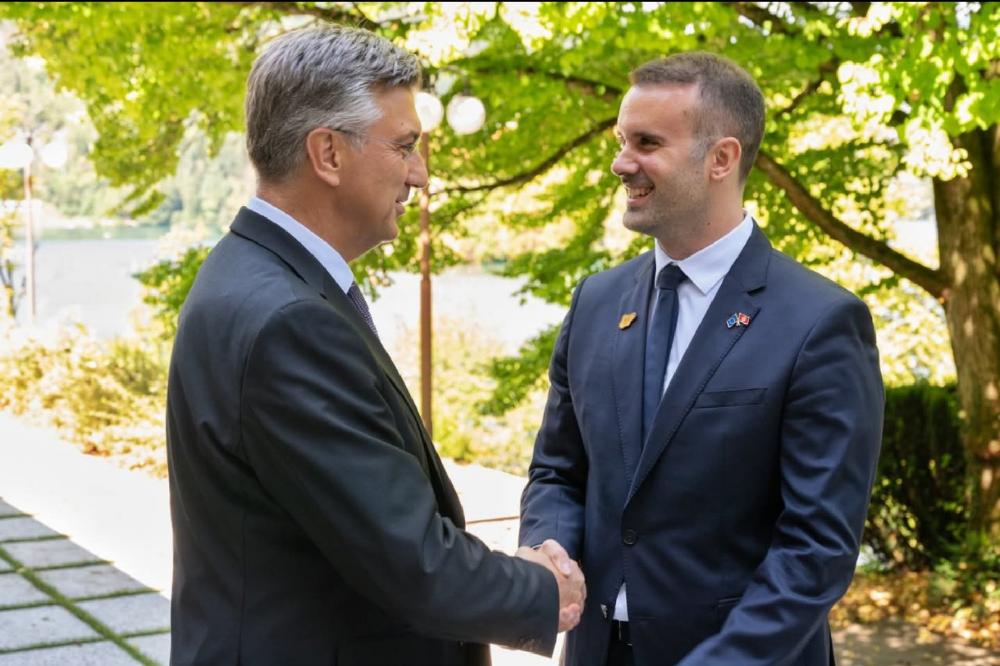
Croatia says it is not blocking Montenegro’s European Union accession, but insists that unresolved wartime, border and property disputes must be settled before negotiations can conclude. With Podgorica targeting EU membership by 2028, the disagreement threatens to complicate the Western Balkans’ most advanced accession process.
PODGORICA, Nov. 10 (BalkanView) – Croatia has warned Montenegro that it must resolve outstanding bilateral disputes before completing its European Union accession negotiations, rejecting accusations that Zagreb is using its EU membership to pressure its neighbour.
Vanda Babić Galić, special adviser to Croatia’s foreign minister, said Zagreb had clearly communicated its expectations and remained committed to supporting Montenegro’s European ambitions.
“Croatia is not blocking Montenegro, nor is it blackmailing Montenegro,” Babić Galić told the PLENUM 2026 regional conference in Podgorica on Monday.
She said Montenegro had a historic opportunity to join the EU and could count on Croatia’s support, but warned that the government was moving too slowly.
“Montenegro is moving at a snail’s pace when it should be flying,” she said.
The remarks come as Montenegro enters what it hopes will be the final stage of accession negotiations, with officials aiming to close the remaining negotiating chapters by the end of 2026 and secure EU membership in 2028.
Eight disputes threaten Montenegro’s European timetable
Croatia has linked its support for Montenegro’s accession to progress on eight outstanding bilateral issues, several of which stem from the wars that accompanied Yugoslavia’s collapse in the 1990s.
The disputes include the fate of missing persons, compensation for former prisoners at the Morinj detention camp, prosecution of war crimes, property rights of Croatian families, border demarcation and ownership of the historic naval training ship Jadran.
Two other issues — the naming of a swimming pool in Kotor and a memorial plaque at the former Morinj detention camp — were addressed in October, although Zagreb considers the steps only partial solutions.
Babić Galić said identifying missing persons and prosecuting war crimes would take time, adding that Croatia was prepared to assist Montenegro.
However, she stressed that Zagreb expected concrete commitments rather than political declarations.
The Croatian government, led by Prime Minister Andrej Plenković, has maintained that these outstanding matters must be addressed for Montenegro to complete the accession process.
Border dispute becomes a condition for Chapter 31
One of the most sensitive issues concerns the border around the Prevlaka peninsula, at the entrance to the Bay of Kotor.
Babić Galić said Zagreb considered the land border settled but acknowledged that the maritime boundary remained disputed.
She accused Montenegro of reopening an issue Croatia regarded as resolved and said Zagreb was insisting on a border agreement in connection with the closure of Chapter 31, covering common foreign, security and defence policy.
According to Babić Galić, the last meeting on border demarcation took place in 2015.
She said the two countries’ border commissions could meet again in November, with the coming two months likely to show whether progress was possible.
The Croatian official also warned Podgorica against attempting to bypass Zagreb in the accession process.
Croatia, she said, is a full EU member and cannot be excluded from decisions requiring agreement among member states.
Montenegro still believes EU membership in 2028 is possible
Montenegro’s chief EU negotiator, Predrag Zenović, expressed confidence that the disputes could be resolved through constructive bilateral negotiations.
He said technical commissions and competent institutions should seek mutually acceptable solutions.
Zenović declined to comment directly on negotiations between Zagreb and Podgorica, saying he lacked the mandate to discuss them.
Nevertheless, he maintained that Montenegro’s target of joining the EU in 2028 remained realistic.
“I believe Montenegro will be an EU member state by 2028,” he said.
Zenović said Montenegro had fulfilled all 98 closing benchmarks across 33 negotiating chapters and cited the European Commission’s latest assessment, which gave the country an overall preparedness score of 3.98.
He described EU membership as an opportunity to continue transforming Montenegro rather than an endpoint for reforms.
Former deputy prime minister warns against bilateral blackmail
Jovana Marović, a former Montenegrin deputy prime minister and member of the Balkans in Europe Policy Advisory Group, warned that unresolved bilateral disputes could undermine Montenegro’s accession timetable.
She said the country could complete negotiations by the end of 2026 and sign an accession treaty in June 2027, provided political obstacles were overcome.
Marović called for a more proactive approach from Podgorica but also urged Zagreb to avoid turning bilateral disputes into last-minute conditions.
“I expect the Croatian side not to act exclusively as the blackmailing party in this dialogue,” she said.
She proposed establishing binding deadlines for resolving outstanding issues, potentially through provisions in Montenegro’s accession treaty.
Such an arrangement, she argued, would allow the two countries to continue negotiations on an equal footing after Montenegro became an EU member.
Marović challenged Croatia’s attempt to connect the border dispute with Chapter 31, noting that the European Commission had given Montenegro its highest preparedness rating in that area.
She said outstanding questions, including wartime compensation, should be resolved but not at the expense of the entire accession process.
Could Montenegro become a second-class EU member?
Marović also raised concerns about possible safeguards in Montenegro’s future accession treaty.
She warned that arrangements discussed in the European Commission’s latest proposals could leave Montenegro subject to restrictions for up to 15 years, potentially affecting its voting rights in the Council of the EU.
Such provisions, she argued, risked creating a category of second-class EU members.
Her comments reflect a broader debate about how the EU should accommodate new members while protecting its decision-making procedures.
Marović also warned that ratification of an accession treaty could take more than two years, creating another potential obstacle to Montenegro’s membership target.
The precise scope of any future safeguards would depend on negotiations and the final accession treaty.
Opposition pledges support but questions democratic progress
Ivan Vuković, a lawmaker from Montenegro’s opposition Democratic Party of Socialists (DPS), said his party would continue supporting strategic decisions necessary for EU accession.
However, he questioned whether progress in negotiations was matched by improvements in the country’s political and institutional environment.
Vuković pointed to controversies surrounding security legislation and political disputes over the country’s wartime past as evidence of continuing divisions.
He said Montenegro needed to confront the gap between its formal achievements in EU negotiations and the political realities experienced by citizens.
Despite those concerns, he pledged that the parliamentary opposition would cooperate on decisions essential to advancing membership.
Civil society: EU membership must not become a geopolitical reward
Daliborka Uljarević, executive director of Montenegro’s Centre for Civic Education, warned that the EU enlargement process must produce genuine democratic reforms rather than merely reward political leaders for completing negotiations.
“EU membership must not be a reward to political structures for conducting negotiations on the wave of a revived enlargement policy,” she said.
Instead, accession should demonstrate that institutions had become more professional, society more democratic and citizens freer and safer, she added.
Uljarević said the geopolitical importance of the Western Balkans could not substitute for democratic transformation.
She also cautioned against sacrificing the quality of reforms for speed or selectively confronting the legacy of the 1990s wars.
Valida Repovac Nikšić, vice-dean at the Faculty of Political Sciences in Sarajevo, said Montenegro’s progress represented an important moment for the entire Western Balkans.
She argued that the effectiveness of EU enlargement should be measured not simply by the number of negotiating chapters closed but by its contribution to strengthening democracy.
A test for the EU’s credibility in the Western Balkans
Montenegro is widely regarded as the Western Balkans’ most advanced EU candidate, and its accession would carry significance beyond the country’s borders.
A successful enlargement could demonstrate that membership remains achievable for candidates that meet the required conditions.
However, the latest disagreement with Croatia illustrates how bilateral disputes can complicate the process even when a candidate makes substantial progress on EU reforms.
Zagreb argues that settling wartime and territorial issues is an essential part of good-neighbourly relations.
Critics warn that allowing member states to impose additional bilateral demands late in negotiations risks weakening the credibility of the EU’s merit-based accession system.
For Montenegro, the challenge is to reconcile these competing pressures without sacrificing either its European timetable or the need for lasting agreements with its neighbours.
The next two months could determine whether Montenegro moves closer to becoming the EU’s next member — or whether unresolved disputes with Croatia push its European ambitions further into the future.