


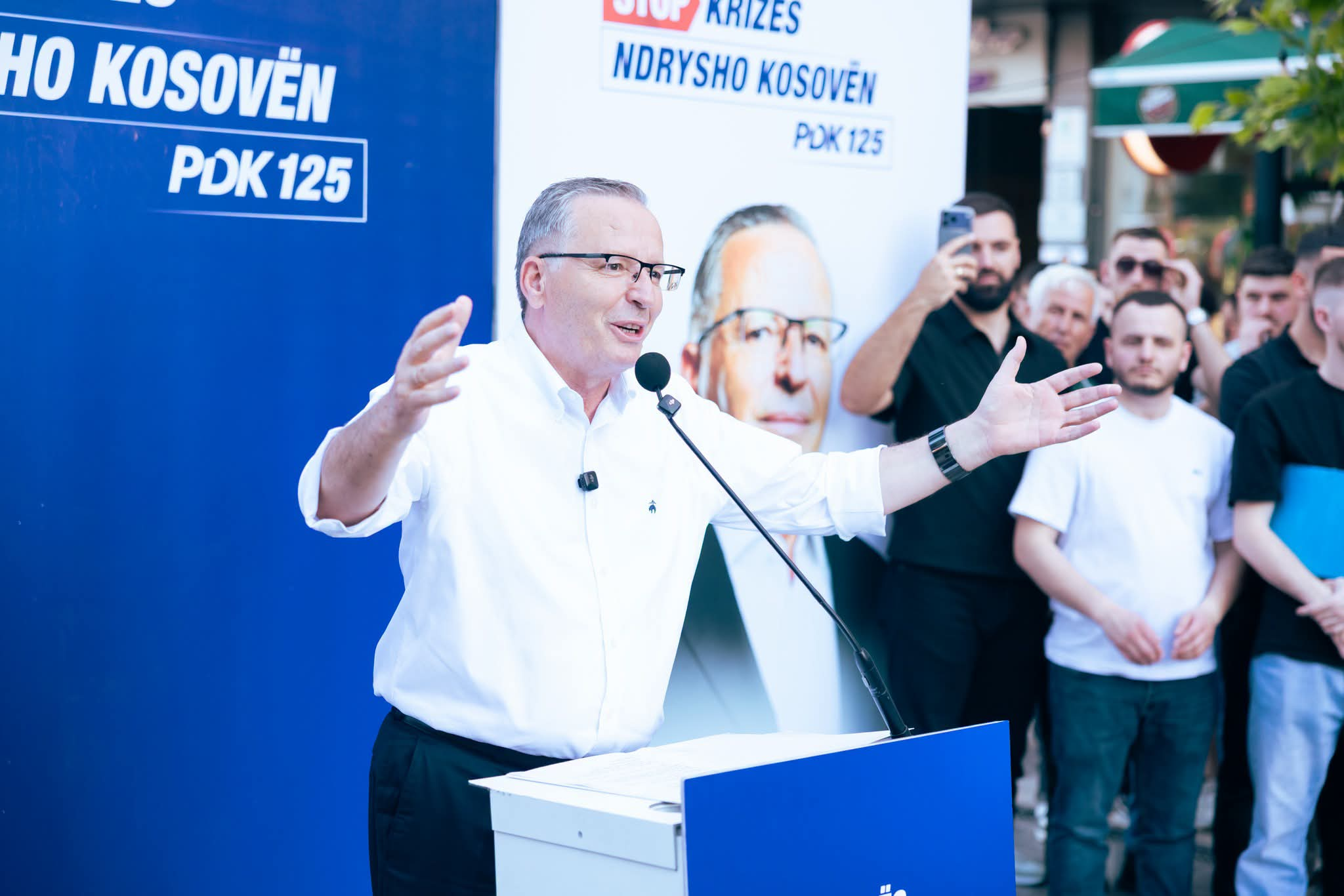
A reported meeting between Kosovo Prime Minister Albin Kurti and opposition leader Bedri Hamza, just hours before Hamza’s resignation, has raised questions about a possible political understanding over the Kosovo Specialist Chambers. As Vlora Çitaku takes temporary control of the PDK, attention is turning to proposed legal changes affecting the court prosecuting former Kosovo Liberation Army leaders.
PRISTINA, Oct. 21 (BalkanView) – Bedri Hamza resigned as chairman of the Democratic Party of Kosovo (PDK) on Wednesday, hours after reportedly meeting Prime Minister Albin Kurti to discuss proposed amendments to the law governing the Kosovo Specialist Chambers.
The PDK, Kosovo’s largest opposition party, subsequently appointed former ambassador Vlora Çitaku as acting chairwoman, opening the way for a new leadership election.
According to a report by Indeksonline, Kurti assured Hamza during their meeting that his ruling Vetëvendosje movement would support amendments to the Law on Specialist Chambers, including changes that could be proposed during the legislative process.
The account was attributed to unnamed sources. Neither Kurti nor Hamza was quoted publicly confirming the reported assurances, and there was no established evidence that the meeting was directly connected to Hamza’s resignation.
The reported discussions nevertheless added a new dimension to the leadership change, linking it to one of Kosovo’s most politically sensitive issues: the prosecution of former Kosovo Liberation Army leaders in The Hague.
Reported agreement over Specialist Chambers legislation
According to Indeksonline, the meeting took place several hours before Hamza informed the PDK leadership of his irrevocable resignation.
The sources said Kurti assured Hamza that Vetëvendosje would vote in favour of the legislation if changes were introduced to the Law on Specialist Chambers.
The report did not specify the content of the potential amendments or explain how they might affect ongoing proceedings.
Lajmi.net reported that the legislation was at Kosovo’s presidency, awaiting promulgation.
The Kosovo Specialist Chambers, based in The Hague, were established under Kosovo law to prosecute alleged crimes committed during and immediately after the 1998–1999 Kosovo conflict.
The court has been a contentious issue in Kosovo, particularly within the PDK, whose political history is closely associated with former KLA leaders.
Any legislative changes affecting the court would be politically sensitive and could raise questions about Kosovo’s international legal commitments.
Hamza steps down, pledges continued support for former KLA leaders
Hamza announced his resignation after informing the party’s leadership of his decision.
Speaking at a news conference, he said political leaders must recognise when it is time to transfer responsibility.
He emphasised that stepping down as chairman did not mean abandoning the party.
Hamza said he would remain a loyal PDK member and voter, stressing that his commitment to the organisation extended beyond holding office.
He also reaffirmed his determination to continue supporting efforts aimed at securing the release of former KLA leaders facing proceedings in The Hague.
Hamza said he had hoped that, after September 16, he would be able to hand responsibility for the party back to figures he described as its leaders of war and peace.
His remarks highlighted the continuing influence of the PDK’s historic leadership on its political identity and internal direction.
Vlora Çitaku appointed acting PDK chairwoman
Following Hamza’s resignation, the PDK leadership appointed Vlora Çitaku as acting chairwoman.
Local media reported that Çitaku was the only candidate proposed for the interim position, and the party subsequently confirmed her appointment.
Çitaku, a former Kosovo ambassador to the United States, is among the PDK’s most prominent political figures.
Her diplomatic experience and international profile could prove significant as the party prepares for its next leadership contest.
However, the appointment is temporary, and the party is expected to organise an internal election to select a permanent chairman or chairwoman.
Çitaku thanks Hamza for his leadership
In a public message following the resignation, Çitaku praised Hamza for his commitment to the PDK and Kosovo.
She said he had accepted the responsibility of leading the party out of a desire to serve rather than personal ambition.
Çitaku also highlighted his political maturity and the confidence he had inspired within the party.
“We still have a lot of work to do together,” she said.
Former PDK chairman Memli Krasniqi also thanked Hamza, saying the party had overcome significant challenges during his leadership.
Other senior party figures expressed appreciation for Hamza’s contribution and called for unity.
Political implications of the Kurti-Hamza meeting
The reported meeting between Kurti and Hamza is significant because the two politicians represent opposing political camps.
Vetëvendosje and the PDK have frequently disagreed over governance, institutional reforms and Kosovo’s political direction.
The reported assurance concerning the Specialist Chambers legislation suggests the possibility of cooperation on an issue that cuts across traditional party divisions.
However, the available reporting does not establish a broader political agreement between the two parties.
Nor does it demonstrate that Kurti’s reported commitment influenced Hamza’s decision to resign.
The timing of the meeting and resignation is likely to attract political scrutiny, particularly as the PDK prepares to choose a new leader.
PDK enters a new leadership phase
The immediate challenge for Çitaku will be to maintain party unity and manage the transition towards a permanent leadership election.
The PDK remains a central force in Kosovo’s opposition and has an established political network across the country.
Its leadership change could affect relations with other parties, the opposition’s parliamentary strategy and future electoral preparations.
The reported discussions over the Specialist Chambers also place the party’s historic ties to former KLA leaders back at the centre of political attention.
For now, three questions remain unresolved: why Hamza chose to resign at this moment, whether the reported understanding with Kurti will translate into legislative action, and who will emerge as the PDK’s next permanent leader.