


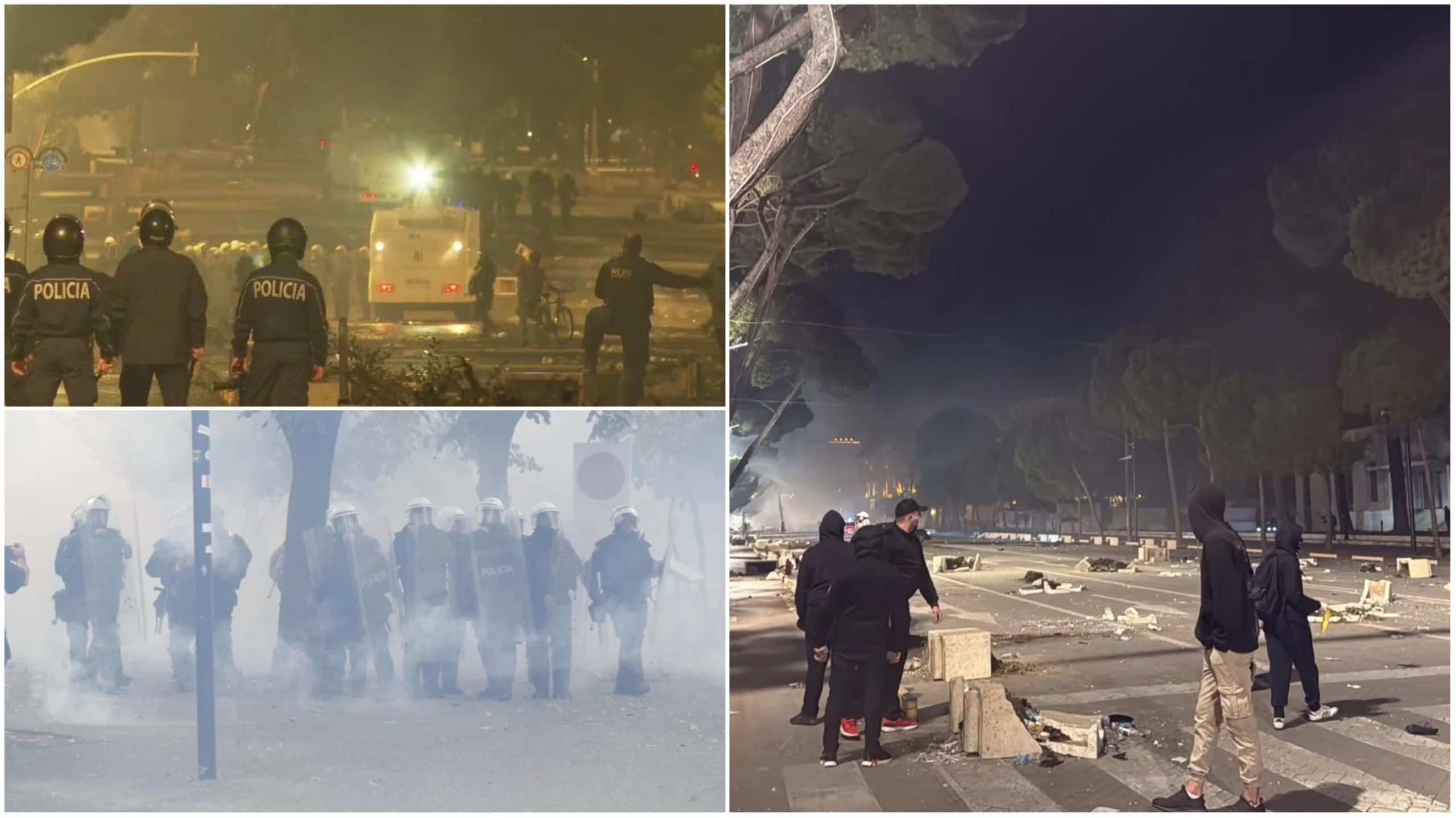
Albania’s capital descended into chaos on Thursday as masked protesters attacked government buildings, set fires and damaged banks and businesses during a third day of anti-government demonstrations. At least 26 people were injured, while Prime Minister Edi Rama rejected demands to resign, insisting that governments must be changed through elections, not violence.
TIRANA, Oct. 15 (BalkanView) — Violent clashes between protesters and police spread across Albania’s capital on Thursday as demonstrations against Prime Minister Edi Rama’s government entered a third consecutive day, leaving at least 26 people injured and extensive damage to public institutions and private businesses.
Masked demonstrators threw stones, fireworks and other objects at police and government buildings, while security forces responded with tear gas, pepper spray and water cannon, according to reports by Albanian television stations Top Channel, News24 and Ora News.
Several government ministries were attacked, bank branches were vandalised and fires broke out in different parts of the capital.
The most intense confrontations took place near the prime minister’s office, where police repeatedly attempted to disperse crowds gathered along Dëshmorët e Kombit Boulevard.
Despite the escalating violence and growing pressure on his government, Rama ruled out stepping down.
In comments reported by Top Channel as having been given to Reuters, the prime minister said governments should be changed through democratic elections rather than violence.
He also expressed willingness to engage in dialogue with students and address their legitimate demands.
Protesters break into ministry as fires spread
The unrest began in the morning near the Ministry of Education, where demonstrators damaged fencing and threw stones at the building.
Protesters subsequently moved towards parliament, the Ministry of Infrastructure and other government institutions.
At the Ministry of Infrastructure, windows were smashed as police attempted to clear the surrounding streets.
Some female demonstrators lay across the road to obstruct advancing police officers, prompting officers to use crowd-control measures.
By the evening, protesters had entered the Ministry of Economy, according to Top Channel.
Television footage and eyewitness reports indicated that demonstrators removed equipment and office furnishings, including a printer, from the building.
The ministry was also targeted by fires, while windows at the Central Election Commission were smashed.
BalkanWeb separately reported that protesters set fire to the main entrance of the Ministry of Finance, with flames and smoke spreading around the doorway.
The Interior Ministry was repeatedly targeted throughout the day.
Demonstrators threw stones and other objects at its entrance and facade, while police deployed tear gas from the building’s roof to prevent them from entering.
The headquarters of Rama’s Socialist Party was also attacked.
Banks and businesses targeted
The violence extended beyond government institutions.
At least four commercial bank branches were attacked during the demonstrations, according to Top Channel.
In central Tirana, protesters smashed glass doors and windows, damaged entrances and forced their way into some bank premises.
At one branch, demonstrators reportedly removed files and documents from inside the building before leaving.
A cash machine was also destroyed.
Shops belonging to two telecommunications companies were damaged, while several other businesses were vandalised or looted.
In the area behind the National Historical Museum, protesters broke into commercial premises and damaged equipment.
A fire extinguisher was taken from one business and thrown into burning debris in the street, according to local media reports.
Fires were reported in kiosks, rubbish containers and makeshift barricades across the capital, including along Rruga e Dibrës and Dëshmorët e Kombit Boulevard.
A security booth near Albania’s National Cyber Security Authority was set ablaze.
Local media also reported damage to a guard booth near the United States Embassy.
There was no indication in the reports that protesters had entered the embassy compound.
Police vehicles attacked as officers retreat
One of the most serious confrontations occurred near Ura e Bllokut, where protesters threw stones at dozens of police vehicles.
Top News correspondent Kleida Muka reported from the scene that officers attempted to push back demonstrators but were forced to retreat.
She also reported that some police officers threw stones back towards protesters during the confrontation.
The account raises questions about the conduct of both demonstrators and security personnel as the clashes intensified.
Elsewhere, police deployed tear gas and water cannon along Gjergj Fishta Boulevard and near the prime minister’s office.
Protesters erected makeshift barricades to obstruct advancing security forces.
In several locations, demonstrators regrouped after being dispersed, forcing police to conduct repeated operations.
By late evening, protesters were reported to be moving towards Tirana’s police headquarters, where security forces had established a blockade.
Another group reportedly damaged doors and windows at buildings in the city’s student residential district.
At least 26 injured, including police officers
Top Channel reported that 26 injured people had been admitted to Tirana’s Trauma Hospital during Thursday’s unrest.
The reported casualties included police officers and demonstrators.
One police officer underwent surgery, while several protesters remained under medical supervision.
A 34-year-old female protester suffered a head injury and was being closely monitored at the Trauma Hospital.
The Health Ministry said she was conscious and in stable condition.
A police commander from Shkodra was also reported to have suffered a serious head injury.
The full number of injured people across Albania had not been established in the reports available late Thursday.
Police had arrested 55 people and opened criminal proceedings against another 98 in connection with the previous day’s unrest, according to figures reported by Albanian media.
A complete tally of arrests and detentions during Thursday’s demonstrations was not immediately available.
Protests spread beyond Tirana
The demonstrations were not confined to the capital.
Clashes and incidents were also reported in Durrës, Shkodra, Elbasan, Korça, Kukës and other Albanian cities.
In Durrës, protesters confronted police, damaged traffic infrastructure and public property, and lit fires in public spaces.
Five police officers were reported to be receiving hospital treatment following confrontations in the coastal city.
In Korça, demonstrators reportedly damaged the local education directorate, while police detained several participants.
Student demonstrations and school boycotts were reported in other cities.
The escalating unrest also disrupted the functioning of state institutions.
Albania’s parliament postponed its scheduled plenary session, while some public administration employees were instructed to work remotely because of security concerns.
Rama rejects resignation, opposition backs students
The protests have developed into a major confrontation between Rama’s government and demonstrators demanding political change.
Rama has rejected calls for his resignation and accused political opponents of exploiting the unrest.
He argued that the destruction of public institutions and private property should not be attributed to students exercising their right to protest.
The opposition Democratic Party has expressed support for the student demonstrations and established a legal team to assist protesters detained or arrested by police.
Its leader, Sali Berisha, has called on students and school pupils to boycott classes.
The competing political narratives have added to tensions surrounding the demonstrations.
While government officials have blamed opposition-linked groups for much of the violence, some protesters have alleged excessive use of force by police.
Those competing allegations have not been independently established.
The European Union delegation in Tirana condemned the escalation of violence, while the Organization for Security and Co-operation in Europe called for dialogue and restraint.
Business organisations also urged authorities to protect public and private property and ensure accountability for attacks.
Political crisis unfolds as Albania advances towards EU membership
The unrest comes at a significant moment for Albania’s European integration.
On October 13, the European Union and Albania provisionally closed negotiations on Chapter 20, covering enterprise and industrial policy.
The decision brought the number of provisionally closed chapters to four, with Albania having opened all 33 screened negotiating chapters.
The government aims to complete accession negotiations in 2027.
However, the EU continues to assess candidate countries on democratic governance, the rule of law and the functioning of public institutions.
The violence does not automatically alter Albania’s negotiating timetable, but the authorities’ response to the demonstrations and their handling of allegations of excessive force could attract scrutiny.
The immediate challenge for the government is to restore public order while protecting the right to peaceful assembly.
For protesters, the challenge is to distinguish their political and social demands from the violence and destruction reported across the country.
As Thursday drew to a close, the situation in Tirana remained volatile, with protesters continuing to move through the capital and police maintaining a heavy presence around government buildings.