


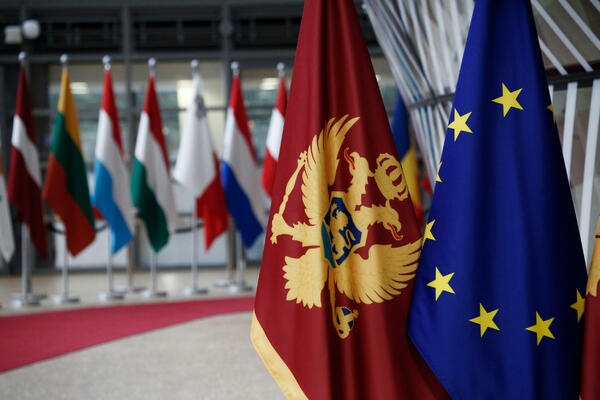
Montenegro has moved another step closer to European Union membership, closing three additional negotiating chapters and bringing its total to 21 out of 33. With 12 chapters still open, the small Balkan country is strengthening its position at the forefront of EU enlargement.
BRUSSELS, Oct. 12 — The European Union and Montenegro provisionally closed three more chapters in the country’s accession negotiations on Monday, bringing the total to 21 and marking another milestone in Podgorica’s efforts to become the bloc’s next member.
The chapters cover economic and monetary policy, statistics, and social policy and employment, three areas central to aligning Montenegro’s economic governance, statistical systems and labour policies with EU standards.
The decision was taken at an intergovernmental accession conference under Ireland’s presidency of the Council of the EU.
Montenegro has opened all 33 negotiating chapters and has now provisionally closed 21, leaving 12 to be completed before negotiations can be concluded.
“I am proud that at the second Intergovernmental Conference for Montenegro held under the Irish presidency, we provisionally closed three more negotiating chapters,” said Thomas Byrne, Ireland’s Minister of State for European affairs and defence.
“Enlargement is a geopolitical necessity for the EU and remains a top priority of the Irish presidency,” he added.
Montenegro accelerates its EU accession process
Monday’s decision follows another accession conference on July 14, when Montenegro provisionally closed two chapters covering competition policy and the customs union.
Together, the two meetings have resulted in the provisional closure of five chapters in three months, demonstrating continued momentum in the country’s accession negotiations.
The latest progress strengthens Montenegro’s position as one of the most advanced EU membership candidates in the Western Balkans.
Podgorica has set an ambitious political objective of completing accession negotiations and joining the European Union by 2028.
However, meeting that target will depend on the pace of remaining reforms, the closure of outstanding chapters and the agreement of EU member states.
### What the three chapters mean
The newly closed chapters cover important aspects of Montenegro’s economic and social integration into the EU.
Chapter 17 — Economic and monetary policy: Covers alignment with EU rules governing economic and monetary policy, including the institutional framework for economic coordination.
Chapter 18 — Statistics: Concerns the development of reliable and internationally comparable statistical systems necessary for implementing and monitoring EU policies.
Chapter 19 — Social policy and employment: Addresses employment, labour standards, workplace conditions, social dialogue and related social policy requirements.
The provisional closure of these chapters indicates that EU member states consider Montenegro to have met the relevant negotiating benchmarks at this stage.
The final 12 chapters remain crucial
Despite the progress, the European Council stressed that provisional closure does not mean the negotiations are definitively completed.
The EU will continue monitoring Montenegro’s alignment with European legislation and its implementation throughout the accession process.
Under the negotiating framework, agreements on individual chapters are not final until an overall agreement has been reached.
The EU can also reopen previously closed chapters if necessary.
This means Montenegro must not only complete the remaining negotiations but also demonstrate that reforms are being implemented and sustained.
A geopolitical signal to the Western Balkans
Montenegro’s progress comes as EU enlargement has regained strategic importance amid growing geopolitical competition and security concerns across Europe.
The Irish presidency’s description of enlargement as a “geopolitical necessity” reflects the increasingly prominent role of security and regional stability in the EU’s approach to candidate countries.
For the Western Balkans, Montenegro’s progress offers a potential demonstration that accession negotiations can produce concrete results.
The country could become an important test of whether the EU can translate renewed political commitments on enlargement into actual membership.
For Podgorica, the challenge is now to maintain the pace of reforms while securing agreement on the final 12 chapters.
With 21 chapters provisionally closed, Montenegro has completed nearly two-thirds of the chapter-closing process.
But the remaining negotiations, the final accession agreement and ratification by EU member states will determine whether its ambition of joining the bloc by 2028 becomes reality.