


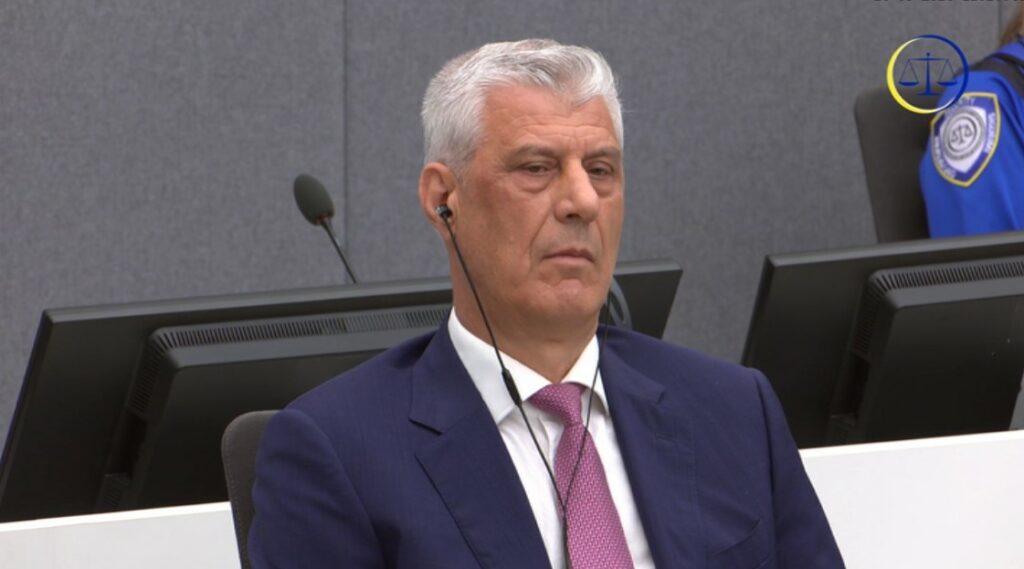
Albania’s parliament has united behind former Kosovo Liberation Army leaders convicted of war crimes in The Hague, calling the first-instance ruling against Hashim Thaçi and three others deeply unjust, as the landmark judgment opens a new regional dispute over justice, victims and the legacy of the Kosovo war.
TIRANA/PRISTINA, Sept 17 (BalkanView) – Albania’s parliament expressed “deep indignation” over the conviction of former Kosovo President Hashim Thaçi and three other former Kosovo Liberation Army leaders on Thursday, rejecting what it described as a deeply unjust first-instance ruling that has triggered sharply contrasting reactions across the Balkans.
The declaration came a day after the Kosovo Specialist Chambers in The Hague convicted Thaçi, Kadri Veseli, Jakup Krasniqi and Rexhep Selimi of war crimes committed during the 1998-99 Kosovo conflict.
Thaçi and Krasniqi were each sentenced to 25 years in prison, Veseli to 18 years and Selimi to 13 years, for a combined 81 years.
The four were convicted of war crimes including murder, torture, cruel treatment and arbitrary detention but acquitted of crimes against humanity.
Albanian parliament speaker Niko Peleshi read the joint declaration, which said the judgment could not alter the historical character of Kosovo’s struggle or place the aggressor and victim on the same footing.
The declaration reaffirmed parliament’s position that the KLA fought for Kosovo’s freedom and independence and rejected attempts to relativise crimes committed by forces under the government of former Yugoslav President Slobodan Milošević.
Albanian lawmakers also stressed that Wednesday’s judgment was not the final legal word because the defendants have the right to appeal.
The parliamentary intervention elevates Tirana’s reaction from statements by individual politicians to an institutional response from Albania’s legislature.
Court: The KLA itself was not on trial
The political reaction contrasts with a crucial distinction contained in the judgment itself.
The judges explicitly said the proceedings were not a trial of the KLA, its struggle for Kosovo’s independence or the crimes committed by Serbian and Yugoslav forces against Kosovo Albanians.
Instead, the court said it was determining the individual criminal responsibility of Thaçi, Veseli, Krasniqi and Selimi for specific crimes.
The Trial Panel found the four responsible for the arbitrary arrest and detention of 385 people, the torture of 303, cruel treatment of 49 and the murder of 96 people between April 1998 and June 20, 1999.
Victims included Kosovo Albanians perceived as political opponents or collaborators, as well as Serbs, Roma and others.
The judges found that the defendants shared a common criminal purpose to target perceived opponents of the KLA.
At the same time, they acquitted all four of six crimes-against-humanity charges because prosecutors failed to prove beyond reasonable doubt the required legal elements.
The distinction has become central to the political argument unfolding after the verdict.
Albanian and Kosovo politicians have focused on preventing the convictions from being interpreted as a judgment on the KLA’s liberation struggle, while the court has insisted that its findings concern four individuals and specific crimes.
Human Rights Watch: A step towards justice
Human Rights Watch offered a sharply different assessment from Albania’s parliament, describing the convictions as an important step towards accountability for victims of the Kosovo conflict.
The organisation said the judgment demonstrated that powerful political and military leaders were not beyond the reach of justice.
It also stressed that the victims identified in the judgment were not exclusively Serbs.
They included Kosovo Albanians regarded as political opponents or suspected collaborators, as well as Serbs and Roma.
Human Rights Watch said accountability should apply regardless of the ethnicity or affiliation of either victims or perpetrators.
The organisation also placed the ruling in the wider context of incomplete accountability for crimes committed during the Kosovo war, noting extensive crimes committed by Serbian and Yugoslav forces against Kosovo Albanians and the limited number of domestic prosecutions in Serbia.
That broader record remains central to the dispute over the Specialist Chambers.
Thaçi urges calm and prepares appeal
Thaçi, meanwhile, urged Kosovo citizens to remain calm following his conviction.
His lawyer Luka Mišetić said the former president was grateful for the support he had received and intended to challenge the judgment.
Thaçi and his co-defendants have consistently denied criminal responsibility.
The appeals process is now likely to become the legal focus of the case.
The four men have been detained in The Hague since November 2020, meaning time already served will be deducted from their sentences.
For their supporters, the appeal offers another opportunity to challenge the Trial Panel’s findings.
For victims and human rights organisations, the first-instance judgment represents a rare instance in which senior KLA figures have been held criminally responsible for wartime abuses.
Kosovo leaders seek common response
The verdict has also triggered political consultations in Pristina.
Prime Minister Albin Kurti met Democratic Party of Kosovo leader Bedri Hamza as Kosovo’s political establishment considered its response to the judgment.
Hamza has also called for discussions among political leaders over the steps that should follow.
The reaction cuts across Kosovo’s normally bitter party divisions because Thaçi, Veseli, Krasniqi and Selimi remain closely associated with the country’s independence struggle.
Thaçi went on to serve as prime minister and president. Veseli became parliamentary speaker, while Krasniqi and Selimi also held prominent political positions after the war.
Public anger was visible immediately after the judgment, with demonstrations in Pristina and The Hague.
Veterans have announced further protests.
The political challenge for Kosovo’s institutions is to defend their interpretation of the KLA’s historical role while recognising that the Specialist Chambers are part of Kosovo’s legal system and that the defendants retain the right to appeal.
Croatia stresses individual responsibility
Croatia took a more restrained position.
Its foreign ministry said it had taken note of the first-instance judgment and would not prejudge the final outcome of proceedings.
Zagreb stressed that individual criminal responsibility established in judicial proceedings did not change the broader context of Kosovo’s struggle for freedom and independence.
That formulation closely reflects the distinction made by the judges themselves: individual crimes can be prosecuted without turning a criminal trial into a judgment on an entire armed movement or population.
Serbia says judgment does not go far enough
The reaction from Serbia moved in the opposite direction.
Serbian Interior Minister Ivica Dačić portrayed the convictions as confirmation of longstanding Serbian accusations against the KLA, while also criticising the scope of the judgment.
Serbian officials and associations representing victims have expressed dissatisfaction that the four were acquitted of crimes against humanity and that conduct after June 20, 1999 was not included among the war-crime convictions.
The court found that the armed conflict had ended by that date, meaning alleged subsequent acts could not qualify as war crimes under its jurisdiction on that basis.
That legal finding has become one of the principal points of criticism in Serbia.
Milorad Dodik, the Bosnian Serb political leader, also criticised the judgment, describing it as inadequate in addressing crimes against Serbs.
Those statements represent political interpretations of the verdict rather than findings of the court.
Two competing readings of the same verdict
The reactions reveal how the same judgment is being interpreted through fundamentally different historical narratives.
In Kosovo and Albania, political leaders are emphasising that crimes committed by individuals cannot be used to criminalise the KLA or rewrite a conflict in which Serbian and Yugoslav forces committed widespread abuses against Kosovo Albanians.
In Serbia and Republika Srpska, political figures are using the convictions to reinforce their longstanding accusations about crimes committed by KLA members while arguing that the judgment did not go far enough.
Human rights organisations have taken a third approach: treating the ruling primarily as an accountability case in which the ethnicity or political status of perpetrators and victims should not determine whether crimes are prosecuted.
The court itself attempted to establish that boundary.
It did not rule on whether Kosovo’s struggle for independence was legitimate.
It did not put the KLA as an organisation on trial.
And the convictions do not erase judicial findings concerning crimes committed by Serbian and Yugoslav forces during the conflict.
The judgment addressed whether four named defendants bore criminal responsibility for specific acts.
The battle now moves from the courtroom to history
That legal distinction has done little to prevent the judgment from becoming a regional political event.
For Kosovo and Albania, the central concern is increasingly the historical interpretation of the verdict.
For Serbia, the ruling has reopened arguments about Serbian victims and accountability for KLA crimes.
For victims and human rights organisations, the question is whether the convictions can strengthen the principle that crimes committed by any side deserve investigation and prosecution.
And for Thaçi, Veseli, Krasniqi and Selimi, the legal battle is not over.
The appeals process will determine whether the convictions and sentences survive further judicial scrutiny.
Until then, the Sept. 16 judgment remains a first-instance decision.
But one consequence is already clear: nearly three decades after the Kosovo war, the struggle over how that conflict is remembered remains almost as politically charged as the question of how its crimes should be judged.