


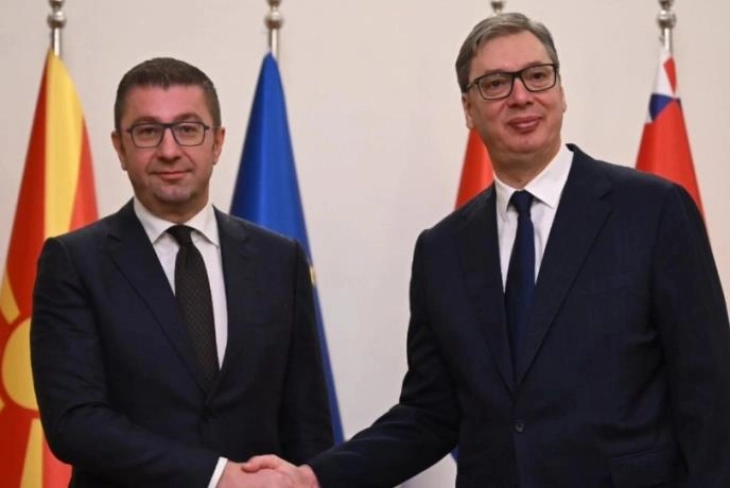
SKOPJE, Aug 15 (BalkanView) – North Macedonian Prime Minister Hristijan Mickoski on Saturday rejected Serbian President Aleksandar Vučić’s remarks about the Serbian Orthodox Church in Skopje, saying he would not engage in rhetoric that belonged to “the last century”.
Vučić recently said during a speech in Mrkonjić Grad that the Serbian Orthodox Church was “one and the same” in places including Mrkonjić Grad, Pirot, Sydney, Skopje, Frankfurt and Melbourne.
The reference to Skopje sparked reactions in North Macedonia, where church independence is closely tied to questions of national identity after decades of dispute between the Macedonian Orthodox Church–Ohrid Archbishopric, or MOC-OA, and the Serbian Orthodox Church.
“For me personally, the MOC-OA Justiniana Prima represents one of the brightest and most sacred parts of the Macedonian Orthodox identity,” Mickoski told reporters.
“We of course also have Macedonians of other religious denominations, but as a pillar of Macedonian identity, the MOC is above everything for me as a person.”
Mickoski said he had no intention of entering into a political exchange over Vučić’s statement.
“I neither intend to comment on such a statement nor do I wish to engage in any daily communication with outbursts of something that belongs more to the last century than to the 21st century,” he said.
Macedonian Church stresses its canonical territory
The MOC-OA also responded, although without directly confronting Vučić.
Its Holy Synod said the church carries out its spiritual and pastoral mission towards all Orthodox Christians “on its canonical territory”, regardless of their national, political, cultural or ethnic affiliation.
The wording was widely interpreted in North Macedonia as an assertion that Skopje falls under the canonical jurisdiction of the MOC-OA.
The church said it remained deeply conscious of its historical role and responsibility in the spiritual life of the Macedonian people while remaining open to all Orthodox believers.
Its response stopped short of explicitly stating that the Serbian Orthodox Church has no jurisdiction in Skopje or asking Vučić to retract or clarify his remarks.
A dispute with deep historical roots
The sensitivity surrounding the statement reflects the long and difficult history between the two Orthodox churches.
The Macedonian Orthodox Church declared autocephaly from the Serbian Orthodox Church in 1967, beginning a schism that lasted for more than half a century.
Canonical and liturgical communion was restored in 2022. Serbian Patriarch Porfirije subsequently announced in Skopje that the Serbian Orthodox Church recognised the autocephaly of the Macedonian church, and a Tomos confirming that decision was later presented in Belgrade.
The MOC-OA is still seeking broader recognition of its autocephalous status, including from the Ecumenical Patriarchate.
Vučić’s decision to list Skopje alongside cities in Serbia and Serbian diaspora centres abroad therefore carried particular political and ecclesiastical weight in North Macedonia.
Critics said the formulation risked implying that the Serbian Orthodox Church retained a form of spiritual or canonical jurisdiction in the North Macedonian capital.
Mickoski’s response marked one of the clearest political reactions from Skopje, framing the controversy not as a technical church dispute but as rhetoric belonging to a past era of competing national claims in the Balkans.