


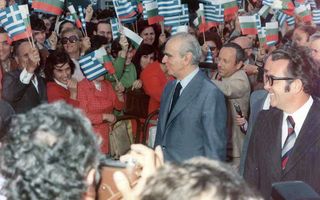
ATHENS, July 12 (BV) – Newly declassified archives from Bulgaria’s former State Security (DS) service reveal that communist intelligence officials proposed assassinating former Greek Prime Minister Konstantinos Karamanlis in Paris in 1968 using an explosive device concealed inside a book.
According to documents published by Bulgaria’s Commission for the Disclosure of Documents, the proposal formed part of a broader package of “active measures” submitted to the Soviet KGB on March 12, 1968, aimed at destabilizing Greece, worsening relations between Greece and Turkey and weakening NATO’s southeastern flank during the Cold War.
The seven-page top-secret document proposed mailing the explosive package from the United Kingdom to reduce suspicion. Intelligence planners believed the attack would deepen divisions between rival political forces in Greece and fuel instability under the military junta that had seized power in April 1967.
The proposal acknowledged that the parcel could also kill a secretary or family member if opened before reaching Karamanlis.
The same document outlined other covert operations designed to inflame Greek-Turkish tensions, including bomb attacks against symbolic sites such as the Turkish Consulate in Thessaloniki, housed in Mustafa Kemal Atatürk’s birthplace, as well as planned attacks on religious sites that could be blamed on nationalist groups from the neighboring country.
The Bulgarian intelligence service regarded Karamanlis, then living in self-imposed exile in Paris, as a key pro-Western political figure whose potential return could stabilize Greece and strengthen NATO’s position in the region.
The Soviet KGB ultimately rejected the Bulgarian proposals. Historians believe Moscow was reluctant to provoke a crisis involving NATO while preparing for the military intervention that crushed the Prague Spring in Czechoslovakia later that year.
The findings are based on declassified Bulgarian intelligence archives and broader research into Soviet intelligence activities during the Greek military dictatorship. Historians say the documents provide rare insight into the scope of Cold War covert operations, including plans that were never carried out.