


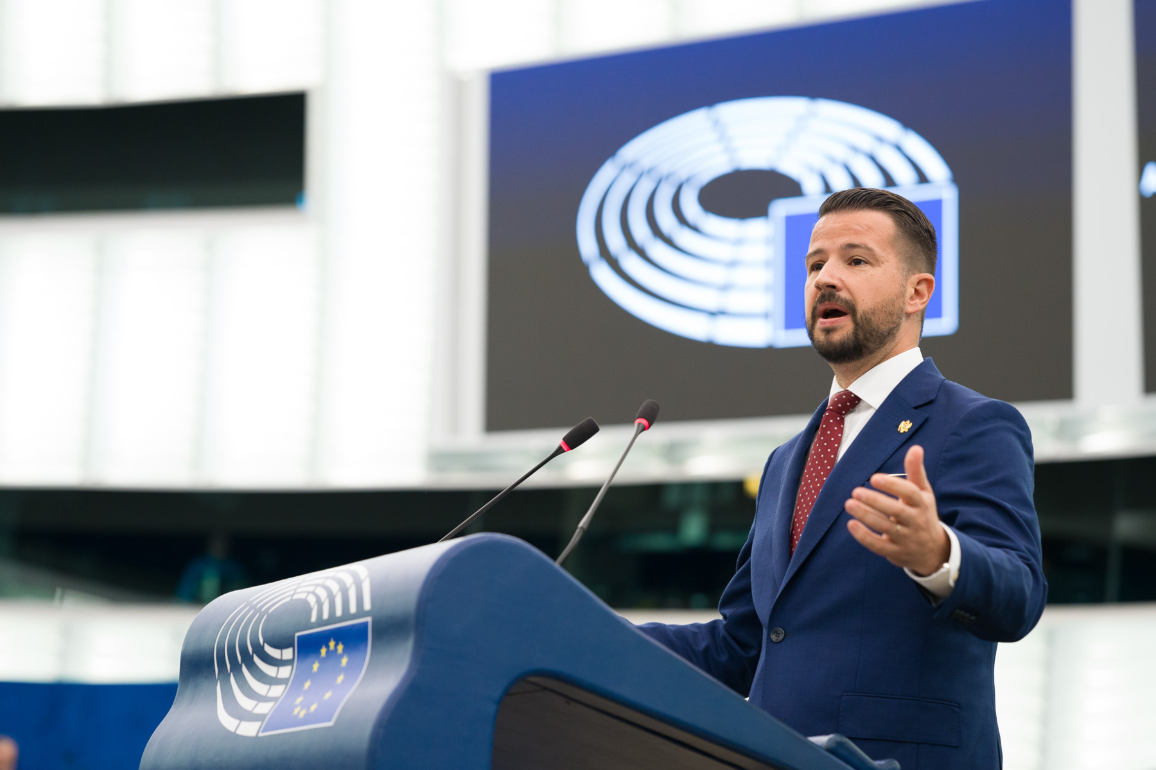
President Milatović tells European Parliament Montenegro is ready to become the bloc’s next member
STRASBOURG, June 21 (BV) — Montenegro has stepped up its bid to become the next member of the European Union, with President Jakov Milatović telling the European Parliament that his country is ready to assume the responsibilities of membership and complete accession negotiations by the end of 2026.
Addressing lawmakers in Strasbourg, Milatović presented Montenegro as the frontrunner among Western Balkan candidates at a moment when EU enlargement has returned to the center of Europe’s geopolitical agenda.
“We are ready to bind our future to the common European future,” Milatović said, declaring that Montenegro aims to become the EU’s 28th member state.
His message comes as Brussels increasingly views enlargement not only as a reform-driven process but also as a strategic response to growing security challenges, Russia’s war against Ukraine, and competition from external powers in the Western Balkans.
Montenegro Leads the Regional Pack
Montenegro remains the most advanced EU candidate in the Western Balkans.
The country opened accession negotiations in 2012 and has since opened all 33 negotiating chapters, while provisionally closing 16. Work has already begun on drafting an accession treaty, a stage that no other Western Balkan candidate has yet reached.
European Parliament President Roberta Metsola described the current moment as “Europe’s enlargement moment” and said Montenegro was leading the way.
“Enlargement is not an act of charity. It is an investment in a stronger, safer and more prosperous Europe,” Metsola said.
The remarks underline a broader shift in Brussels, where enlargement is increasingly framed as a security imperative rather than solely a technical reform process.
A Different Pace Across the Western Balkans
Montenegro’s progress contrasts sharply with the mixed fortunes of other countries in the region.
Albania has accelerated negotiations and recently fulfilled interim benchmarks under the crucial “Fundamentals” cluster, winning praise from EU officials and strengthening expectations that it could move rapidly through the next stages of accession.
North Macedonia remains blocked by the unresolved issue of constitutional amendments required under the 2022 negotiating framework. While Brussels insists the agreed commitments must be implemented, Prime Minister Hristijan Mickoski’s government continues to seek guarantees that no additional bilateral demands will emerge later in the process.
Bosnia and Herzegovina faces a different challenge. European Council President António Costa recently warned that Sarajevo risks losing hundreds of millions of euros in EU funding unless key judicial reforms are adopted and a chief negotiator is appointed.
Kosovo, meanwhile, remains outside formal candidate status and continues to face pressure from Brussels to normalize relations with Serbia before meaningful progress toward membership can occur.
Serbia has opened numerous negotiating chapters but continues to face scrutiny over democratic reforms, media freedom, rule of law issues and its relationship with Russia.
Enlargement Returns to the Strategic Agenda
The renewed focus on Montenegro comes amid a broader debate about the future of EU enlargement.
For years, accession momentum in the Western Balkans slowed as enlargement fatigue spread across Europe. The war in Ukraine has changed that calculation.
EU leaders increasingly argue that integrating the Western Balkans is essential for continental stability and for limiting external influence from Russia, China and other actors.
The challenge for Brussels is maintaining credibility. Candidate countries have spent years implementing reforms while public support for EU integration has gradually eroded due to repeated delays.
Montenegro’s progress is therefore being watched closely throughout the region. If Podgorica succeeds in completing negotiations by the end of 2026, it would become the first Western Balkan country to join the EU since Croatia’s accession in 2013.
Such a development would send a powerful signal that enlargement remains achievable and could inject new momentum into accession efforts across the region.
Reform Challenges Remain
Despite the optimism, EU institutions stress that membership is not guaranteed.
Milatović acknowledged that significant work remains, particularly in strengthening the rule of law, improving public administration and ensuring the independence of state institutions.
These areas remain among the most closely monitored chapters in the accession process and will likely determine whether Montenegro can meet its ambitious timeline.
Still, the political message from Strasbourg was unmistakable: while much of the Western Balkans remains stuck in various stages of the accession process, Montenegro is positioning itself as the region’s next success story.
Whether it crosses the finish line will largely determine the credibility of the European Union’s renewed enlargement strategy.