


By Stavros Tzimas
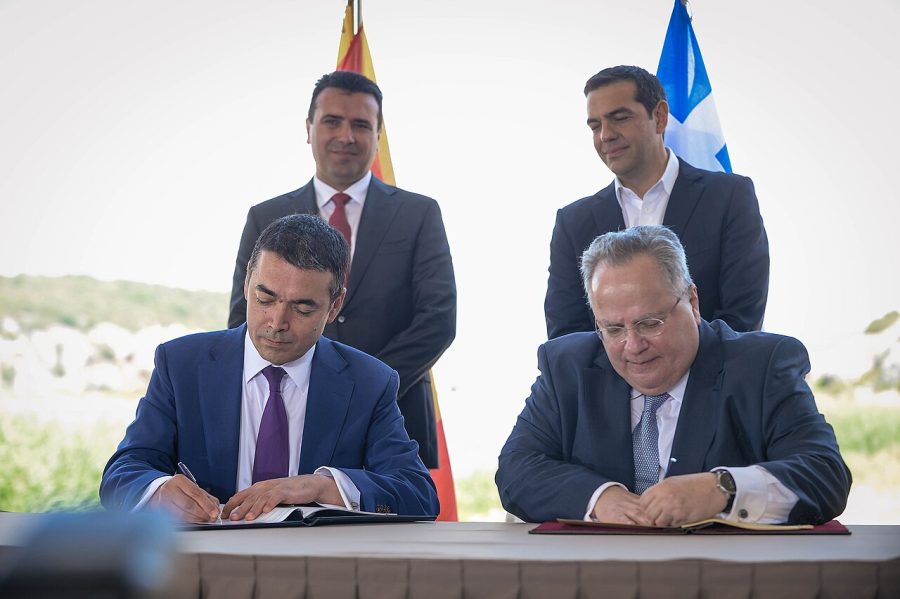
Eight years ago, on June 17, 2018, Greece and the then Former Yugoslav Republic of Macedonia (FYROM) were reveling in the celebratory atmosphere created by the signing in Prespes, northern Greece, of the controversial Prespa Agreement under the gaze of the international community, which was supposed to settle the pending name issue and pave the way for the neighboring country’s accession to NATO and the EU.
The agreement divided the societies in both countries, but was applauded by the international community, which saw it as an important step toward consolidating stability in the Balkans.
Its implementation process is a subject of much debate, with both sides showing no willingness to implement what was agreed. If anyone wanted to say what each side achieved, then Athens succeeded in registering a composite name for the country – North Macedonia – in international organizations, thus breaking out of a diplomatic impasse that it had been in for years, and Skopje got its NATO membership under the new name.
Since then, the nationalist leaders of VMRO DPMNE – who came to power after the collapse of the social democratic government of Zoran Zaev which had signed the agreement – have systematically engaged in efforts to undermine it. They refuse to implement it domestically, insisting on simply using the name “Macedonia” everywhere, and Greece, as a “response,” insists on not ratifying three memoranda that were foreseen by the Prespa Agreement.
As things stand, the future of the agreement is unclear, but neither side seems to be worried. And if Greece is not angry about the current stalemate, the same should not be true of the leadership of North Macedonia. The country’s top goal, after NATO, is its accession to the European Union, which is impossible without Athens’ consent.
At present, Greece has no reason to spend diplomatic capital to force Skopje to honor its obligations “under the penalty of a veto,” as Bulgaria is blocking the accession path with its own veto, demanding the constitutional recognition of its own minority in North Macedonia.
Even if the nationalist prime minister – and Viktor Orban admirer – Hristijan Mickoski overcomes the obstacle of Bulgaria by backing down, he will have to deal with Greece, and the merry-go-round in the southern Balkans will continue.
Brussels wants North Macedonia to join the European family mainly for geopolitical reasons but without the burden of problems and ethnic pending issues with neighboring member-states. Of course, the current leaders in Skopje know this, but it seems impossible for them to overcome their (nationalist) selves, even if everyone pays for it; those who voted for them and those who did not.
Source: eKathimerini