


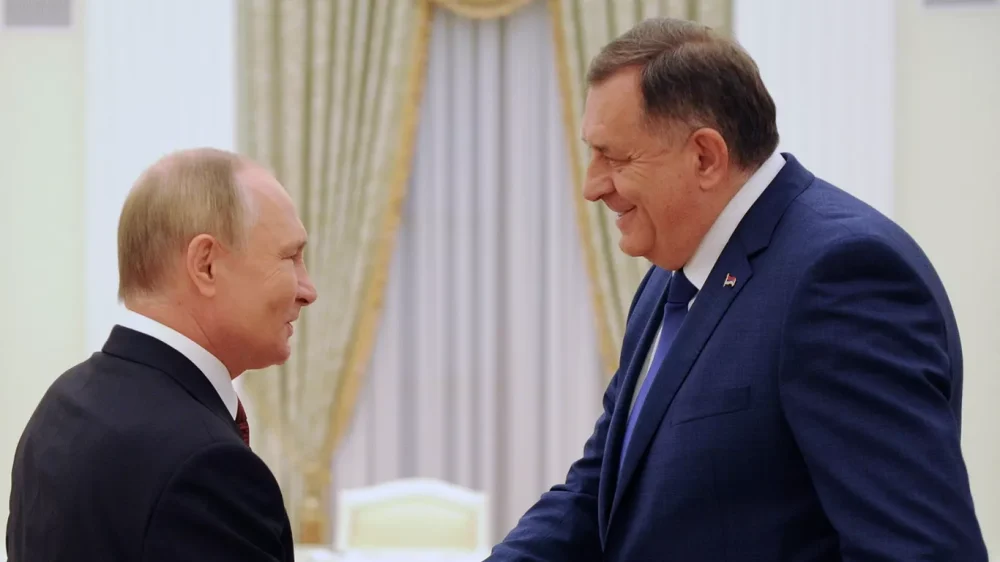
Bosnian Serb leader Milorad Dodik accused Western countries on Friday of trying to sever ties between Serbs and Russia, arguing that both NATO and the European Union were pursuing policies aimed at limiting communication and cooperation with Moscow.
In an interview with Russia’s state news agency TASS, Dodik said Serbia and Republika Srpska, the Serb-majority entity within Bosnia and Herzegovina, were increasingly surrounded by NATO and EU member states, creating what he described as a form of geopolitical isolation.
“The European Union has literally encircled Serbia and Republika Srpska,” Dodik said, pointing to neighboring countries that are members of both NATO and the EU.
He argued that Western efforts to expand European integration in the Balkans, including through Montenegro and Albania, would further reduce Serbia’s room for maneuver and limit its connections with Russia.
“This refers not only to air traffic. NATO and the European Union pursue the same goal,” Dodik said.
The Bosnian Serb leader reiterated his long-standing view that Serbs and Russians share close historical, cultural and religious ties.
“We are fraternal peoples and have the same roots,” he said, adding that Western governments viewed such relations as evidence of Russian influence in the Balkans.
Dodik also questioned the benefits of EU membership for Serbs, while acknowledging the economic importance of maintaining relations with the bloc.
“Integration into the European Union will not benefit our Serbian people,” he said. “At the same time, circumstances require us to keep borders open and maintain economic cooperation with the European Union.”
He argued that Western sanctions and restrictions had complicated trade with Russia, particularly because transport routes pass through EU territory.
“Today we cannot trade with Russia as actively because transit routes run through the European Union and are blocked by Europeans on both sides,” Dodik said.
Despite ongoing tensions between Brussels and Moscow, Dodik predicted that European countries would ultimately be unable to completely disengage from Russian energy supplies.
His comments come at a time of heightened geopolitical competition in the Western Balkans, where the European Union has stepped up efforts to accelerate enlargement and reduce Russian influence following the war in Ukraine.
Dodik, one of the region’s most outspoken pro-Russian politicians, has repeatedly criticized Western sanctions against Moscow and opposed Bosnia’s alignment with several EU foreign policy positions concerning Russia.