


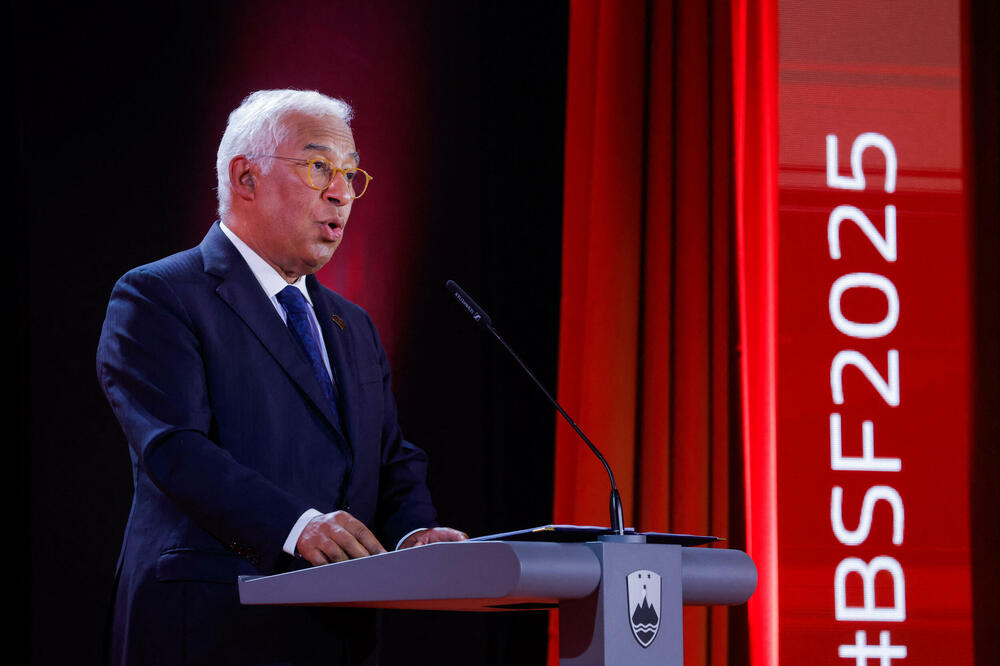
SKOPJE/BRUSSELS, May 29 (BV) – European Council President António Costa will embark on a five-day tour of the Western Balkans next week, visiting all six regional partners ahead of the EU-Western Balkans Summit in Montenegro, in what officials describe as a strong signal of renewed European commitment to enlargement.
Costa’s visit comes at a moment of growing geopolitical competition in Southeast Europe. The United States recently presented a new Western Balkans strategy focused on economic partnerships and countering Chinese and Russian influence, while Serbia has further strengthened its strategic partnership with China during President Aleksandar Vučić’s visit to Beijing.
“My second Western Balkans tour sends a clear signal: the EU’s commitment to the region is real; as real as the opportunity for enlargement. The momentum is there. Now is the time to deliver,” Costa said ahead of the trip.
The European Council president will begin his regional tour in Sarajevo on June 1 before travelling to Tirana and Skopje on June 2, Pristina on June 3, Belgrade on June 4, and finally Tivat, Montenegro, where he will co-chair the EU-Western Balkans Summit on June 5 alongside European Commission President Ursula von der Leyen and Montenegrin President Jakov Milatović.
Enlargement Returns to the Forefront
The tour follows a series of developments suggesting renewed momentum in the enlargement process.
Albania this week opened the phase of closing negotiation chapters with the European Union after receiving positive assessments from Brussels regarding reforms in the judiciary, rule of law and public administration. Prime Minister Edi Rama described the moment as historic, expressing confidence that Albania could become an EU member before the end of the decade.
At the same time, discussions continue within the EU on innovative models of gradual integration, following proposals championed by German Chancellor Friedrich Merz and growing recognition that full membership processes may require intermediate stages.
The summit in Tivat is expected to focus on “shared prosperity and stability,” regional cooperation, economic integration and security challenges.
Brussels Responds to Growing External Competition
Costa’s visit also reflects broader concerns within the EU regarding the growing influence of external actors in the Western Balkans.
The latest U.S. strategy for the region identifies China and Russia as key competitors seeking to exploit institutional weaknesses, energy dependence and unresolved disputes. Washington has shifted away from post-conflict state-building toward economic partnerships and strategic competition.
China, meanwhile, continues expanding its footprint through investments, infrastructure projects and technology cooperation, particularly in Serbia. During his recent visit to Beijing, Vučić signed more than 20 cooperation agreements and secured commitments for nearly one billion euros in new investments.
Chinese President Xi Jinping awarded Vučić the Order of Friendship, China’s highest honour for foreign nationals, while both leaders praised what they described as an “iron friendship” between the two countries.
Security Dimension Growing
The EU’s renewed engagement is also driven by security concerns.
Analysts increasingly warn that unresolved disputes in Bosnia and Herzegovina, tensions in northern Kosovo and wider geopolitical rivalries risk undermining regional stability.
Recent assessments from European and transatlantic think tanks have urged stronger security guarantees for the region, including enhanced support for EUFOR in Bosnia and closer coordination among European allies.
The issue is likely to gain additional prominence ahead of the NATO Summit in Ankara in July, where Western Balkans stability, Black Sea security and broader European defence challenges are expected to feature prominently.
A Test of European Credibility
For Brussels, Costa’s tour is about more than diplomacy. It is also a test of whether the European Union can convert years of promises into tangible progress.
After more than two decades of enlargement fatigue, wars in Ukraine and the Middle East, rising great-power competition and concerns over strategic autonomy have pushed the Western Balkans back toward the centre of Europe’s geopolitical agenda.
The message from Brussels is increasingly clear: enlargement is no longer viewed solely as a transformative policy for candidate countries, but also as a strategic necessity for the European Union itself.