


By Stavros Tzimas
In the spring of 2001, slogans in support of the National Liberation Army (NLA), or UCK, were heard for the first time in what was then referred to as the Former Yugoslav Republic of Macedonia, now North Macedonia. During a gathering of thousands of Albanians in Tetovo, held in support of the free operation of the then-illegal Albanian-language university, protesters voiced support for armed struggle aimed at securing equal recognition of the Albanian population (25-28% of the country) within state institutions. As the square reverberated with slogans, gunfire was heard from the nearby slopes of the Sar Mountains.
The shots were fired by armed groups linked to the UCK, which – following the model of Kosovo – had already been formed clandestinely in the mountainous areas above Tetovo, with the aim of advancing Albanian rights through armed resistance.
Violent armed clashes followed, which eventually ended following the intervention of the international community. This led, in September of that year, to the signing of the Ohrid Framework Agreement, which granted the Albanian community a number of key concessions.
Although tensions eased, ethnic divisions and mistrust, as seen elsewhere in the Balkans, did not disappear. The divide between the two major communities remained largely dormant for 25 years, but is now beginning to resurface.
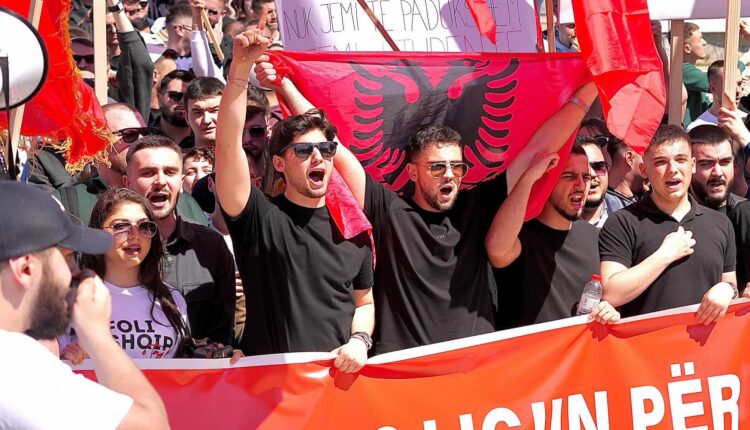
Recently, slogans in support of the UCK were once again heard – this time in the center of Skopje – reviving deeply painful memories.
On this occasion, Albanians took to the streets, referencing the events of 2001 and demanding that the bar exam for Albanian graduates of law faculties be conducted in their mother tongue (a demand not foreseen by the Ohrid Framework Agreement).
Notably, hundreds of participants arrived by bus from Tirana and Kosovo, giving the protest a broader pan-Albanian dimension and drawing attention and concern in neighboring Balkan capitals, in Brussels, and among regional analysts.
Aleksandar Srbinovski, a journalist and analyst from North Macedonia, writing in Vreme warned that: “It’s no longer an internal student issue, it’s a coordinated political pressure that crosses our borders and anyone who seriously follows the geopolitics of the region must clearly see that.”
The historical divide between Albanians and Slav-Macedonians has long contributed to instability since the establishment of what is now North Macedonia in 1991, a key country in Balkan geopolitical balances.
The rise of the nationalist-populist VMRO-DPMNE party, alongside renewed questioning of agreements with neighboring countries (Bulgaria and Greece) and internal arrangements with the Albanian community – on which the country’s current multiethnic framework is based – creates potentially destabilizing conditions with wider regional implications.
Source: eKathimerini