


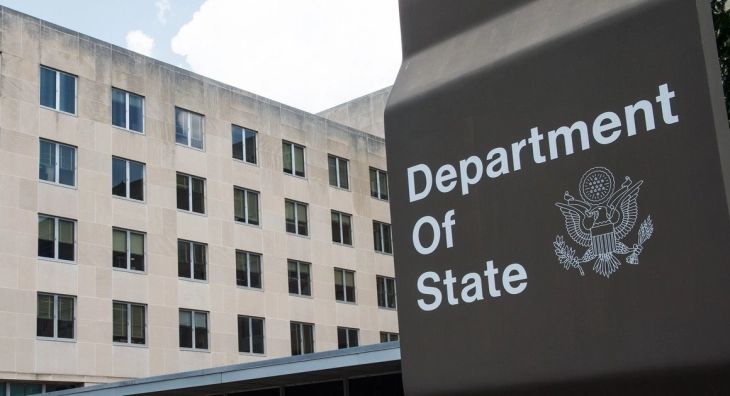
The United States is shifting its Western Balkans policy toward a more transactional approach focused on regional stability, economic cooperation, security partnerships and direct U.S. interests, according to a report to Congress.
The report says Washington’s engagement with Albania, Bosnia and Herzegovina, Kosovo, Montenegro, North Macedonia and Serbia will no longer be centred on rescue, reconstruction or long-term international supervision.
Instead, the administration says it wants locally driven solutions, stronger commercial ties and a reduced dependence on outside intervention.
“The U.S.-led nation-building era has passed,” the report says, adding that Washington remains ready to support the region where its involvement is welcomed and advances U.S. interests.
The first pillar of the policy is stability. The report says unresolved disputes, ethnic divisions and weak institutions continue to threaten progress across the region.
In Bosnia and Herzegovina, Washington says it remains committed to the Dayton Peace Agreement, the country’s sovereignty and territorial integrity. It says U.S. diplomacy helped end Bosnia’s most serious political crisis since the 1992-1995 war and will continue pressing local actors to avoid destabilising moves.
On Kosovo and Serbia, the United States says it will keep encouraging both sides to normalise relations and reach a durable agreement acceptable to both parties.
Security cooperation remains a central part of the strategy. The report says Albania, Montenegro and North Macedonia have strengthened NATO through their membership, while the United States will continue encouraging military modernisation and higher defence spending.
Washington also says U.S. forces will continue participating in NATO’s Kosovo Force, describing KFOR as essential for a safe and secure environment in Kosovo.
A second major pillar is economic and commercial cooperation. The report presents the Western Balkans as a region of 18 million people with strategic transport routes, natural resources, a growing technology sector and a skilled workforce.
The administration says it will work with U.S. agencies to promote American companies, improve the business climate, reduce regulatory barriers, strengthen contract enforcement and ensure transparent procurement.
Energy is identified as a major strategic concern. The report says dependence on Russian energy remains a vulnerability and that U.S. liquefied natural gas, nuclear technology, small modular reactors and renewable energy could offer alternatives.
Priority projects mentioned include the Southern Interconnection gas pipeline between Croatia and Bosnia, a proposed Serbia-North Macedonia gas interconnector, hydropower projects in Albania, Bosnia, North Macedonia and Serbia, upgrades to Kosovo’s coal power plants and new transmission links with European markets.
The report also warns that China and Russia are exploiting instability, corruption and weak governance in the region.
It says Moscow fuels ethnic grievances, supports destabilising actors and uses energy supplies to pressure politicians. China, it says, is expanding influence through loans, trade, propaganda, elite partnerships and infrastructure projects that often lack transparency.
Organised crime is also described as a direct threat to U.S. national security. The report says Western Balkan criminal networks have links with drug cartels in the Western Hemisphere and are involved in narcotics trafficking, illegal migration networks, money laundering and illicit financial flows.
The administration says future U.S. funds will be directed toward programmes that produce clear and measurable benefits for American interests.
That means more support for commercial deals, market access, investment reforms, law enforcement operations, cybercrime investigations, border security, arms control, demining and military training.
The overall message is clear: Washington still sees the Western Balkans as strategically important, but it wants the region to carry more responsibility for its own stability while opening more space for U.S. companies, energy interests and security cooperation.