


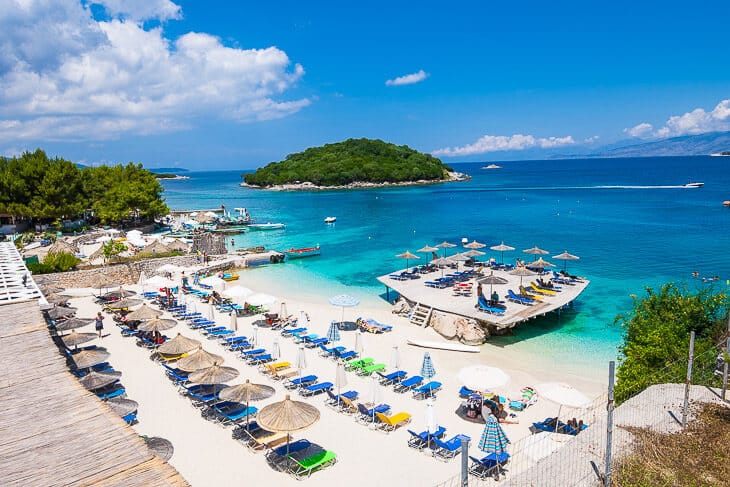
Southern Europe continues to dominate global tourism, but new data show that the Balkans are increasingly becoming one of the continent’s fastest-growing travel regions, driven by coastal tourism, lower prices and rising international visibility.
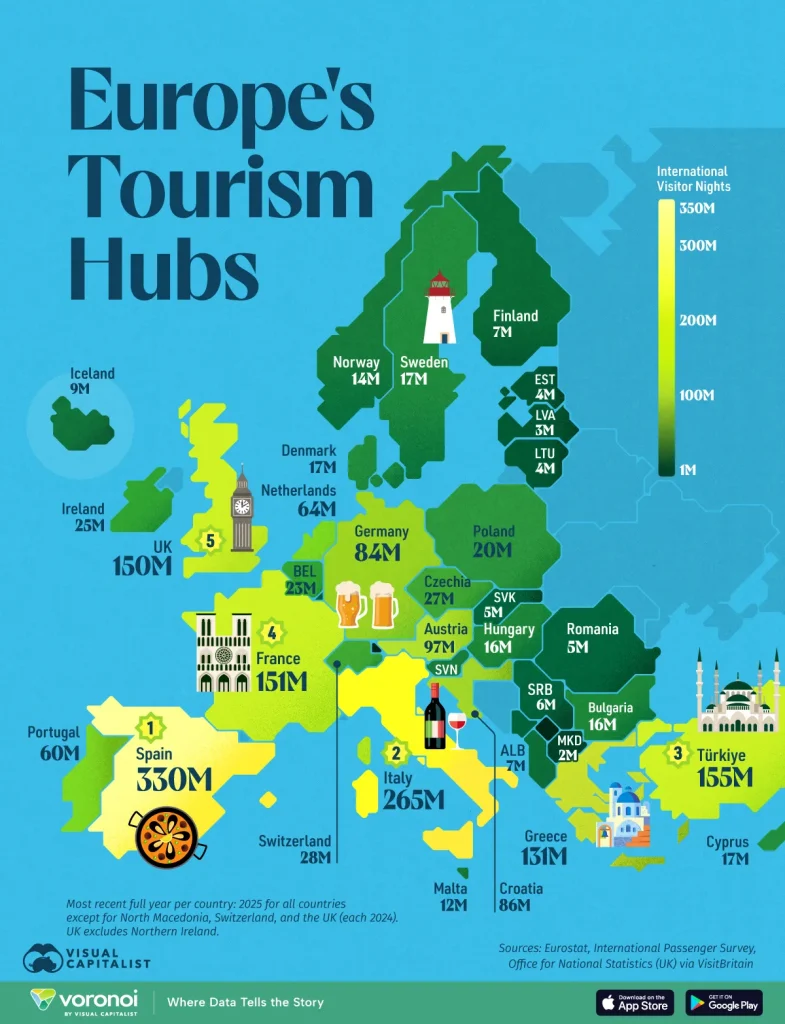
According to data compiled by Visual Capitalist using Eurostat and UK Office for National Statistics figures, several Balkan and Southeast European countries ranked among Europe’s most visited destinations by international visitor nights in 2025.
Türkiye ranked third in Europe with nearly 155 million international visitor nights, behind only Spain and Italy, underlining its position as a major tourism powerhouse linking Europe and Asia.
Greece placed sixth with more than 130 million visitor nights, while Croatia ranked eighth with over 85 million — a remarkable figure for a country of fewer than four million people.
The figures highlight the growing importance of the Adriatic and Eastern Mediterranean regions in Europe’s tourism economy, as travelers increasingly seek cheaper alternatives to traditional Western European destinations.
Croatia’s tourism boom has accelerated over the last decade, helped by global exposure from television productions, cruise tourism and major investments in coastal infrastructure. The country’s Adriatic coastline, islands and historic cities such as Dubrovnik and Split have transformed it into one of Europe’s highest-performing tourism markets relative to population size.
Greece continues to benefit from strong seasonal tourism, with islands including Santorini, Mykonos and Crete remaining among Europe’s most recognizable summer destinations. Tourism remains one of the pillars of the Greek economy after years of financial crisis and economic restructuring.
Türkiye has also consolidated its position as one of the world’s largest tourism destinations, combining beach tourism, historical heritage and large-scale urban tourism centered around Istanbul. Turkish tourism has remained resilient despite years of regional instability and economic turbulence.
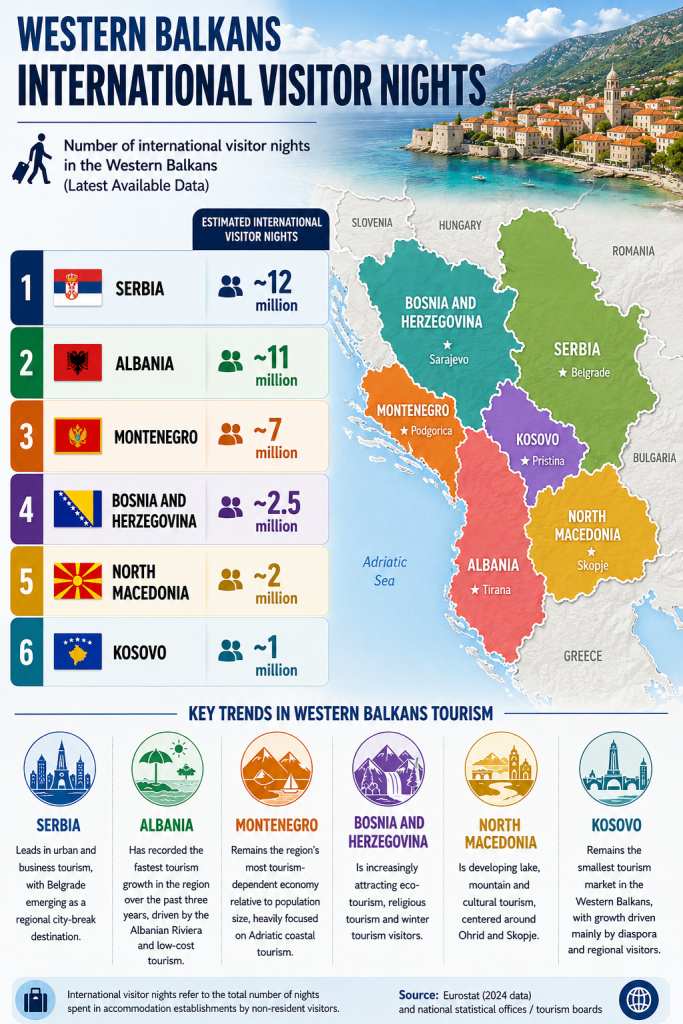
Although not included among Europe’s top 15 destinations by visitor nights, other Balkan countries are also experiencing tourism growth.
Albania has emerged as one of Europe’s fastest-growing tourism markets, driven by low-cost coastal tourism along the Albanian Riviera and rising international airline connectivity. Montenegro continues to attract high-end tourism along the Adriatic coast, while Serbia has expanded city-break and festival tourism centered around Belgrade and Novi Sad.
Bosnia and Herzegovina and North Macedonia remain smaller tourism markets but are increasingly promoting mountain tourism, cultural heritage and eco-tourism as alternatives to overcrowded Mediterranean destinations.
Analysts say the Balkans are benefiting from several structural shifts in European tourism, including rising travel costs in Western Europe, growing demand for “undiscovered” destinations and the expansion of low-cost airlines across Southeast Europe.
The data also underline the dominance of Mediterranean tourism in Europe overall.
Spain remained Europe’s most visited country with nearly 330 million international visitor nights, followed by Italy with more than 264 million. France and the United Kingdom also remained among Europe’s largest tourism markets despite cooler climates and higher travel costs.
Collectively, the European Union recorded more than 1.5 billion international visitor nights, reaffirming Europe’s position as the world’s leading tourism region.
Tourism has become increasingly important for Balkan economies, many of which rely heavily on seasonal revenues, foreign investment and service-sector growth tied to international travel.
Regional governments are now racing to expand airports, highways, hotels and energy infrastructure in an effort to sustain tourism growth while competing with established Mediterranean destinations.