


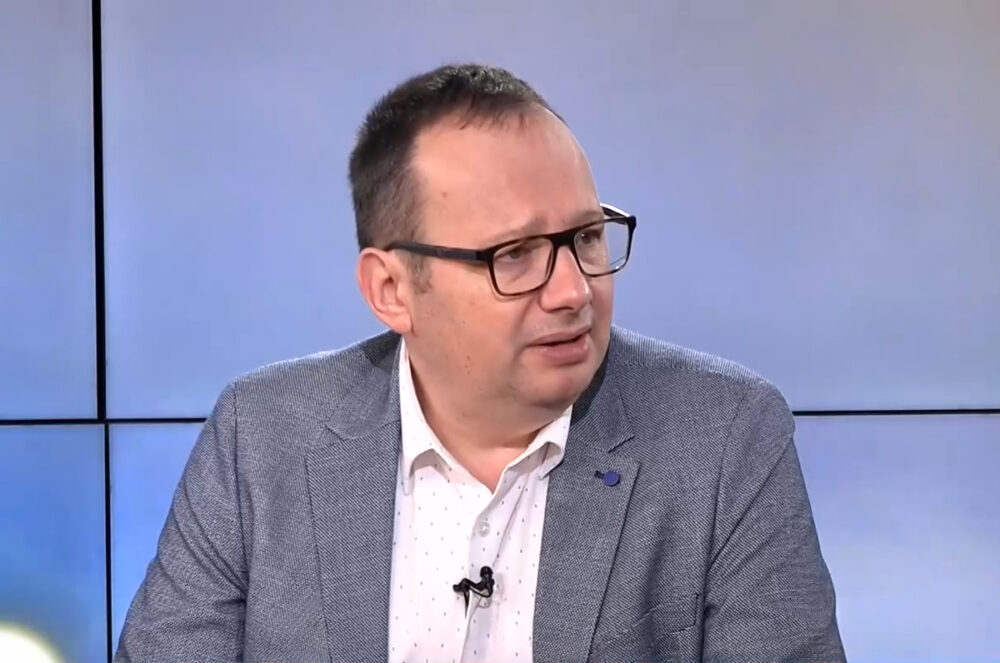
The victory of former Bulgarian president Rumen Radev and his “Progressive Bulgaria” coalition in the parliamentary elections was expected, analyst Nikolaj Krastev said in an interview with Serbian newspaper Danas, adding that the country “now has to resolve many issues,” above all “to end the trend of short-lived governments and form a stable administration.”
“It was expected that Rumen Radev would win. All polls indicated that,” Krastev said, noting that the coalition secured around 45 percent of the vote, or 132 parliamentary seats.
He added that “there were attempts of foreign influence through fake profiles on TikTok and Instagram,” following patterns seen in other electoral processes in the region.
According to Krastev, support for Radev stems from “widespread dissatisfaction with rising prices and corruption over the past 10 years,” which he links to the governments of GERB, Boyko Borisov and Delyan Peevski.
“Citizens voted against the corruption model,” he stressed.
Krastev said that protesters who toppled the government of Prime Minister Rosen Zhelyazkov in December last year “largely voted for Radev,” who had promised to fight corruption.
“Many voters who were undecided before the election ultimately gave him their support,” he added.
Radev’s victory, according to the analysis, fits into a broader pattern.
“Bulgarians tend to place their trust in new ‘saviors’ every 10 to 15 years,” Krastev said, recalling the victory of Simeon Saxe-Coburg-Gotha in 2001, followed by Boyko Borisov in 2009 and Slavi Trifonov in 2021.
The political landscape, he added, has been “significantly reshaped.”
“For the first time, the Bulgarian Socialist Party fell below the threshold,” Krastev said, adding that Borisov’s party “dropped to third place,” behind the pro-Western bloc “We Continue the Change – Democratic Bulgaria.”
This, he noted, signals that “judicial reforms must be carried out quickly.”
He added that it remains to be seen “whether Radev will maintain this winning momentum” in the presidential elections later this year and in the local elections in 2027.
On foreign policy, Krastev said “a major question remains” whether Radev will align with the eurosceptic bloc or pursue a different course.
“A large share of pro-Russian voters rallied behind Radev,” he said.
In his first statement after the election results, Radev said he supports “pragmatic relations with Russia,” while also emphasizing that his coalition “backs Bulgaria’s European path.”
“Europe needs critical thinking and pragmatic action,” Radev said, warning that the continent must not “become a victim of moral leadership in a new world without rules.”
He called for a “new security architecture” and a “return of Europe as an industrial power.”
“Without access to cheap energy resources, there can be no competitiveness,” Radev said, adding that Europe should strive for “strategic autonomy” and halt the process of deindustrialization.