


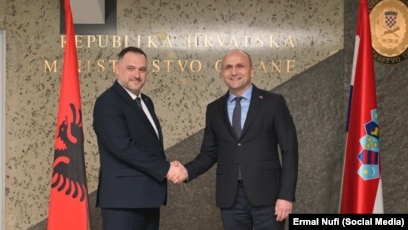
Croatia’s defence minister Ivan Anušić rejected Serbian accusations that military cooperation between Croatia, Albania and Kosovo poses a threat to regional stability, as a new exchange of statements highlighted rising tensions in the Western Balkans.
Anušić said the cooperation was aimed at strengthening stability and security in Southeast Europe and was “not directed against any third party,” responding to remarks by Serbian President Aleksandar Vučić.
“There is no basis for such claims,” Anušić said, adding that Croatia’s defence partnerships were transparent and aligned with its commitments as a member of NATO and the European Union.
His comments came after Vučić said Serbia would continue to strengthen its military capabilities, citing what he described as pressure from neighbouring countries.
Anušić confirmed he had met Albanian Defence Minister Ermal Nuka in Zagreb, where the two discussed expanding defence ties and joint capabilities.
“Our goal is peace, security and stability in Southeast Europe. That is the foundation of our cooperation,” Anušić said.
“The time when others could dictate Croatia’s policies is over,” he added.
Serbia signals military modernization push
Separately, Vučić said Serbia was entering what he described as a “revolutionary period” of military modernisation, following a meeting with senior defence officials in Belgrade.
He proposed the creation of specialised military units equipped with robotic platforms, long-range strike drones and so-called loitering munitions, as part of a broader strategy to modernise the Serbian Armed Forces.
“We will form battalion-level units with robotic systems and divisions for long-range offensive drones,” Vučić said, adding that Serbia would continue investing in surveillance, coordination and advanced combat systems.
He also announced that Serbia would sign “major and important contracts” in the coming days for the procurement of weapons and military equipment, alongside new international defence agreements.
Vučić said Serbia aimed to build a layered air defence system integrated with electronic warfare capabilities, enabling the country to monitor and respond to complex operations across the region.
“We will have the capacity to monitor everything – from strategic aviation in the region to complex long-distance operations,” he said.
Background and regional tensions
Croatia, Albania and Kosovo signed a joint declaration on defence and security cooperation last year, outlining plans to enhance coordination, training and strategic dialogue. Officials in all three countries have repeatedly stressed that the initiative is not directed against any state.
However, Serbian authorities have portrayed the cooperation as a potential security concern, particularly given Belgrade’s non-recognition of Kosovo’s independence.
Serbia maintains military neutrality but has significantly increased defence spending in recent years, acquiring advanced missile systems, drones and air defence equipment while balancing ties between the European Union and partners such as Russia and China.
Analysts warn of escalating rhetoric
Analysts say the latest developments point to a growing security narrative in the region, where political messaging and military signalling increasingly overlap.
Edward Joseph of Johns Hopkins University warned that repeated references to external threats could create a “manufactured sense of insecurity,” potentially used to justify increased military spending and political consolidation.
“Persistent and exaggerated alarms about regional threats are concerning, especially when not supported by clear evidence,” he said.
Experts add that Serbia’s push toward advanced military technologies, including unmanned systems and robotics, raises questions about long-term strategic intentions in a region still marked by unresolved disputes.
Fragile balance
While no immediate escalation is expected, diplomats say such rhetoric risks reinforcing mistrust and complicating efforts to improve regional cooperation.
The Western Balkans remains sensitive to shifts in security policy, with NATO members such as Croatia and Albania closely aligned with Western defence structures, while Serbia continues to pursue a multi-vector foreign policy.
Maintaining dialogue and avoiding inflammatory narratives will be critical to preserving stability, analysts say, as the region navigates renewed geopolitical uncertainty. (BV)