


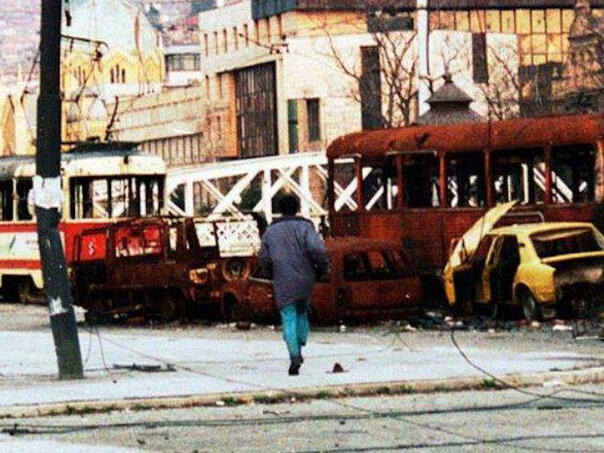
Bosnia marked the 34th anniversary of the start of the Siege of Sarajevo on Sunday, with calls for remembrance, accountability and reconciliation as the legacy of the 1992–1995 war continues to shape the region.
Bosnian journalist and columnist of Radio Sarajevo, Dragan Bursać, said the anniversary should serve as a moment for moral reckoning, describing the siege as “one of the darkest chapters” in the history of the Serbian people.
“For such acts, it is impossible to seek forgiveness, but it is possible to finally condemn the perpetrators in human terms,” he said, urging a break from the legacy associated with wartime leaders Ratko Mladić and Radovan Karadžić.
He called for extending a hand to Sarajevo’s citizens and said “we must all work together to earn the respect of Sarajevo,” while urging acts of remembrance for victims of the conflict.
LONGEST SIEGE IN MODERN WARFARE
The siege began on April 5, 1992, and lasted 1,425 days, making it the longest siege of a capital city in modern history. Around 350,000 residents were trapped under constant shelling and sniper fire from positions in the surrounding hills.
More than 11,000 civilians were killed, including about 1,600 children, while over 50,000 people were wounded, according to historical data and court findings.
The first victims of the siege were two women shot during peace demonstrations on a central Sarajevo bridge on the opening day of the blockade. The last recorded victim was killed in January 1996, shortly before the siege formally ended.
During the conflict, an estimated 500,000 projectiles were fired at the city, with some of the heaviest bombardments recorded in 1993. Two separate attacks on the Markale marketplace in 1994 and 1995 killed and wounded dozens of civilians.
Civilian infrastructure, including hospitals, cultural landmarks and media buildings, was heavily damaged or destroyed. Among the sites hit were the city hall, the Olympic Museum and newspaper offices, as well as residential areas across the city.
LIFE UNDER SIEGE
Residents endured severe shortages of food, water and electricity, improvising daily survival methods. Makeshift oil lamps lit homes during blackouts, while water was collected from public points often targeted by shelling.
Sniper fire became a constant threat, with civilians frequently killed or wounded while crossing streets or even inside their homes.
Despite the conditions, many residents resisted and organised the defence of the city, often with limited resources in the early stages of the war.
WAR CRIMES CONVICTIONS
International tribunals later ruled that the campaign against Sarajevo’s civilian population constituted a deliberate strategy of terror.
Former Bosnian Serb military commander Stanislav Galić was sentenced to life imprisonment for crimes related to the siege, while his successor Dragomir Milošević received a 29-year sentence.
Karadžić and Mladić were also sentenced to life imprisonment for, among other crimes, the terror campaign against civilians in Sarajevo.
ENDURING LEGACY
Commemorations across Bosnia included ceremonies, tributes and public reflections, underscoring how the siege continues to influence political discourse and collective memory.
Bursać called on people visiting Sarajevo to lay flowers in memory of victims, saying their lives were “woven into the city’s streets.”
The siege remains a defining symbol of the war in Bosnia, reflecting both the scale of civilian suffering and the resilience of those who endured it.