


North Macedonia has solid technical preparation for European Union membership but remains politically blocked, risking a widening gap with neighbors already advancing in accession talks, the head of a Skopje-based think tank said in an interview.
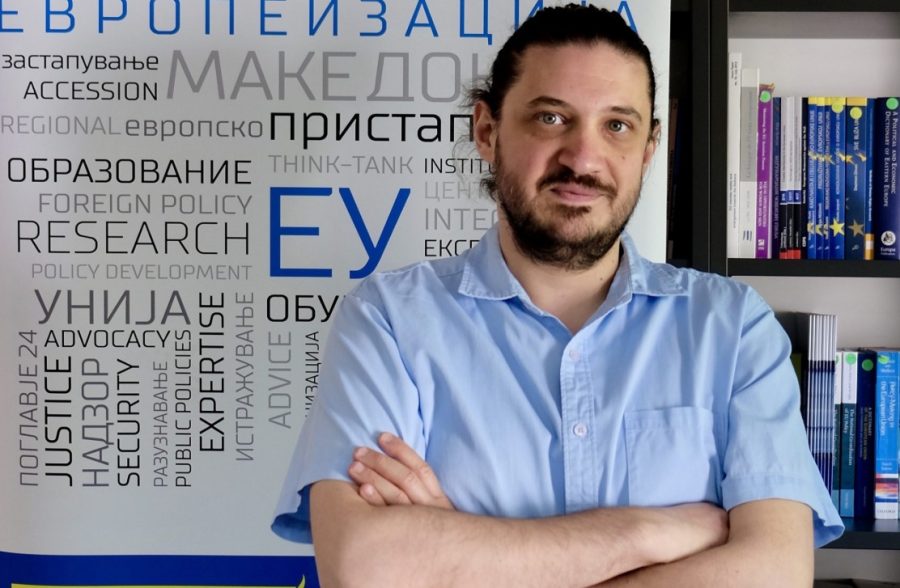
In an interview with Balkanview, Executive Director of Eurothink Dimitar Nikolovski said the country faces a combination of external political blockages and insufficiently implemented domestic reforms, particularly in rule-of-law areas that form the foundation of the EU accession process.
Balkanview: From the perspective of an independent think tank, how do you assess North Macedonia’s current position in the EU integration process compared with Albania? Is the country really ahead, as authorities claim, even though it has not started negotiations?
Dimitar Nikolovski: From the perspective of an independent think tank, North Macedonia does have a relatively high level of technical preparedness in parts of the EU acquis and a long administrative tradition of alignment with EU standards.
However, Albania is currently ahead in terms of the dynamics of the negotiations themselves.
In our case, the process is stuck in a political and institutional blockage. The screening process has been completed, but opening the first negotiating cluster depends on constitutional amendments. The European Commission has clearly noted that screening is finished and that the Council set conditions for opening Cluster 1 after the constitutional changes are adopted.
So the claim that we are “ahead”, despite not actually moving forward in negotiations, is more a domestic political narrative than a measurable reality within the EU enlargement methodology.
Balkanview: To what extent can North Macedonia’s stagnation be explained by external blockages, and how much is linked to a lack of internal reforms, especially within the “Fundamentals” cluster?
Dimitar Nikolovski: External blockages are a real factor and should not be dismissed, especially because they shift the process away from criteria-based evaluation toward bilateral political issues.
But if we want an honest analysis, stagnation cannot be explained solely by external obstacles.
The “Fundamentals” cluster — rule of law, democratic institutions, public administration, and fundamental rights — is where the EU measures results most closely. In these areas, we have often delivered reforms that are partial and insufficiently sustainable.
Even when external obstacles are removed, the core challenge remains institutional implementation, independence, accountability, and capacity.
Balkanview: The European Commission’s latest report notes limited progress in the rule of law. What are the main structural weaknesses that Skopje has failed to overcome?
Dimitar Nikolovski: The weaknesses are structural rather than purely technical.
First, there are persistent concerns about the integrity and independence of the judiciary, including perceptions and practices of political influence, selective justice, and limited accountability. The European Commission again emphasises the need for an efficient and independent judiciary as a cornerstone of EU values.
Second, corruption risks remain high in the public sector. The issue is not only legislation but also weaknesses in investigations, prosecutions, asset confiscation, and institutional coordination.
Third, institutional sustainability remains low. Reforms often depend on political cycles and are sometimes reset after elections instead of becoming embedded within the system.
Finally, public administration capacity remains limited, particularly in human resource management and policy implementation, which directly affects the country’s ability to implement EU legislation.
Balkanview: Is there a gap between formally adopting laws and implementing them in practice?
Dimitar Nikolovski: Yes, this gap is one of the most serious challenges.
Very often, we have legislation adopted on paper but weak secondary legislation, insufficient budgets, limited staff, incomplete IT systems, and weak inspection capacity to enforce those laws effectively.
The European Commission’s 2025 report points to several areas with incomplete implementation and repeats recommendations from previous years. That is a signal that reforms are either progressing slowly or remain largely cosmetic.
In Brussels, this is seen as a credibility issue. It is not enough to show that you know what needs to be done. You also have to demonstrate that the state can deliver results and sustain them.
Balkanview: How seriously is North Macedonia addressing its commitments under the EU Green Agenda?
Dimitar Nikolovski: In practice, it is often treated as a checklist exercise — a strategy, an action plan, or donor-funded project — rather than a genuine transformation of development policy in energy, industry, transport, waste management, water systems, and biodiversity.
The real test is whether the Green Agenda is linked to actual budgets, institutional authority, and effective enforcement of environmental standards.
The European Commission explicitly highlights the need to strengthen administrative and inspection capacities for implementing the environmental acquis.
So the challenge is not declarations, but execution.
Balkanview: How problematic is it that political elites often present the country as a “victim of injustice” in the EU process?
Dimitar Nikolovski: Politically, it may be understandable, but strategically, it is damaging.
If the entire narrative is reduced to injustice, two things happen.
Domestically, institutions feel less pressure to implement reforms because the perception is that nothing depends on internal performance.
Externally, the message sent to partners is that the country expects political sympathy rather than demonstrating results.
North Macedonia has indeed faced unfair obstacles. But the most effective strategy is a dual approach: firmly insisting that bilateral issues should not dominate the accession process while simultaneously delivering strong domestic reforms.
Balkanview: How does stagnation in EU integration affect the daily lives of citizens?
Dimitar Nikolovski: EU integration is not symbolic. It is a mechanism that pushes the state to become more functional.
When the process stagnates, the consequences are tangible.
Economically, uncertainty reduces investor confidence and encourages young people to see emigration as a rational choice.
Institutionally, reforms slow down or become diluted.
And in terms of quality of life, problems such as pollution, weak public services, corruption, and unequal treatment by institutions become more entrenched.
Balkanview: If the current pace continues, is there a risk that North Macedonia could fall behind Albania?
Dimitar Nikolovski: If nothing fundamentally changes, there is indeed a risk that the country could remain behind for a prolonged period. Albania has already opened negotiating clusters and, by late 2025, opened the final remaining cluster, meaning it is moving into a phase where the focus is on closing chapters rather than opening them.
But this is not predetermined.
North Macedonia could restore credibility relatively quickly if two things happen: a political decision to unblock the process and tangible results in the “Fundamentals” cluster.
In the end, the European Union responds primarily to two things: predictability and delivered reforms.