


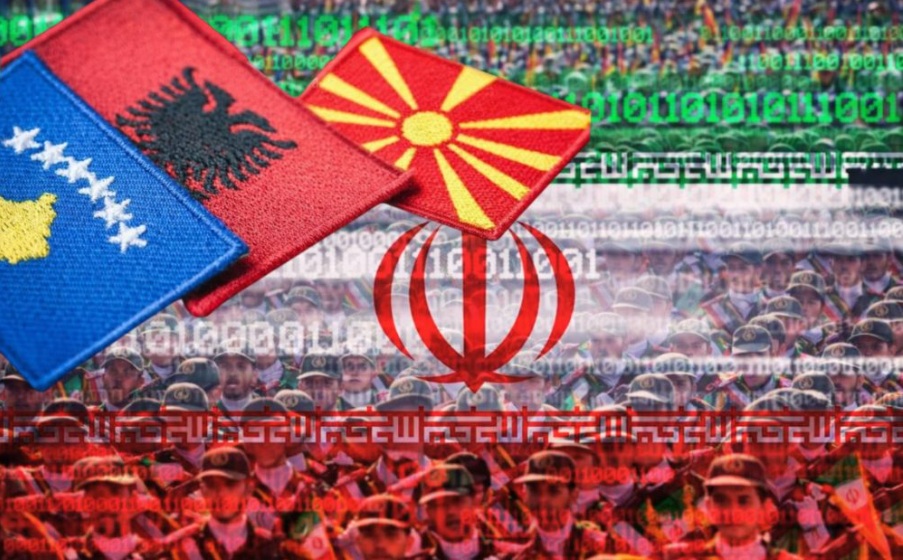
The Islamic regime appears increasingly battered by lethal American-Israeli strikes. As the American operation code-named “Epic Fury” and the Israeli “Lion’s Roar” enter their fourth day, a small but visible front seems to have opened on Albanian soil as well.
Across the digital spaces of Kosovo, Albania and North Macedonia, a dozen pages, profiles and self-styled analysts have sprung to the defense of the theocratic regime in Tehran. Many go further — spreading fierce anti-American rhetoric among Albanians, some even calling for Iranian missiles to target Camp Bondsteel in Kosovo.
NACIONALE has chronicled a little-noticed dimension of this “Iranian front” among Albanians, where dangerous anti-Western narratives are being carefully stitched together.
By Col Mehmeti
On Sunday morning, at precisely 9:45 a.m., a lightning strike from the sky caught the entire hierarchy of the ayatollah’s regime off guard.
In what former CIA Director David Petraeus described as a “stunning display of arrogance,” the Supreme Leader had gathered his security chiefs at his palace. The 86-year-old cleric, black turban atop his head, reportedly began speaking about the end of the Zionist regime — when his words were cut short by a violent khaa-boom.
Precision missiles rained down, etching into history an “unbelievable operation” that future military historians will study for generations.
Retired U.S. General Jack Keane called it “brilliantly executed.” Yet dense pro-Iranian propaganda in Albanian sees the war through a different lens.
According to several figures presented in certain Tirana studios as “security experts,” America and Israel have their days numbered before a mighty Iran that is merely preparing to slap its enemies into submission.
In reality, the joint American-Israeli campaign has already struck over 2,000 targets inside Iran, dismantling much of the regime’s leadership pyramid from Ali Khamenei downward.
Paradoxically, parts of the Albanian media sphere insist that Iran is racing toward certain victory.

Wonder No. 1: “A missile will fall on Durrës”
About a week ago, Tirana-based analyst Ilir Kulla speculated on possible Iranian retaliation. On the program “Matrix” on TËVË 1, he suggested that Tehran would reciprocate every strike — including, potentially, firing a missile at Durrës, where the MEK dissident camp is located.
“I think they will send one of their missiles to Durrës, to that famous base,” Kulla warned ominously.

Wonder No. 2: “The U.S. will tire, Iran is very strong”
Another commentator, Dritan Goxhaj, speaking on “Jashtë Kontrollit” on NTV, portrayed Iran as capable of exhausting the United States in a prolonged war.
“America should calculate carefully,” he said. “This will not be a short war. A long war benefits Iran, not the U.S., which lacks capacity for a prolonged conflict. They’ll run out of Tomahawks in ten to fifteen days.”
The certainty of such claims stood in stark contrast to military realities.


Wonder No. 3: “Iranians ready for unlimited war”
Known for his open sympathy toward Tehran, Olsi Jazexhi has been omnipresent across Albanian television. On Facebook and live broadcasts alike, he has circulated half-verified claims of Iranian “successes,” warning that Iranian missiles could strike Albania as well.
“This war has no limits,” he said on MCN TV. “The Iranians have made up their minds.”
For him, Israeli Prime Minister Benjamin Netanyahu will bear the cost of a war he initiated.

The Tears of Ikballe
More restrained but symbolically potent was pro-Iranian activist Ikballe Berisha-Huduti from Prizren. In a post invoking Shiite martyrdom, she wrote:
“Rest in peace, leader of humanity,” referring to Khamenei.

Iran’s Digital Volunteers
Since Sunday’s strikes, Albanian digital space has been flooded with dozens of pages and profiles amplifying pro-Iranian narratives. Many carry overtly religious content and circulate dubious videos or half-verified “updates” reversing the reality on the ground.
Preliminary mapping suggests the most active sources originate in North Macedonia and Kosovo. A Facebook page titled “Lajme nga Bota,” with over 10,000 followers, warned that “Kosovo may face a missile storm” targeting Bondsteel. The post garnered hundreds of supportive interactions.
Similar calls have appeared on Telegram in Serbian, including one account openly publishing coordinates of Bondsteel with the message: “Here is another American base! Grateful in advance.”
The anti-Kosovo rhetoric has also spilled into Bosnia, where accounts such as “Bosnia Reporter” lashed out after President Vjosa Osmani expressed support for the United States.

From North Macedonia to Albania: Anti-Western Undercurrents
Several Facebook pages from North Macedonia — including “TetovaSot” and “Video Tetova1” — have amplified pro-Iran content. Kosovo-based page “Dovleti i Naltsum” blends neo-Ottoman and pro-Turkish messaging, sharing clips of Turkish President Recep Tayyip Erdoğan and Foreign Minister Hakan Fidan, alongside Russian President Vladimir Putin.
In Albania, “FokusPress” has been among the most active in defending the Islamic regime.

A Difficult History
The roots of Albanian-Iranian relations stretch back decades. In 1979, Enver Hoxha’s regime was among the first to express diplomatic sympathy for the Khomeinist revolution.
By the late 1990s, Tehran sought influence in Kosovo and North Macedonia, opening cultural centers and embassies. Yet in 1999, Iran aligned diplomatically with Belgrade, opposing NATO’s intervention to stop ethnic cleansing in Kosovo.
Scholars like Henry H. Perritt have described the Kosovo Liberation Army’s refusal of Iranian overtures as a remarkable act of strategic discipline, preserving Western support.


Source: Nacionale.com