


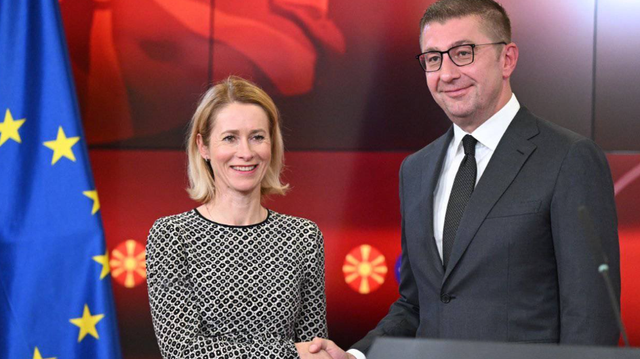
North Macedonia could join the European Union as early as 2027 under a model that would not initially grant the country voting rights, Prime Minister Hristijan Mickoski said, describing the idea as part of wider discussions in Europe linked to Ukraine’s post-war integration.
Mickoski said a proposal increasingly discussed in Brussels envisages accelerated EU integration for Ukraine after the end of the war, accompanied by parallel steps for Western Balkan countries to avoid creating political imbalance in the enlargement process.
“There is an idea that is being heard more loudly in Brussels, connected to the peace plan for Ukraine,” Mickoski said in an interview with local television Kanal 5. “Ukraine’s integration would proceed on a fast track for reconstruction after the conflict. That would be unprincipled toward the Western Balkans, so scenarios are being considered that include us as well.”
Fast-track model under discussion
Under one scenario outlined by Mickoski, Ukraine, along with North Macedonia, Albania and Montenegro, could enter the bloc at the beginning of 2027 and participate in EU institutions without voting rights during an initial phase.
He said such a model would require alignment with the EU’s common foreign and security policy — which he said Skopje has already largely achieved — as well as further progress on the rule of law.
The prime minister’s comments come days after he said Skopje had not yet received a formal proposal regarding accession without veto rights, adding that the government would engage only once concrete terms were presented.
“When something serious comes on paper, we can discuss it more,” he said earlier this week.
Constitutional changes could be part of package
Mickoski indicated that constitutional amendments — a longstanding condition for advancing accession talks — could be included in any broader agreement, noting that previous governments had already accepted such obligations.
A second scenario being discussed could widen the framework to include other regional aspirants such as Bosnia and Serbia, as well as Moldova, he said, reflecting what he described as rapidly changing geopolitical circumstances.
“The world is changing dynamically, and we must anticipate those changes and adapt,” Mickoski said.
Government seeks progress, but not “under pressure”
Mickoski said his government remained committed to unblocking the EU accession process but would not accept arrangements it viewed as unfavorable or imposed under pressure. He added that North Macedonia’s arguments were gaining clearer understanding internationally.
The country’s EU path has been stalled by disputes with neighboring Bulgaria and by the requirement to amend the constitution to include recognition of a Bulgarian minority, a step that needs a parliamentary supermajority.
Mickoski reiterated that constitutional changes would not proceed without guarantees, including protections for what he described as the rights of ethnic Macedonians in Bulgaria and assurances that bilateral disputes would not be used to block future accession steps.
Political divisions persist at home
The prime minister also criticized the opposition, saying internal divisions could weaken the country’s negotiating position, and signaled little room for consensus with opposition leaders who support swift constitutional amendments to advance EU talks.
North Macedonia has been an EU candidate for nearly two decades, but progress toward membership has been slow, reflecting both domestic reform challenges and broader enlargement fatigue within the bloc.
European officials have not publicly confirmed the scenarios described by Mickoski, and any change to enlargement methodology would require agreement among all EU member states.