


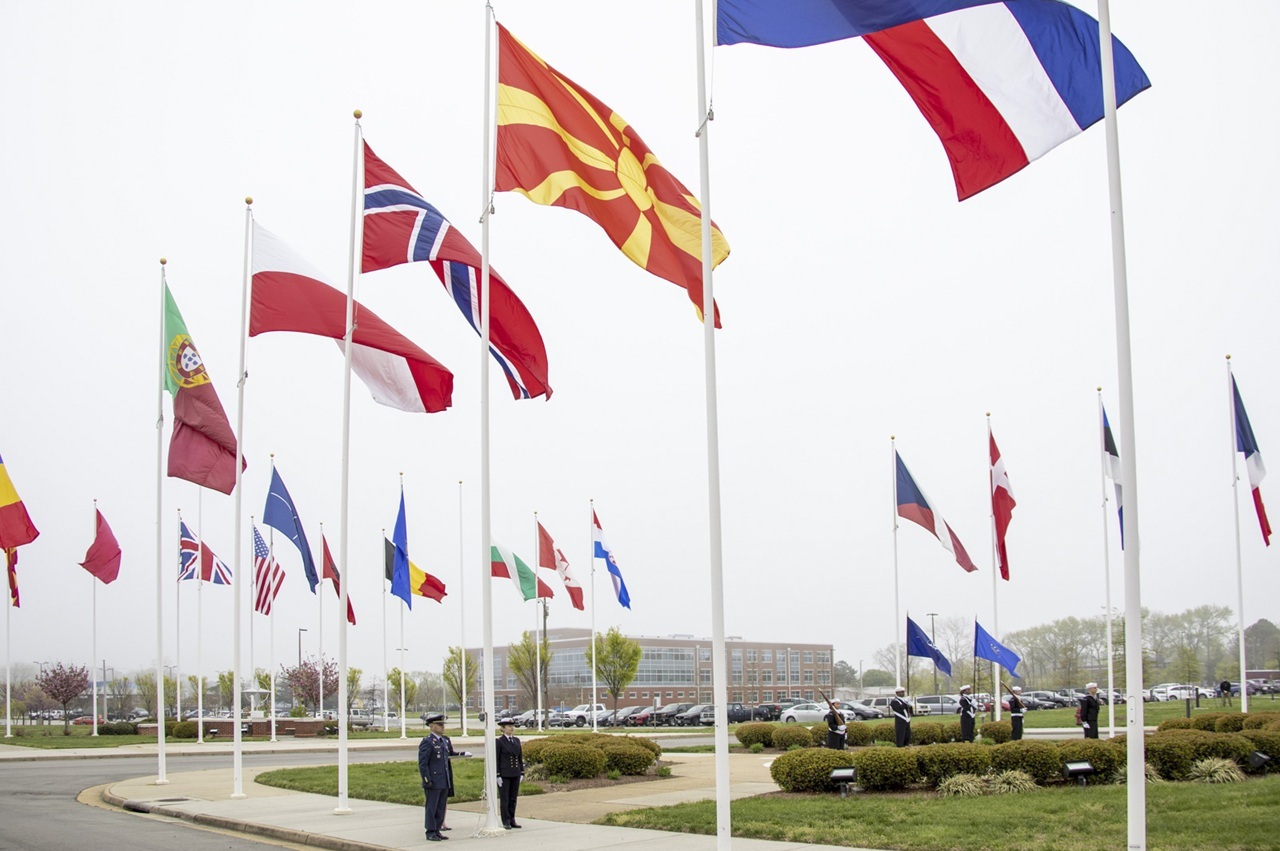
For small states, history rarely arrives gently. It comes as pressure – geopolitical, economic, and existential – forcing choices that define generations. North Macedonia’s path into NATO was one such choice: not merely a diplomatic achievement or military alignment, but a transformation of how the country understands stability, sovereignty, and its place in Europe.
More than five years after joining the Alliance in 2020, the debate inside North Macedonia has shifted. The question is no longer whether NATO membership was worth it, but what it has actually done – economically, politically, and psychologically – to a country long suspended between aspiration and vulnerability.
A group of economists, politicians, and former officials now describe NATO membership less as an endpoint than as an organizing framework shaping investment flows, democratic reforms, and even the state’s sense of survival.
Security as Economic Policy
Academician Abdylmenaf Bexheti approaches NATO from an economist’s vantage point rather than a military one. The numbers, he argues, tell a story that political rhetoric often obscures.
Between 2020 and 2023 — years marked globally by pandemic disruption — North Macedonia attracted roughly €2.1 billion in foreign direct investment. Much of it came from Western countries, particularly NATO members and European Union economies, as well as from investments from the United States and Turkey.
The timing matters. NATO accession coincided with renewed industrial expansion, particularly in the automotive supply chain, where Western European manufacturers deepened their presence. For investors, NATO membership functioned as a certification of geopolitical predictability — an invisible but powerful guarantee.
Yet Bexheti cautions against easy triumphalism. Falling unemployment statistics partly reflect emigration rather than domestic transformation. Employment itself has grown only modestly, with roughly 10,000 to 15,000 new jobs concentrated in export-oriented industries.
Economic growth, however, has accelerated. For two decades before NATO membership, average GDP growth hovered around 2.1 percent. After accession, it climbed closer to 3 percent annually — a difference that economists attribute largely to rising exports and investment confidence.
The structure of trade reinforces the geopolitical shift: roughly 80 percent of North Macedonia’s exports now flow toward NATO countries, with the European Union accounting for the majority.
Security alignment, in other words, has quietly become an economic strategy.
Stability as a Market Signal
The most valuable benefit of NATO membership may be something economists struggle to quantify: stability.
Membership lowers borrowing risk. Countries inside collective security systems obtain more favorable financing conditions, longer debt maturities, and greater investor confidence. For a small economy facing rising fiscal needs, this translates into tangible advantages in international capital markets.
Yet stability also creates new obligations. NATO expectations require rising defense spending — potentially increasing expenditures toward 3 percent of GDP or beyond. In the short term, this presents fiscal pressure. In the long term, proponents argue, it opens industrial opportunities, from textiles and logistics to food supply chains capable of serving NATO procurement systems.
North Macedonia, however, is not yet technologically prepared to capture these gains fully. Domestic firms remain limited by competitiveness gaps and technological capacity, highlighting a paradox: membership creates opportunity faster than economies can absorb it.
NATO Beyond the Military
To understand NATO’s deeper impact, former parliamentarian Ismet Ramadani traces the story back to 1993, when Macedonia’s parliament unanimously adopted its first pro-NATO resolution. At the time, the decision faced virtually no political opposition — an extraordinary consensus in a region often defined by fragmentation.
The strategic orientation toward NATO and the European Union became twin pillars of state identity.
But accession demanded internal transformation. Annual reform plans submitted to NATO exposed weaknesses in governance: politicized courts, corruption, ethnic tensions, and institutional fragility. Military reform required dismantling remnants of Yugoslav-era structures resistant to change.
NATO integration, paradoxically, became a mechanism for domestic democratization.
Ramadani argues that the Alliance functions as a political system as much as a military one — embedding democratic norms, institutional transparency, and intelligence oversight into member states.
The effect is subtle but profound: leadership positions in security institutions now require NATO-level certification, ensuring compatibility with allied intelligence systems and reducing vulnerability to foreign infiltration.
Intelligence, Influence, and Hybrid Threats
Membership also reconfigured North Macedonia’s exposure to geopolitical competition.
Shared intelligence, cyber-defense cooperation, and hybrid-threat monitoring have strengthened resilience against foreign interference. NATO support helped establish structures capable of identifying cyberattacks and disinformation campaigns — capacities the country previously lacked.
Officials describe a new security reality: threats are less likely to arrive as armies and more likely as data breaches, influence operations, or ethnic polarization amplified through external actors.
The Alliance provides not just protection but early warning — allowing the country to act “one step ahead,” as former Defense Minister Slavjanka Petrovska puts it.
In an era where hybrid threats blur war and politics, access to shared information may be NATO’s most valuable currency.
Collective Defense and Small-State Survival
For Trajan Gocevski, North Macedonia’s first defense minister, NATO membership resolves a problem that haunted the country at independence: survival without military capacity.
When Yugoslavia collapsed, the newly independent state possessed neither a functioning army nor control over its own territory. Foreign troops remained present even after independence was declared, and international recognition was uncertain.
The path toward NATO, begun in 1992, stretched nearly three decades.
Today, collective defense replaces vulnerability. North Macedonia’s airspace is protected by allied aircraft from neighboring NATO states. Article 5 — the principle that an attack on one member is an attack on all — provides security no small country could independently afford.
As Gocevski bluntly notes, even decades of national defense budgets could not purchase capabilities equivalent to those provided through alliance membership.
Democracy, Identity, and the Atlantic Anchor
Perhaps the most consequential change is psychological.
NATO membership reshaped how North Macedonia imagines its future at a moment when European Union accession appears distant. For many policymakers, the Alliance has become the primary anchor of Western integration — sustaining democratic expectations even as EU enlargement slows.
The benefits extend beyond security guarantees: increased institutional cooperation, intelligence sharing, joint exercises, and participation in decision-making structures where even small states hold formal equality through consensus rules.
North Macedonia cannot dominate NATO policy. But it possesses a voice — and, crucially, a veto — alongside global powers.
The Unfinished Transformation
The country’s NATO story ultimately reveals a broader lesson about modern alliances. Membership does not instantly solve structural problems. It does not eliminate corruption, halt emigration, or guarantee prosperity.
What it does provide is a framework within which solutions become more plausible.
Security attracts investment. Cooperation strengthens institutions. Shared intelligence reduces vulnerability. Democratic norms gain external reinforcement.
NATO, in this sense, did not simply secure North Macedonia’s borders. It altered the incentives shaping its political and economic evolution.
For a small state navigating a fragmented global order, that may be the most consequential transformation of all: not protection alone, but the ability to plan the future with fewer existential uncertainties.