


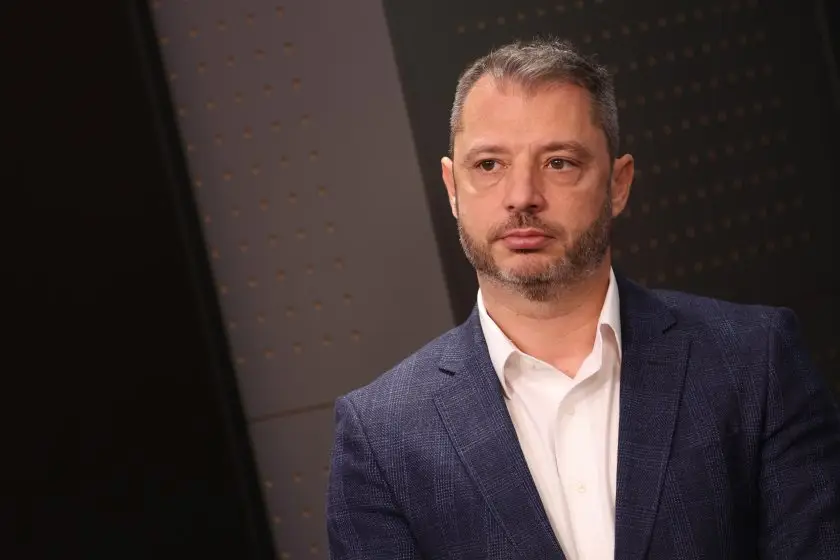
Bulgaria’s ruling centre-right party GERB on Sunday denied media reports that senior lawmaker Delyan Dobrev had resigned from the party, with a top official saying no such move had been formally submitted and dismissing speculation of internal rifts.
Kostadin Angelov, deputy speaker of parliament and a senior figure in GERB, told reporters that as of Sunday no resignation had been filed by Dobrev, who has been one of the party’s prominent faces in recent years.
“No such information has reached us,” Angelov said, responding to media publications suggesting that Dobrev might step down from the party. “Mr. Dobrev is one of the recognizable politicians of GERB. Together we have achieved many of the policies we have fought for over the past years.”
Angelov added that any decision by Dobrev to resign would be a personal act and “should not be a reason for political speculation,” stressing that the party remained cohesive despite pressure on its members.
“All of us have families and children and are under enormous pressure in parliament,” he said. “We face insults, slander and hate speech. Very often we have to explain at home what exactly we do and what is happening.”
Dobrev Rejects Exit Reports
Hours later, Dobrev himself publicly denied that he was leaving the party. In a post on Facebook, he said reports of his departure were untrue.
“It is not true that I am leaving GERB. I remain in the party and will continue to help each one of you with whatever I can,” Dobrev wrote, adding: “There is nothing true in what is circulating in the public space. Dear opponents, do not rush to celebrate.”
The exchange followed a day of heightened political tension in Sofia, where several domestic issues have dominated headlines, including the removal of a village mayor convicted of vote-buying and ongoing disputes over law enforcement actions in a high-profile criminal case.
Party Unity Under Scrutiny
GERB, led by long-time political figure Boyko Borissov, has been a dominant force in Bulgarian politics for more than a decade, alternating between government and opposition amid repeated elections and shifting coalitions. The party has often portrayed itself as a stable, pro-European formation committed to fiscal discipline, euro adoption and strong transatlantic ties.
Angelov rejected suggestions of internal conflict, saying he had not witnessed any tensions within the party or with its leadership.
“From a political standpoint, GERB is a very large political formation. Many people have left, many have joined. GERB has always remained monolithic and strong, because the strength of our party is not in individuals,” he said. “The strength is in the team and in the results we achieve together.”
He described attempts to frame the reports as evidence of internal strife as “a harmful path” driven by speculation rather than facts.
Broader Political Context
The reports come at a sensitive time for Bulgaria’s political landscape. The country has faced years of fragmented parliaments, caretaker governments and public frustration over corruption and governance standards. Debates over euro adoption, defence spending and judicial reform continue to shape the domestic agenda.
GERB has sought to project stability amid these pressures, particularly as Bulgaria navigates economic adjustments and broader European security debates. Party officials say unity within its ranks is essential as the country approaches key policy milestones and potential electoral developments.
For now, both party leadership and Dobrev have sought to close the door on speculation, insisting that no resignation has been tendered and that GERB remains intact.
Bulgaria has been pushed into another period of political uncertainty as the country prepares for snap parliamentary elections after its most recent governing coalition collapsed amid mass protests and parties repeatedly failed to form a new majority. The government led by Prime Minister Rosen Zhelyazkov resigned in December 2025 in the face of widespread demonstrations against corruption and economic policy, and successive attempts by leading parties to take on the task of forming a government were declined, triggering the constitutional process for early elections. In response, President Iliana Iotova – now acting after the resignation of President Rumen Radev earlier this year – appointed senior central bank official Andrey Gyurov as interim prime minister to lead a caretaker cabinet charged with preparing a free, transparent snap vote set for April 19, 2026. Bulgaria’s current snap election will be the eighth in five years, underscoring deep political fragmentation and ongoing tensions over governance, anti‑corruption reforms and public trust as the country recently entered the eurozone.