



By Dragan Danilovski, PhH
On January 5, U.S. health authorities published a revised version of the vaccines that are federally recommended for children and adolescents.
Under the new schedule, the number of diseases for which there is a “universal recommendation” for vaccination is reduced from 17 to 11. Some vaccines – such as those against rotavirus, influenza, hepatitis A and B, meningococcal disease and COVID-19 – have been moved into categories that apply only to high-risk groups or are placed under so-called “shared clinical decision-making,” meaning an individualized assessment through discussion with a physician.

In the United States itself, this change has sparked significant debate. Several professional associations, including the American Academy of Pediatrics and the American Medical Association, have publicly expressed concern that the changes could lead to reduced coverage and the re-emergence of diseases that have been declining for decades. Some of the criticism also relates to the transparency of the process, which this time differs from the usual, careful procedure followed by the Immunization Committee (ACIP).
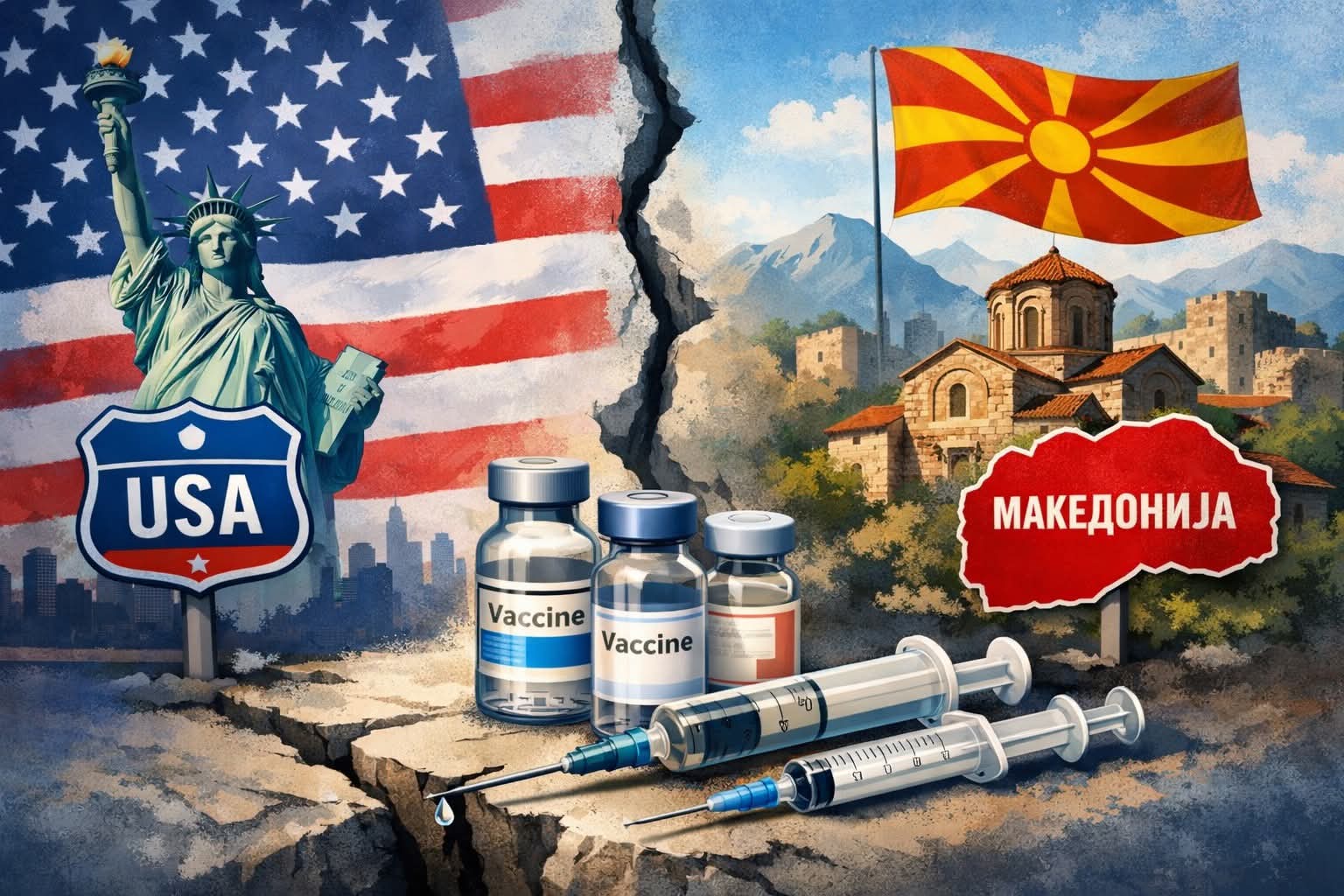
But the key question for us is the following: what do these changes mean for North Macedonia? Should we be concerned? And should we expect any impact on our vaccination calendar?
The answer is clear: for our country there is no immediate implication, nor is there a reason for premature comparisons. However, it is necessary to provide professional context – precisely because of the sensitivity of the topic and trust in vaccination.
Vaccination calendars are not globally uniform – they are locally adapted.
Each country builds its vaccination calendar based on the following elements:
- which diseases are actually circulating in the country;
- the level of risk of severe outcomes among unvaccinated children;
- the safety and effectiveness profile of specific vaccines;
- the level of coverage, trust and access to primary health care.
North Macedonia and the United States have completely different epidemiological conditions.
Over the past decade, our region has faced several measles outbreaks; hepatitis A circulation is periodically higher than in countries with very similar calendars; rotavirus gastroenteritis continues to cause a significant hospital burden. In addition, there is a so-called residual risk of hepatitis B in our country, especially among unvaccinated adult groups, which further underscores the rationale for early vaccination.
In other words, there is no universal calendar that applies to all countries. Not even the European Union has a single vaccination calendar – each country has its own priorities, precisely because of local epidemiology.
In North Macedonia, there are no changes to the immunization program. Combination vaccines – such as MMR (measles, mumps, rubella) – remain routine and are not in question. They are part of global standard practice and are supported by data collected over decades. Combination vaccines reduce the number of injections, ease logistics, improve coverage, and are safe and effective.
It should also be emphasized that the American changes do not mean that any vaccine has become “bad” or “unnecessary.” These are merely changes in the classification of recommendations, not in the scientific evidence regarding vaccine effectiveness or safety.
In our context, the risks of the return of previously controlled diseases are real. Any reduction in coverage – under the influence of confusing international signals or manipulated interpretations – could lead to renewed outbreaks.
Message to parents: Our recommendations remain unchanged; vaccines remain the strongest protection.
Any news from abroad inevitably creates dilemmas for some parents. That is why it is important to say clearly and unequivocally:
- Our vaccination calendar remains the same. The same applies to the timing of administration, combination vaccines, and the obligations arising from the Law on Protection of the Population from Infectious Diseases.
- Children in North Macedonia should receive vaccines according to their age – as before. These vaccines protect them from diseases that continue to circulate in our region.
- “Shared decision-making” does not mean “it should not be given.” It is a decision-making model specific to the U.S. health system and is not part of our normative or organizational context.
- Trust in vaccines should be based on scientific facts, not on partial interpretations of foreign decisions.
It is important for parents to ask questions – but to seek answers from pediatricians and official professional bodies, not on social media.
Message to institutions: proactive communication is needed
Although North Macedonia has no obligation or reason to react to the U.S. decision, it would be useful for health institutions to provide a brief clarification. To explain the situation in our country and prevent unnecessary confusion among Macedonian parents. Not to comment on the policies of another country.
Because when it comes to such sensitive topics, silence creates space for speculation. And trust in immunization is built and maintained through timely, transparent and professional communication.
In conclusion:
No country should automatically copy another country’s vaccination calendar. Vaccination policy must be “tailor-made” to its own epidemiology, its own health infrastructure and its own population.
North Macedonia must remain committed to a rational, science-based approach: high coverage with routine vaccines, clear recommendations, a stable calendar and an informed public. And every international development – including this one – should be viewed soberly and with an understanding of the local context.