



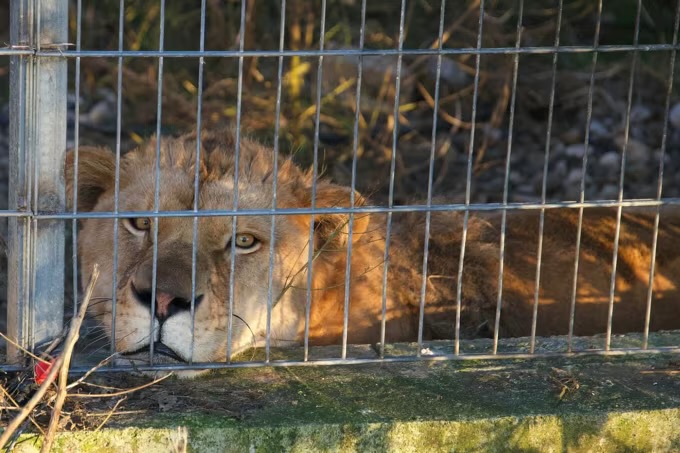
A lion and a bear rescued from illegal private captivity in northern Albania arrived at animal sanctuaries in Germany in early December, after authorities discovered they were being kept as pets on a private estate, an international animal welfare group said.
The animals – Erion, a three-year-old lion, and Flora, a two-year-old bear – were confiscated after Albania’s National Forestry Agency traced the lion through videos posted on social media by its owner. Authorities have not identified the person who kept the animals.
The rescue operation was carried out by Four Paws, an international animal welfare organisation, whose veterinarians sedated the animals before transporting them in crates on a 70-hour journey across several European countries. On Dec. 13, Erion was transferred to a wild animal sanctuary in southeastern Germany, while Flora was taken to a bear sanctuary in northern Germany, the organisation said.
“We are very happy that the authorities confiscated the animals and that we now have the chance to bring them to Germany, where they can start over and live in species-appropriate conditions,” said Magdalena Scherk-Trettin, a senior project manager at Four Paws.
The organisation said both animals were found in poor condition. An initial assessment showed that Flora was malnourished and suffering from dental problems, while Erion had lost his mane for reasons that veterinarians have yet to determine.
Illegal wildlife trade remains a persistent problem in Albania and the wider region, where bears and other exotic animals are often kept in cages at restaurants or on private properties with little or no professional care, animal welfare groups say.
The origins of the two animals remain unclear. Four Paws said it believes Erion was a victim of illegal wildlife trafficking, while Flora was likely poached from the wild.
“The rescue highlights Albania’s urgent need to tackle illegal wildlife trade and the private keeping of wild animals,” the organisation said.
According to Four Paws, weak legislation, legal loopholes and poor enforcement have contributed to the widespread captivity and trade of wild animals in Albania. The group estimates that more than 60 big cats are still being kept in inadequate conditions across the country.
Under Albanian law, individuals or organisations may keep wild animals if they were born in captivity, including in zoos or specialised facilities, or if non-native species were legally acquired from licensed breeders. Animals can be confiscated if welfare or veterinary standards are not met, but the law does not provide for sanctions against owners of exotic pets, Four Paws said.