


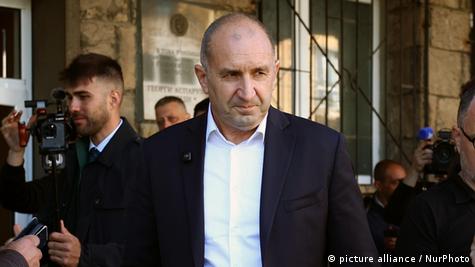
Former president Rumen Radev secured a decisive victory in Bulgaria’s parliamentary election, opening the way for the first single-party government since 1997.
Radev’s party, Progressive Bulgaria, won 44.59% of the vote, according to final results, giving it an outright majority in parliament.
“Progressive Bulgaria won decisively. This is a victory of hope over distrust, a victory of freedom over fear,” Radev said.
He said voters “rejected the arrogance of the old parties” and “did not fall for lies and manipulation.”
The result marks a sharp shift in Bulgaria’s political landscape after years of instability and repeated elections.
Turnout increased compared with the 2024 vote, reflecting stronger voter mobilisation.
Established parties suffered heavy losses. GERB, led by former prime minister Boyko Borissov, fell to 13.4%, its weakest result. The PP-DB coalition followed with 12.8%.
The Movement for Rights and Freedoms secured 6.6%, down from 11.5% in the previous election. The Bulgarian Socialist Party failed to pass the 4% threshold, exiting parliament for the first time since 1990.
Authorities reported widespread vote-buying allegations. Interior Minister Emil Dechev said there were 631 reports linked to DPS and 318 linked to GERB.
“I am convinced only a small part of the total amount was seized,” Dechev said, referring to more than 1.2 million euros confiscated during the campaign.
More than 370 suspects were detained. About 50 individuals with immunity were under investigation, he said.
Radev campaigned on anti-corruption measures, inflation control, stronger institutions.
He pledged a more independent foreign policy within the European Union.
“Strong Bulgaria in a strong Europe needs critical thinking. It needs pragmatism,” he said.
He said Europe must focus on energy security, industrial competitiveness.
“Europe became a victim of its ambition to be a moral leader in a world without rules,” he added.
Radev signalled openness to dialogue with Russia. He opposed military support for Ukraine in the past. He said Bulgaria would not block EU decisions but could opt out if national interests were affected.
Analysts say he faces immediate challenges. Approval of the 2026 budget. Inflation pressures linked to Middle East tensions. Judicial reform.
“There are two major expectations. Justice. Stability,” political scientist Antoni Todorov said.
Radev resigned as president earlier this year to run in the election. He built support on anti-corruption protests and discontent with political elites.
His party attracted young voters, middle-aged groups, older voters.
He also won strong support abroad. About 67% of voters who abstained previously backed him, according to estimates.
Bulgaria now enters a new phase after years of fragmented parliaments and fragile coalitions.
The direction of policy, European alignment, relations with Russia remain uncertain.