


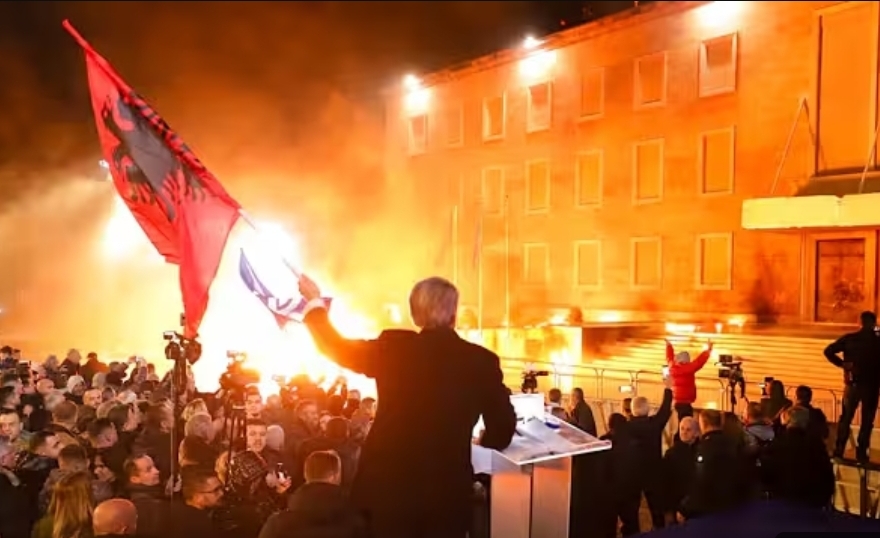
Violent clashes between police and opposition supporters erupted in Albania’s capital on Saturday as thousands of protesters rallied against Prime Minister Edi Rama’s government, accusing it of corruption and demanding his resignation.
Riot police used tear gas and water cannon to disperse crowds after protesters hurled petrol bombs, fireworks and stones at government buildings, including the prime minister’s office and the parliament, authorities and witnesses said. At least 11 police officers were injured and more than 20 protesters were detained, according to the State Police.
The protest, organised by the opposition Democratic Party (PD), lasted for nearly four hours and marked one of the most serious outbreaks of political violence in recent months in the Balkan country, which is seeking to advance its bid for European Union membership.
Video footage broadcast by local media showed flames erupting outside the government complex as Molotov cocktails exploded against walls and stairways, while police officers in riot gear formed cordons to protect key institutions. Several explosions appeared to occur close to officers, prompting police to intensify their response.
Police said they acted after repeated warnings to protesters to halt violent acts were ignored.
“In accordance with the law, police intervened to disperse the crowd after attacks using Molotov cocktails, pyrotechnics and hard objects,” the State Police said in a statement, adding that some of the injured officers were treated for burns at Tirana’s Trauma Hospital.
Opposition leaders at the forefront

The protest was led by former prime minister and Democratic Party leader Sali Berisha, who addressed supporters from the main boulevard opposite the government headquarters before violence escalated.
Holding an Albanian national flag, Berisha accused Rama of leading what he called a “criminal organisation” and said the opposition was entering the “final phase of resistance” against the government.
“The season of resistance will continue,” Berisha said after the protest ended, declaring that the demonstration had “fulfilled its mission.”
Senior PD lawmakers, including Flamur Noka, Luciano Boçi and Besart Xhaferri, were seen at the front lines of the protest as demonstrators pushed against police barricades. At one point, opposition deputies attempted to form a human barrier to block the advance of a water cannon, but were unable to stop police from dispersing the crowd.
Following Berisha’s speech, protesters moved from the prime minister’s office toward the parliament building, where further clashes broke out. Police again deployed tear gas and water cannon as stones and fireworks were thrown.
Authorities said one of the detained protesters was a minor, a claim that sparked additional criticism from opposition figures and civil society groups.
Government condemns violence
Prime Minister Rama condemned the protest, accusing the opposition of orchestrating violence and vandalism.
“The state will not bow to violence,” Rama said in a statement, describing the protesters as “paid mercenaries” acting under Berisha’s direction.
Taulant Balla, head of the ruling Socialist Party’s parliamentary group, said the violence was “nothing new from Sali Berisha,” and expressed hope that injured police officers would recover fully.
Security experts later cordoned off parts of the government and parliament compounds, treating them as crime scenes while investigators documented damage and collected evidence of incendiary devices used during the clashes.
Burn marks, shattered glass and debris were visible around the buildings hours after the protest ended.
Political tensions running high

Saturday’s demonstration came amid heightened political tensions in Albania following a legal dispute involving Deputy Prime Minister Belinda Balluku, who was temporarily suspended from office by a special anti-corruption court. Prime Minister Rama has appealed the decision to the Constitutional Court, which has yet to issue a ruling.
The opposition has seized on the case as evidence of what it describes as systemic corruption within the government, while Rama’s allies accuse the opposition of exploiting judicial decisions to destabilise the country.
The protest was the second nationwide rally organised by the Democratic Party this month, underscoring deep political polarisation in Albania more than a year after parliamentary elections consolidated the Socialists’ grip on power.
International observers have repeatedly urged Albania’s political leaders to avoid violence and engage in dialogue, warning that instability could undermine reforms required for EU accession talks.
As night fell, police said the situation in central Tirana had largely calmed, though tensions remained high. Authorities said investigations were continuing and further arrests could follow.