



From North Macedonia and Kosovo to Serbia, Albania, Bosnia and Herzegovina and Montenegro, women continue to face deadly violence despite years of legal reforms. Official figures reveal thousands of domestic violence complaints, dozens of killings and a persistent gap between reporting abuse and receiving effective protection.
SKOPJE/PRISTINA, Nov. 8 (BalkanView) – When 17-year-old Biljana Ćirić from North Macedonia and 49-year-old Arlinda Zekaj from Kosovo sought protection from violence, they turned to institutions established to keep them safe.
Both were subsequently killed.
Their deaths have triggered protests and demands for accountability, exposing a problem extending far beyond the two countries: across the six Western Balkan economies, women continue to be killed by partners, relatives or other perpetrators, often against a background of previous violence, threats or institutional intervention.
Data from governments, women’s rights organisations, the United Nations and the Organisation for Security and Co-operation in Europe (OSCE) show that domestic and gender-based violence remains a major regional challenge.
Yet the statistics also reveal another weakness: the six states do not consistently measure femicide and domestic violence using the same definitions, making it difficult to establish the true regional scale of the problem.
Two killings, one question: Could the victims have been protected?
In North Macedonia, protesters marched through central Skopje on November 8 following the killing of Ćirić, whose body was discovered in the trunk of a burned-out vehicle in Bogdanci.
According to the informal initiative “Not One More!”, which organised the demonstration, the teenager had previously reported violence and death threats, and protective measures had been imposed.
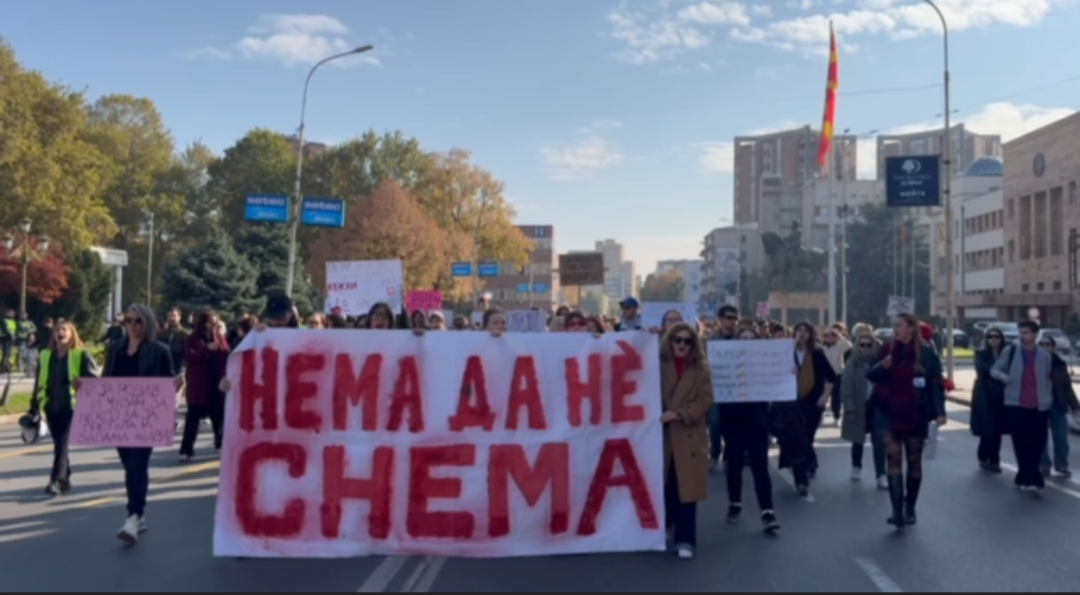
The activists demanded an investigation into whether police, prosecutors and other institutions had responded adequately to those warnings.
“When a girl asks for protection and is then murdered, that is a question of concrete responsibility,” protest participant Elena Petrova said.
In Kosovo, Zekaj was killed on October 25 in the village of Vitomirica, near Peja, shortly after police officers had driven her home following another complaint about threats.
According to an investigation published by Deutsche Welle, Zekaj had repeatedly reported threats from her husband and his relatives.
A court had issued a protection order against her husband, but the arrangement allowed him to remain in the family home subject to distance restrictions.
Three days before her death, Zekaj reported that her brother-in-law, Albert Sylaj, had threatened to kill her.
On the night of October 25, police dropped Zekaj at her home at 8:58 p.m. At 9:10 p.m., officers responding to an emergency call found her dead. She had been attacked with an axe.
Sylaj was arrested two days later and placed under investigation for murder.
The killing sparked demonstrations across Kosovo, with protesters accusing institutions of failing to respond adequately to repeated warnings.
Several police officials and a prosecutor involved in handling Zekaj’s complaints were suspended. Prime Minister Albin Kurti acknowledged that certain institutions had failed.
The two cases have intensified demands for independent investigations into the decisions taken before the killings.

The regional picture: Thousands of reports, dozens of deaths
They Reported Violence. They Were Killed. The Femicide Crisis Exposing Failures Across the Western Balkans
From North Macedonia and Kosovo to Serbia, Albania, Bosnia and Herzegovina and Montenegro, women continue to face deadly violence despite years of legal reforms. Official figures reveal thousands of domestic violence complaints, dozens of killings and a persistent gap between reporting abuse and receiving effective protection.
SKOPJE/PRISTINA, Nov. 8 (BalkanView) – When 17-year-old Biljana Ćirić from North Macedonia and 49-year-old Arlinda Zekaj from Kosovo sought protection from violence, they turned to institutions established to keep them safe.
Both were subsequently killed.
Their deaths have triggered protests and demands for accountability, exposing a problem extending far beyond the two countries: across the six Western Balkan economies, women continue to be killed by partners, relatives or other perpetrators, often against a background of previous violence, threats or institutional intervention.
Data from governments, women’s rights organisations, the United Nations and the Organisation for Security and Co-operation in Europe (OSCE) show that domestic and gender-based violence remains a major regional challenge.
Yet the statistics also reveal another weakness: the six economies do not consistently measure femicide and domestic violence using the same definitions, making it difficult to establish the true regional scale of the problem.
Two killings, one question: Could the victims have been protected?
In North Macedonia, protesters marched through central Skopje on November 8 following the killing of Ćirić, whose body was discovered in the trunk of a burned-out vehicle in Bogdanci.
According to the informal initiative “Not One More!”, which organised the demonstration, the teenager had previously reported violence and death threats, and protective measures had been imposed.
The activists demanded an investigation into whether police, prosecutors and other institutions had responded adequately to those warnings.
“When a girl asks for protection and is then murdered, that is a question of concrete responsibility,” protest participant Elena Petrova said.
In Kosovo, Zekaj was killed on October 25 in the village of Vitomirica, near Peja, shortly after police officers had driven her home following another complaint about threats.
According to an investigation published by Deutsche Welle, Zekaj had repeatedly reported threats from her husband and his relatives.
A court had issued a protection order against her husband, but the arrangement allowed him to remain in the family home subject to distance restrictions.
Three days before her death, Zekaj reported that her brother-in-law, Albert Sylaj, had threatened to kill her.
On the night of October 25, police dropped Zekaj at her home at 8:58 p.m. At 9:10 p.m., officers responding to an emergency call found her dead. She had been attacked with an axe.
Sylaj was arrested two days later and placed under investigation for murder.
The killing sparked demonstrations across Kosovo, with protesters accusing institutions of failing to respond adequately to repeated warnings.
Several police officials and a prosecutor involved in handling Zekaj’s complaints were suspended. Prime Minister Albin Kurti acknowledged that certain institutions had failed.
The two cases have intensified demands for independent investigations into the decisions taken before the killings.
The regional picture: Thousands of reports, dozens of deaths
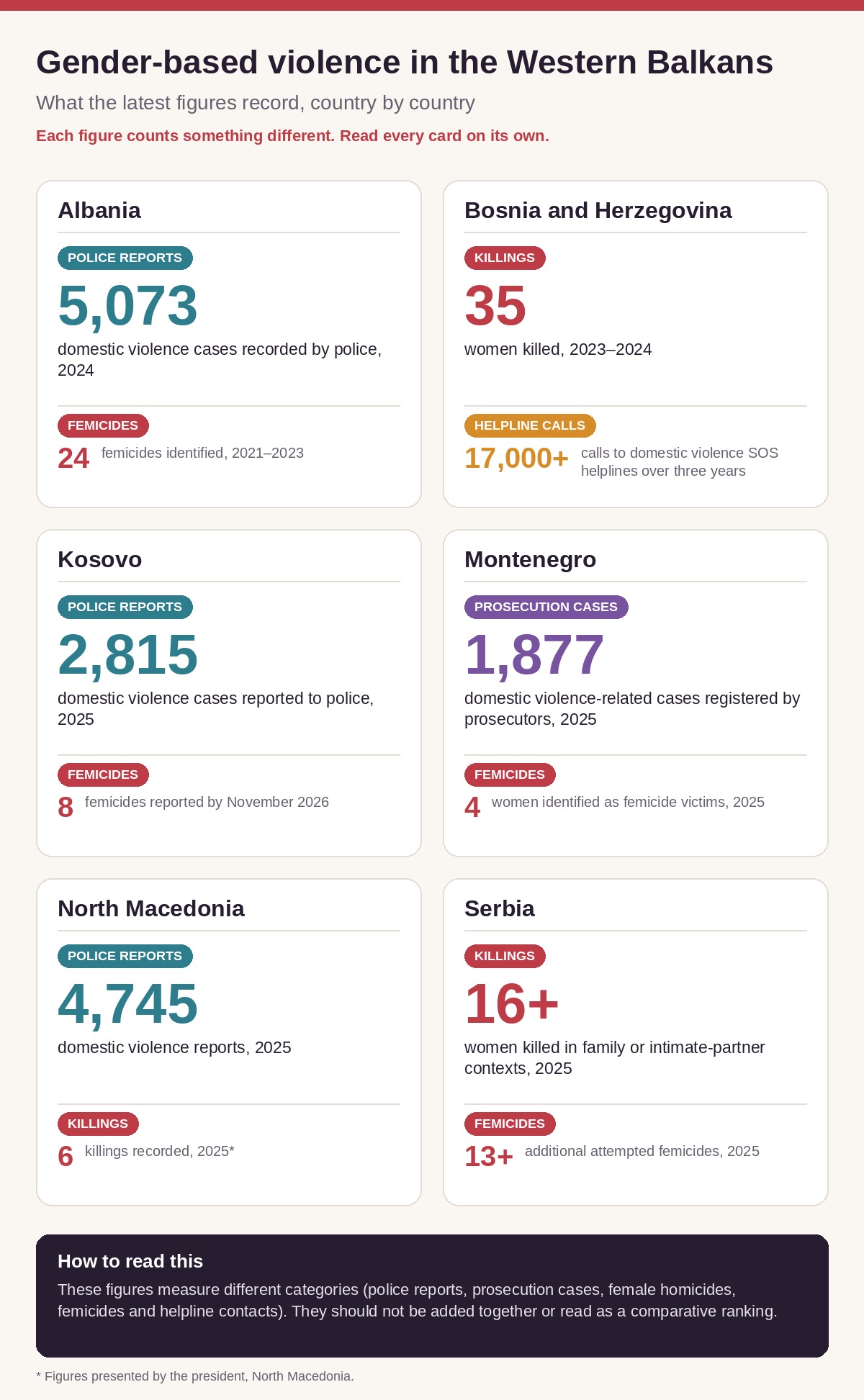
Available figures from the six Western Balkan economies reveal the scale of reported violence, although differences in definitions and reporting periods prevent direct comparisons.
Albania: Nine in ten femicide victims had previously suffered violence
Albania provides some of the region’s most detailed research into gender-related killings.
The country’s Femicide Observatory, established within the Ombudsperson’s Office in 2024 with support from UN Women, identified 24 femicides among 32 killings of women and girls between 2021 and 2023.
Approximately 90% of those femicide victims had previously experienced violence by their perpetrators.
However, only six of the 24 victims had reported the abuse to police, according to the findings.
Two were subject to protection orders or emergency protection orders when they were killed.
Four women were murdered shortly after their perpetrators had been released from prison following sentences for domestic violence.
The findings point to two related problems: many victims never reach the authorities, while some who do report violence remain exposed to serious danger.
Police data recorded 5,073 domestic violence cases in Albania in 2024, compared with 4,641 in 2023.
The observatory is intended to improve coordination between police, prosecutors, courts and other institutions and help identify preventable patterns in killings.
Bosnia and Herzegovina: Women continue to be killed despite legal reforms
Bosnia and Herzegovina recorded 35 killings of women in 2023 and 2024, according to data collected from prosecutors by the country’s Agency for Gender Equality.
Of those, 31 occurred in the Federation of Bosnia and Herzegovina and four in Republika Srpska.
The Office of the High Representative reported that 12 women were killed by partners or family members in 2024 alone.
Over a three-year period, domestic violence SOS helplines received more than 17,000 calls, illustrating the demand for assistance outside formal criminal justice procedures.
Bosnia and Herzegovina has pursued legislative reforms aimed at strengthening protection from domestic violence, including measures in the Federation.
However, activists continue to raise concerns about the availability of shelters, coordination between authorities and enforcement of protective measures.
The country’s complex institutional structure also presents challenges for collecting consistent nationwide statistics and delivering uniform protection.
Serbia: Half of the perpetrators had reportedly been reported before
In Serbia, the Autonomous Women’s Centre documented at least 16 women killed in family or intimate-partner contexts during 2025.
It also recorded at least 13 attempted femicides.
In eight of the 16 fatal cases, perpetrators had previously been reported for violence, according to the organisation’s analysis.
At least five perpetrators had previously been detained or convicted in connection with domestic violence or other violent crimes.
Nine victims were killed by current or former husbands or partners, while five were killed by their sons.
The organisation said the findings demonstrated that criminal convictions and formal legal procedures did not necessarily translate into effective protection.
Serbia has legal mechanisms for emergency intervention and coordination between institutions. Women’s rights organisations have nevertheless repeatedly questioned how authorities monitor repeat offenders and assess escalating threats.
Montenegro: Rising case numbers expose weaknesses in the protection system
Montenegro registered 1,877 domestic violence-related cases in prosecutorial records during 2025, according to the State Prosecutor’s Office.
The number of proceedings increased sharply compared with previous years.
Four women were identified as victims of femicide in 2025, according to figures presented during a public discussion on the issue.
The authorities also recorded seven fatal outcomes associated with domestic violence during the year, a broader category that should not be confused with the number of femicides.
Experts have warned that the absence of a fully functioning unified domestic violence database makes it difficult to determine the precise number of reported incidents and monitor institutional responses.
The increase in recorded proceedings may reflect changes in reporting, prosecution practices or enforcement, rather than necessarily proving that the underlying prevalence of violence has risen by the same proportion.
North Macedonia and Kosovo: Protection orders under scrutiny
In North Macedonia, President Gordana Siljanovska-Davkova said in March that institutional prevention had failed, citing four femicide cases in the first two months of 2026.
She presented figures showing 4,745 domestic violence reports and six killings in 2025.
The killing of Ćirić has renewed debate about whether existing protection measures are sufficiently enforced.
Liberal Democratic Party leader Monika Zajkova has launched a petition calling for electronic monitoring bracelets for perpetrators subject to restraining orders.
The party says parliament rejected proposed legislative changes twice.
The proposal would allow authorities to detect violations of distance restrictions and alert victims and police. Its effectiveness would depend on reliable monitoring, rapid intervention and adequate institutional capacity.
In Kosovo, the Ministry of Justice’s domestic violence database recorded 2,815 cases reported to police in 2025.
Deutsche Welle reported that Zekaj’s death was the eighth femicide in Kosovo during 2026.
According to figures cited in its investigation, 55 women had been killed by partners or family members in Kosovo since 2010.
The latest protests have focused particularly on whether authorities properly assessed the danger facing Zekaj and whether responsibility should extend beyond the officers and prosecutor already suspended.
A regional problem that official statistics cannot fully capture
The OSCE’s major survey on women’s well-being and safety, conducted in 2018 and published in 2019, included all six Western Balkan economies alongside Moldova and Ukraine.
Across the surveyed territories, 70% of interviewed women reported experiencing some form of violence since the age of 15.
The survey also found that 45% had experienced sexual harassment since that age.
These figures are not a Western Balkans-only estimate and should not be presented as current annual prevalence rates. They nevertheless provide evidence of the broader scale of violence that is not captured by police statistics.
Reporting rates are influenced by trust in institutions, economic dependence, social stigma, access to support services and fear of retaliation.
An increase in police complaints can therefore indicate greater willingness to report abuse, changes in recording practices or an actual increase in violence. The number alone cannot establish which explanation is correct.
Why laws are not enough
Across the Western Balkans, governments have introduced legislation, protective orders, criminal penalties and support services intended to combat domestic and gender-based violence.
Yet the cases in North Macedonia and Kosovo illustrate the questions that arise when violence continues after warnings have been reported.
Effective prevention requires more than registering complaints or issuing restraining orders.
Authorities must assess the seriousness of threats, identify repeat offenders, respond to breaches of protective measures and ensure that police, prosecutors, courts and social services share relevant information.
Victims also need safe accommodation, legal assistance, psychological support and financial options that make it possible to escape abusive relationships.
UN Women and the United Nations Office on Drugs and Crime have emphasised coordinated risk assessment, specialised justice responses and reliable data collection as essential elements of femicide prevention.
Their global research estimated that approximately 50,000 women and girls were killed by intimate partners or other family members in 2024 — an average of 137 every day.
The missing regional mechanism
The Western Balkans share a geographical space, similar social challenges and the common objective of closer integration with the European Union.
Yet the region still lacks a single, consistently applied statistical system that would allow policymakers and researchers to compare femicide cases and institutional responses across all six economies.
Albania’s Femicide Observatory offers one possible model for systematic monitoring.
A coordinated regional approach could build on such initiatives by establishing common statistical definitions, tracking previous reports of violence and examining how authorities responded before fatal attacks.
Comparable information could help identify recurring institutional weaknesses, assess the effectiveness of protection orders and inform policy reforms.
Such cooperation would not replace national responsibility for preventing violence or prosecuting crimes.
It could, however, make it harder for repeated warning signs to disappear into fragmented administrative records.
From Skopje to Pristina: Protesters demand accountability, not condolences
The protests in North Macedonia and Kosovo have exposed a crisis of confidence in institutions responsible for protecting victims of violence.
In Skopje, demonstrators demanded individual accountability for institutional failures, stronger legal protections and sanctions against officials found responsible for negligence.
In Pristina, protesters demanded investigations and resignations, arguing that repeated failures require more than disciplinary action against individual officials.
Whether particular authorities breached their legal obligations must be established through independent investigations and due process.
But the broader regional evidence raises a question that goes beyond any single criminal case.
When a woman reports violence, what must happen next to ensure that her complaint becomes effective protection rather than another warning recorded before her death?
For the Western Balkans, answering that question may be a more meaningful measure of institutional progress than the number of laws adopted or strategies announced.
The challenge is not only to punish perpetrators after a killing. It is to build institutions capable of intervening before the next one.