


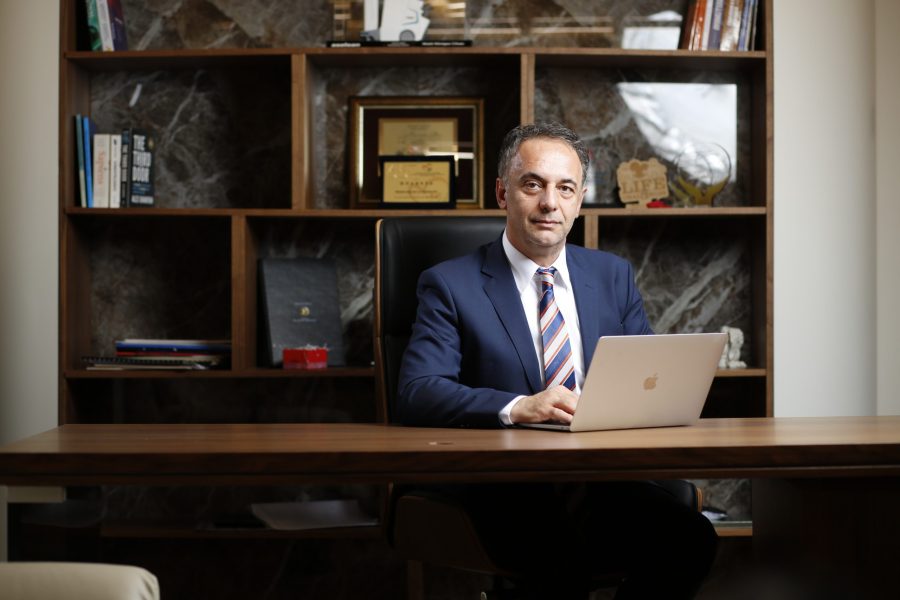
By Azir Aliu
Before, during, and after International Workers’ Day – May 1 – the media and public space each year fill with words we utter with varying intensity: labor, wages, dignity, rights, security.
The intention behind these messages is good – to remind us of the need to respect the worker and to advance their overall dignity within the system.
But what does it truly mean to respect the worker?
Our collective memory and experience most often tie respect for the worker to the level of wages, working hours, the right to rest, social security, and their voice in society.
But in the time we live in, that is no longer enough.
The worker is not merely an economic category, nor a number in statistics measuring the productivity of the processes in which they participate with their labor.
He is a human being with a body that tires, with a heart that reacts to pressure, with lungs that breathe the air we leave him, with a family to which he must return not only sufficiently paid, but also healthy.
That is precisely why the worker’s health does not end with the paycheck.
This sentence carries greater weight today than before, because the conditions in which work is performed are changing faster than our habits and institutional reflexes.
What we once called “harsh weather conditions” is increasingly becoming a health risk.
Heat is no longer just a climatic issue discussed during the summer months, but a matter of labor, public safety, emergency medicine, and preventive healthcare.
For a long time, we recognized the climate crisis as an issue of nature: of forests, rivers, agriculture, energy, and the environment.
But its most concrete language is increasingly not the language of climate reports, but the language of the human body: dehydration, exhaustion, heatstroke, aggravated chronic illness, accelerated pulse, difficulty breathing, impaired concentration, increased risk of injury.
In other words, the climate crisis is becoming part of the health diagnosis of our time.
It does not affect all of us equally; we each face its consequences in different, individualized ways.
Its consequences are first felt by those who do not have the privilege of easily taking shelter: the construction worker standing on concrete that reflects heat; the farmer who cannot postpone work because crops follow the rhythm of nature, not the rhythm of human social needs; the delivery worker, the road worker, the firefighter, the police officer, the worker in an industrial hall, but also the healthcare worker who, on days of increased pressure, feels heat not only as temperature, but as an additional burden on the system.
In an office, a heatwave is often an inconvenience that can be regulated with air conditioning, working from home, or adjusting the daily rhythm.
On a construction site, in the field, on the street, in a production facility, or in a vehicle without adequate conditions, it becomes something far more serious: part of the very conditions in which work is performed.
In 2025, the World Health Organization and the World Meteorological Organization warned that heat stress in the workplace is becoming a global societal challenge.
Their analyses indicate that extreme heat events are becoming more frequent and more intense, posing risks both to outdoor workers and those indoors.
The health consequences are not abstract: heatstroke, dehydration, impaired kidney function, neurological disorders, and long-term effects on people’s health and economic security.
The same analyses show that workers’ productivity decreases by 2 to 3 percent for every degree above 20°C according to the heat stress index.
In this new social context, increasingly exposed to climate change, the primary concern of the healthcare system must never be only the lost working hour.
The primary concern must be the person who may lose their health.
Through this perspective, May 1 gains a new, contemporary meaning.
Historically, it was a symbol of the struggle for working hours, wages, trade union organization, and the right of the worker not to be consumed as material in the industrial rhythm of the factory era.
Today, in the climate era, the same value-based struggle takes on a new form: the right to safe conditions in a world that is becoming hotter, more unpredictable, and harsher toward those who work with their own bodies.
North Macedonia is not outside this reality.
On the contrary, as a country exposed to heatwaves, fires, floods, and other climate risks, we must more seriously articulate climate instability as part of the health agenda.
It is important to say that we are not starting from scratch.
North Macedonia has a National Action Plan for preventing the consequences of heatwaves on public health, aimed at reducing illness and mortality related to extreme temperatures and heatwaves.
This is an important institutional foundation, as it shows that heat is already recognized as a public health risk, not merely a climatic inconvenience.
But today we must be honest: the existence of a plan, protocol, or recommendation is not enough in itself.
At a time when heatwaves are becoming more frequent, longer, and more intense, broader institutional mobilization and the development of systemic sensitivity to this issue are needed.
This means that every institution – from healthcare and labor inspections, to municipalities, employers, trade unions, schools, elderly care homes, protection and rescue services, and the media – must know when the risk begins, whom it threatens most, how warnings are communicated, and who must act specifically.
As Minister of Health, I see this issue primarily as a matter of prevention.
The healthcare system must not be only the last station, the place where a person arrives when the body has already lost the battle with heat, exhaustion, or chronic illness.
Our obligation is to recognize the risk earlier, name it more clearly, and act more systematically.
In this direction, digitalization can play a very important role as an instrument for timely warning, targeted communication, and faster response.
Around the world, digital tools are already being developed that do not merely send a general message that “it will be hot,” but provide warnings directed at specific vulnerable groups.
One such example is the MotherHeat Alert mobile application, developed within an international heat and health project, designed to warn pregnant women, postpartum women, and healthcare workers involved in maternal care when heat risk increases in their area, along with concrete advice on how to protect themselves.
This is the essence of digital prevention in healthcare – not just sending information, but delivering timely, targeted, and usable health messages.
A similar systemic logic can be developed in our country as well.
On days of high heat risk, a digital system could send timely notifications to general practitioners, municipalities, employers, healthcare institutions, elderly care homes, and citizens from the most vulnerable categories.
Employers would receive clear recommendations on working hours, breaks, water, and shelter; general practitioners would be alerted to pay attention to chronically ill and elderly patients; municipalities could activate local measures more quickly, and healthcare institutions could prepare in time for an increased number of patients with heat-related symptoms.
In this way, digitalization goes beyond the idea of administrative modernization and gains a more important function – it becomes part of public health prevention: a system that warns, connects, and guides; a system that does not wait for consequences to appear in an emergency center, but helps intercept danger where it arises – at the workplace, at home, on the street, in the community.
The best health policy is often the one that prevented someone from becoming a patient.
The International Labour Organization warns that climate change creates a “cocktail” of serious health risks for workers, with around 70 percent of the global workforce exposed to potential health risks related to climate change.
These risks are not limited to heat but also include ultraviolet radiation, air pollution, pesticides, increased risk of injury, respiratory and cardiovascular diseases, kidney disorders, and impacts on mental health.
The climate crisis shows us that health is too important to be confined within the boundaries of a single sector.
Coordination is needed with labor inspections, employers, trade unions, municipalities, educational institutions, social work centers, the Red Cross, protection and rescue services, and the media.
The health of the worker in conditions of extreme heat is a shared responsibility, not an administrative competence that can be shifted from one institution to another.
But the most important change, and also the most difficult, is cultural.
For too long, we have romanticized endurance as a virtue, even when it was simply another name for neglected health.
Too often, the worker who endures is seen as “strong,” while the one who asks for a break, water, or protection is seen as someone who cannot endure.
That culture must change.
In times of climate extremes, a break is not weakness but prevention, access to water is basic protection, and shade is a condition for safety.
In medicine, it is well known that the body usually warns before it breaks.
A bit of dizziness, weakness, headache, nausea, accelerated pulse, confusion, decline in concentration.
Signals that are easily ignored during a workday in which the task must be completed, the quota met, the deadline reached.
But it is precisely in those small warnings that the space for prevention lies.
A system that ignores them later pays a much higher price – human, health, economic, and moral.
The idea is not to declare every hot day a crisis, but for the state to know when heat ceases to be merely a weather condition and becomes a health risk.
The difference between improvisation and policy lies precisely in this: policy knows how to recognize risk, assign responsibility, and act before the consequence becomes tragedy.
The workplace, therefore, must be seen as a health environment, that is, as a place where health is created, preserved, or lost every day.
In an era of increasingly severe climate change, dignified work also means health-safe work.
The author is Minister of Health of North Macedonia