


The new U.S. National Security Strategy began to be implemented with the arrest of Maduro, a figure who has seized power in Venezuela and whom Washington has designated as part of a criminal and terrorist organization. What kind of new world order is emerging, and what will be the fate of the region?

By Xhelal Neziri
The U.S. National Security Strategy did not come as a surprise, given the vision of President Donald Trump, who, through his “America First” doctrine, projects a world dominated by realism as a school of thought in international relations. Published in November 2025, this Strategy merely defines Washington’s role and objectives in international affairs. Trump’s doctrine during his first term was based on so-called “principled realism,” under which, before military intervention, problematic countries should be pushed—through pressure and sanctions—toward positive change (as was the case with North Korea, Iran, China, etc.). Now, in the new Strategy, the term “flexible realism” is used, focusing on ending wars and the “use of power for peace.” The single trajectory running through this approach of the Trump administration in international relations is the “protection of American interests.” In this context, the military intervention against Venezuela and the arrest of its illegitimate president, Nicolás Maduro, can also be defined.
After the death of former President Hugo Chávez in 2013, who led Venezuela for 11 years, Maduro has manipulated every election to date. The most recent were those in 2024, when victory was stolen from the opposition candidate. However, Trump does not seek to bring the opposition to power or to democratize Venezuela. His approach is purely realist and was also outlined in the security strategy: “Strategy is a concrete and realistic plan that explains the essential link between ends and means: it begins with an accurate assessment of what is required and the means that are available, or can realistically be created, to achieve the desired outcomes,” the Strategy’s introduction states. “A strategy must assess, rank, and set priorities. Not every country, region, issue, or cause—no matter how worthy—can be at the center of American strategy. The purpose of foreign policy is to protect vital national interests; this is the sole focus of this strategy.” In this regard, an American national interest is a government that will combat drug trafficking, as well as Venezuela’s oil reserves. With 308 billion barrels, the country ranks first in the world, more even than Saudi Arabia with 258 billion barrels. American oil companies such as Exxon, Gulf, Mobil, and others have been present in Venezuela since World War II. In 1971, when the country decided to nationalize its energy resources, American companies lost $5 billion invested in that sector. It was the United States that discovered the oil there and invested in the necessary infrastructure for its extraction and sale—a business from which Venezuela also naturally benefited. After nationalization, the country has produced far less oil than before.
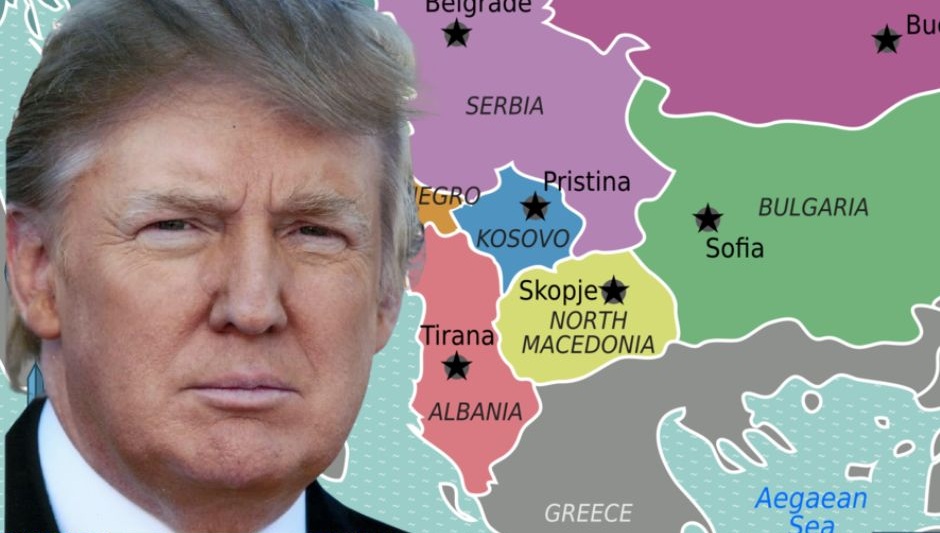
In the latest American strategy, the Balkans are not mentioned at all. The only countries in the region that are mentioned are Kosovo and Serbia, and even then only twice: first in President Trump’s introductory text, and then in the section outlining the Strategy’s principles. In both cases, the two Balkan states are mentioned in the context of preventing armed conflict, which came as a result of mediation or intervention by the American president. It is unclear whether this refers to the signing of the Washington Agreement in 2020 at the White House—when Pristina and Belgrade committed to normalizing relations—or to some intervention during this year, after Trump began his second term.
WHAT IS REALISM IN INTERNATIONAL RELATIONS?
Before continuing to analyze the new Strategy in relation to the region and “flexible realism” as a paradigm, we must return to the main theories of international relations that have dominated the world since the formation of states. The historian and general of ancient Greece, Thucydides—considered the founder of the realist school—saw the world as an anarchic stage, where “the strong do what they can and the weak suffer what they must.” According to realists, the world is a vast jungle without laws, where different states are in constant competition (war) for greater influence. In their view, international organizations, unions, or alliances should not play a role that replaces that of states. It is precisely the power of states that determines their place in the world order, not the values or principles promoted by those organizations, unions, or alliances. Values, principles, or reason, they believe, should not stand in the way of achieving state objectives. State security is the primary goal of realists, and to achieve it, a balance of power among states is necessary. According to proponents of this theory, states should not be dependent on one another, as they exist in a continuous state of conflict and potential hostility. International institutions or supranational organizations should not define or replace the national interests of each state.
Liberals, on the other hand, argue that states are important actors in international relations, but they are not the only ones. In this context, actors from political, civil, and economic society—such as non-governmental organizations, chambers of commerce, citizens’ associations, and others—can also play a significant role. Instead of anarchy, liberals view international relations more optimistically, emphasizing possible order and harmony based on international moral values. They place values, principles, and reason ahead of narrow state interests. Unlike realists, liberals see great potential for achieving and maintaining peace within international institutions such as the IMF, WHO, UN, EU, or NATO.
Realists prefer competition, while liberals prefer cooperation. While the former believe influence can be achieved only through the use of “hard power,” such as military intervention, the latter call for the use of “soft power”—that is, influence through diplomatic channels, by offering funds, markets, expertise, investments, and other benefits to countries. Liberals believe that if states share the same democratic values, they are far less likely to enter into direct conflict with one another. For realists, it does not matter whether the state they cooperate with cultivates democratic values; it is enough that such cooperation serves the state’s interests and security. Exporting democracy, values, or international morality to third countries, according to them, is a waste of time and resources.
PEACE BETWEEN KOSOVO AND SERBIA IN THE NEW STRATEGY
Let us return to the mention of preventing war between Kosovo and Serbia in the Strategy. Some American and European analysts believe this refers to the Washington Agreement, through which Trump believes he stopped a new war in the Balkans. This document was signed in September 2020 between Serbia’s Aleksandar Vučić and Kosovo’s Avdullah Hoti, several months before Trump lost the race for a second term to former President Joe Biden. This serves as a message that Pristina–Belgrade relations will remain on the White House radar, while peace and normalization between the two states are now promoted as one of the American president’s successes.
In this context, Trump’s “flexible realism” implies rapid implementation of provisions aimed at establishing long-term peace. Kosovo and the region do not fall into the category of insignificant countries for which the new Strategy says the U.S. has no interest. On the contrary, the Balkans are the main testing ground for Chinese, Russian, and Iranian influence, which the U.S. has warned it will counter. It is part of the today’s Western Hemisphere in political terms, within which Trump has announced the revival of the “Monroe Doctrine” to combat Eastern influences. Originally, this doctrine was a U.S. foreign policy articulated by President James Monroe in 1823, warning European powers against further colonization or intervention in the Americas and defining the Western Hemisphere as a U.S. sphere of influence. It declared that the U.S. would not interfere in European affairs but would consider any new European attempts to control countries in the Americas as hostile acts. Over time, this doctrine became a cornerstone of U.S. foreign policy.
Now, under the NATO umbrella, Americans and Europeans have expanded what is referred to as the Western Hemisphere, or political West, while Trump’s revival of the Monroe Doctrine sends a message to China and Russia that he “will not allow new colonies” within the American sphere of influence. Not coincidentally, Serbia today is experiencing increasing pressure from the United States to sever all ties with Russia that could translate into concrete influence. Following sanctions on the NIS refinery—where Russia is the main owner—and on Russian energy companies operating in the region, Serbia faces a historic dilemma: remain loyal to Moscow and pay a high price, or fully orient itself toward the West by abandoning its “two chairs” foreign policy. As Belgrade seeks a way out of this situation, another development signals an even tougher American stance: President Trump has signed the National Defense Authorization Act (NDAA) for fiscal year 2026, aimed at further reducing Russian energy influence in the Western Balkans, signaling a harsher and more institutionalized approach that could significantly narrow Serbia’s room for maneuver. The law emphasizes that dependence on Russian natural gas and oil “ties the economies and policies of Western Balkan countries to the Russian Federation” and “hinders their aspirations for membership in the European Union.” According to the law, reducing this dependence is in the national interest of the United States.
This pragmatic approach and Trump’s new doctrine may usher in a new world in which peace is determined by the interests of powerful states. The U.S., as the world’s leading power, will prioritize securing peace and progress—especially in the Western Hemisphere as its zone of influence—while simultaneously preventing China and Russia from “colonizing” states that are part of this hemisphere. It will not seek to interfere in the Eastern Hemisphere by exporting democratic values; however, any attempt to exert influence in the West will be understood as an act of hostility. For small states, such as those in the Balkans, this reshaping of the world order can be read as a message that their stability will depend more on alliances with the West than on international rules, values, and principles.