


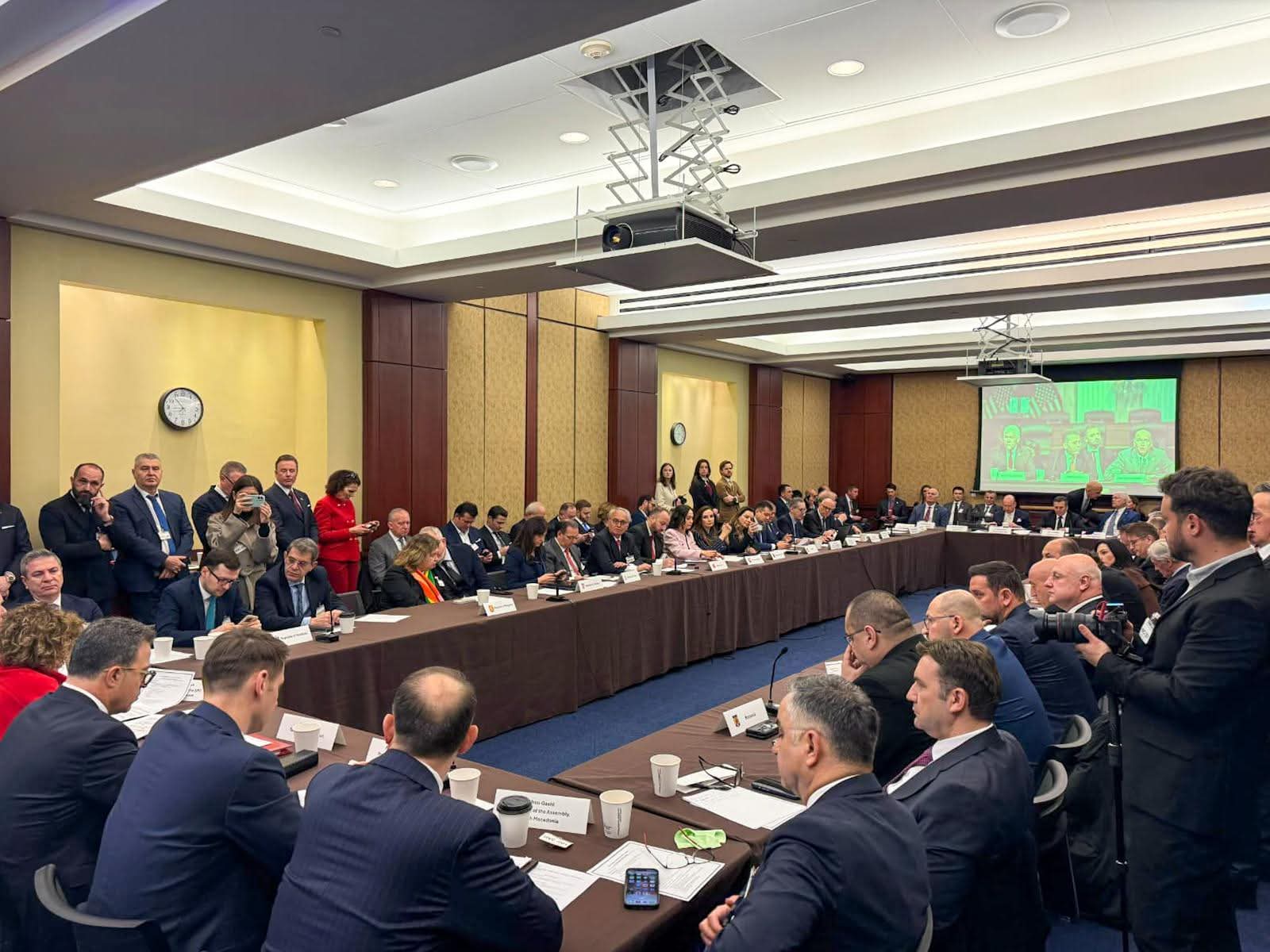
North Macedonian political leaders underscored the strategic importance of NATO and regional stability at the Washington Security Forum, highlighting the Western Balkans’ growing role in global security dynamics.
Speaker of the North Macedonian Parliament, Afrim Gashi, and Deputy Leader of the Democratic Union for Integration (DUI), Bujar Osmani, delivered keynote addresses before world leaders and U.S. lawmakers, emphasizing unity, transatlantic cooperation, and the region’s security challenges.
Gashi reaffirmed North Macedonia’s commitment as a responsible NATO ally and a reliable U.S. partner, highlighting the country’s dedication to democratic values and regional stability.
“Our commitment to NATO is rooted in the belief that no country can ensure its security alone. Our contributions—through disciplined fulfillment of obligations, institutional strengthening, defense investment, and joint interoperability—are key to collective resilience,” Gashi said, quoting former U.S. President John F. Kennedy: “We pledge allegiance to faithful friends. United, there is little we cannot do; divided, there is little we can do.” He also referenced former President George W. Bush in emphasizing the renewal of unity through shared values.
Gashi concluded by stressing North Macedonia’s choice of responsibility over hesitation and unity over division as a pledge to shared values, collective security, and a strong transatlantic alliance.
Osmani, who served as North Macedonia’s foreign minister from 2020 to 2024 and chaired the Organization for Security and Cooperation in Europe (OSCE) in 2023, highlighted the Western Balkans’ increasing role in the global strategic competition. He urged that the region be treated as a strategic investment zone within the Euro-Atlantic order rather than merely as an area for managing instability.
Speaking at Capitol Hill, Osmani linked North Macedonia’s institutional and personal experiences during Russia’s 2022 aggression against Ukraine to current regional challenges. “When Russia’s aggression against Ukraine began, I was serving as North Macedonia’s foreign minister and OSCE chair. It was also the period when our country joined NATO and launched the Strategic Dialogue with the United States,” he said.
Osmani emphasized that security is no longer measured solely by military spending, but also by political, infrastructural, and regional connectivity. He noted differences in European responses to external pressures: integrated states resisted more effectively, while fragmented countries remained vulnerable to outside influence. In this context, he highlighted Corridor 8—a transport and connectivity initiative linking Bulgaria, North Macedonia, Albania, and Italy along NATO’s southern flank—not merely as infrastructure but as a security project.
He also warned that key stability agreements in the Balkans, including the Dayton Accord for Bosnia and Herzegovina and the Ohrid Framework Agreement for North Macedonia, are coming under renewed pressure—not from military force, but from institutional and political challenges.
Osmani outlined three main points for regional security: first, the Western Balkans is an integral part of the global strategic competition; second, regional cooperation strengthens collective defense; and third, infrastructure is now a central element of deterrence, including transport corridors, energy links, and digital networks.
He concluded by stressing that treating the region solely as a zone for managing instability will result in delayed responses, while framing it as a strategic investment zone can anchor it firmly within the Euro-Atlantic order. “This is the lesson from our experience,” he said.
Their remarks come amid ongoing tensions in the Western Balkans, persistent challenges to European and Atlantic integration, and concerns over external influence, including from Russia. Osmani’s Washington visit includes meetings with U.S. lawmakers, experts, and think tanks specializing in Balkan affairs, as transatlantic security forums review priorities to strengthen NATO’s southern flank.