


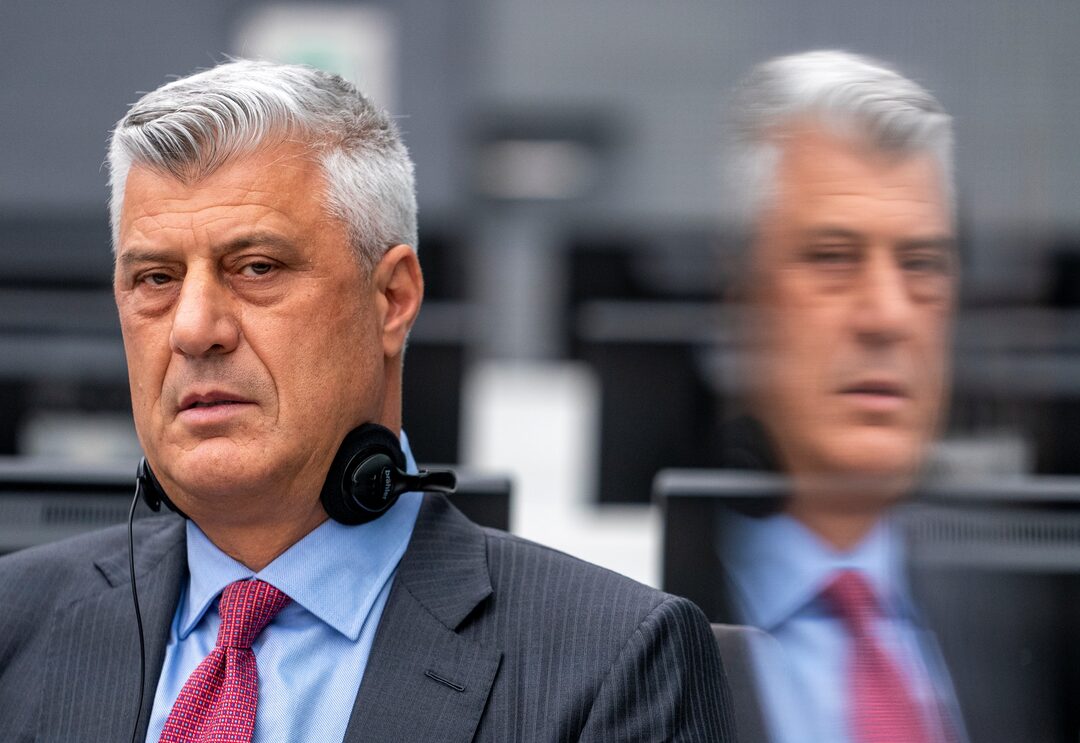
Former Kosovo president Hashim Thaci said the war crimes case against him was unjust and politically motivated, defending his role during the 1998–99 conflict in an interview with Frankfurter Allgemeine Zeitung (FAZ).
“I fought for freedom, not for crimes,” Thaci said, insisting that the Kosovo Liberation Army (KLA) had waged a legitimate struggle against Serbian forces.
Thaci, who is being tried at the Kosovo Specialist Chambers in The Hague, rejected charges including murder, persecution and torture, saying he bore no individual responsibility for such acts.
“The war of the KLA was just,” he told FAZ, adding that it had been supported by Kosovo’s population and later by NATO intervention.
He argued that the events of the 1990s were well documented and not a matter of interpretation.
“This is not a question of interpretation – it is part of the factual record documented by diplomatic files, international organisations and tribunals,” he said, while claiming that some “evidence” produced during the Milosevic era had been fabricated.
“Much of what was fabricated served influence, not the truth,” Thaci added, warning that accepting such claims could set a dangerous precedent.
Thaci described the 1999 NATO intervention as grounded in “freedom, justice, human rights and the protection of human life,” saying the alliance acted because it understood “who we were and what we were going through under Milosevic.”
He said Kosovo’s delegation had accepted peace at the Rambouillet talks in 1999, while “Serbia chose war, repression and ethnic cleansing.”
Thaci also said his main objective had been to secure lasting peace between Kosovo and Serbia and to integrate Kosovo into the international system.
“My main goal was to ensure lasting peace between Kosovo and Serbia – a peace that allows both countries to move forward,” he said.
He stressed the importance of dialogue facilitated by the European Union, but added that progress was more likely when the United States was actively involved.
“The experience has shown that progress is always possible when the United States is actively engaged in our region,” he said.
Thaci also suggested Kosovo had lost time in its relations with Western partners in recent years, calling for stronger ties with the EU and the United States.
Asked about domestic politics, he said political actors should prioritise citizens over party interests.
“Everyone in Kosovo should always place the interests of citizens above party interests,” he said.
On broader legal issues, Thaci said the rule of law should not be politicised.
“Law must never be used as a political instrument,” he said, adding that Kosovo had consistently looked to the West as a model for democracy and rule of law.
The Kosovo Specialist Chambers, based in the Netherlands, were established to investigate alleged crimes by former KLA members following international pressure. The trial is ongoing, with a verdict not expected before 2027.