


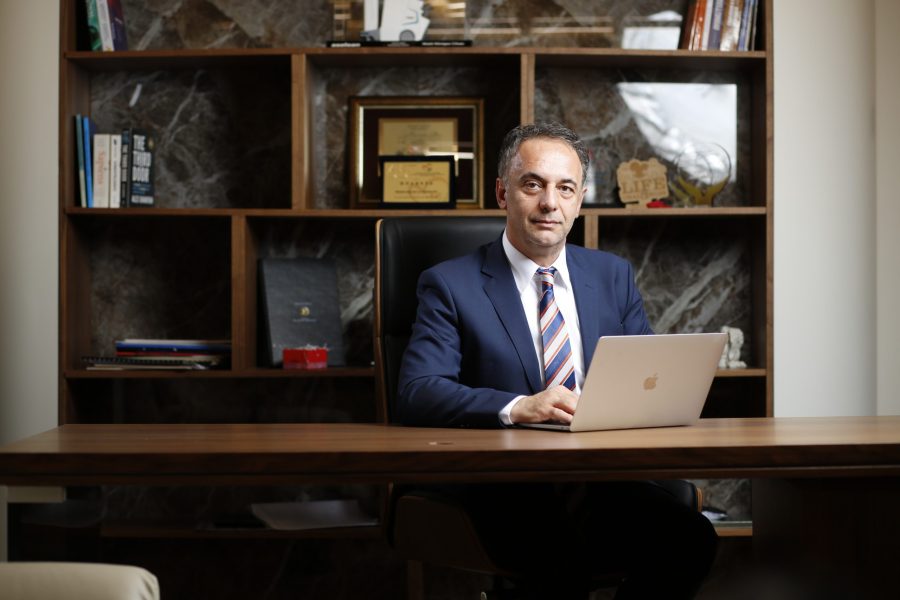
By Azir Aliu
Minister of Health of North Macedonia
There are problems in society that cannot be resolved through a simple “for” or “against” debate, nor through new moralizing. Smoking is precisely such an issue—a deeply rooted habit, a cultural routine and, above all, a major burden on public health. In a system that is meant to care for everyone, smoking cannot be treated as a “private matter” that ends with personal choice. On the contrary, it ends up in the air we all share and breathe. That is why I do not see the new Draft Law on Protection from Tobacco as a punitive mechanism, but as a law aimed at advancing public health and prevention.
Its goal is clear and precise: to protect the health of citizens—especially children, young people and non-smokers—from the harmful effects of tobacco and nicotine. This law is not “against smokers”; it is normatively designed to be “for everyone’s health.” In parts of public opinion, it is easy to create the impression that the state is “fighting people” instead of fighting the causes that make people ill. But we are not fighting citizens—we are fighting addiction and the practices that fuel it, the exposure suffered by non-smokers, and the normalization of smoking in front of children.
When we talk about freedom, we must be precise: one person’s freedom to smoke must not violate another person’s freedom to breathe smoke-free air. In public and shared spaces, air is not private property. When someone smokes in an enclosed public space, at the workplace, on public transport or in a taxi, they go beyond the limits of personal habit and create health risks for others. Involuntary exposure to tobacco smoke and aerosols is not a matter of taste or opinion, but a matter of risk. There is no “safe” level of exposure, and passive smoking is a proven cause of serious illnesses among non-smokers.
The workplace must be safe for employees’ health, and here I am thinking particularly of workers in the hospitality sector—no waiter, bartender or cleaner should have to choose between their job and their health.
Smoking here has long ceased to be merely a bad habit of part of the population; its prevalence is an indicator of a public health crisis. With around 45% of the population smoking, we are among the countries with the highest rates in Europe. In this context of mass smoking, citizens need to know that tobacco is the leading preventable cause of disease and premature death. Particularly worrying is the exposure of children and young people, the growing use of new nicotine products, and the consequences of passive smoking for non-smokers.
Health consequences are only one side of the coin; the other is the enormous economic cost we pay as a society. Diseases linked to smoking account for about 5% of GDP, or approximately €738 million in annual losses due to healthcare costs and reduced productivity. This means overloaded clinics, more chronic patients, more sick leave, and more families paying the price with their health, time, and physical and psychological trauma.
One of the main reasons a new legal solution was necessary lies in changes in reality. Tobacco addiction is taking on new dimensions and going beyond the classic cigarette—with the emergence of electronic cigarettes (with or without nicotine), heated tobacco products, smokeless products and those that imitate smoking. If the law had remained stuck in past definitions, it would have been blind to the present. In the IT world, this is called a “legacy” problem: rules that do not cover reality, while regulatory gaps turn into channels for circumvention. The same applies to public policies.
Therefore, the law clearly stipulates a ban on smoking in all enclosed public and workplace spaces, for all tobacco and nicotine products, including electronic cigarettes and heated tobacco products, as well as on public transport, including taxis. This is a preventive, not ideological, normative determination: where people must share air, the state has an obligation to make that air safe.
The hospitality sector is the most sensitive point, because habits are most visible there and interests strongest. The law is not guided by the appearance of space, but by the quality of the air people breathe. Smoking is prohibited in enclosed parts of hospitality venues and in semi-enclosed spaces where partitions create exposure equivalent to that in enclosed areas. By exception, smoking is allowed only in genuinely and functionally open outdoor spaces, under clear conditions—open on at least three sides and without barriers that trap or direct smoke.
The law also intervenes in certain open public spaces where exposure is unavoidable due to large gatherings of people. “Open” does not automatically mean safe. Therefore, smoking is restricted or prohibited around healthcare, educational and social institutions, at sports and cultural events, in spaces for children and families, and in places where people cannot avoid exposure.
Smoking in vehicles is also regulated when children or minors are present, as well as in vehicles that serve as workplaces. A vehicle is a small enclosed space with a high concentration of smoke, where a child has no ability to protect themselves.
The law places special emphasis on preventing new addictions. The ban on flavors and tastes (fruity, sweet, menthol, herbal, etc.) for all categories of products, including electronic cigarettes, is a strong preventive measure, because these flavors are designed to make first use easier and to accelerate the development of addiction, especially among young people.
At the same time, a complete ban is introduced on advertising, promotion and sponsorship by the tobacco industry—across media, the internet and social networks, through events, prize games, discounts and gifts. Marketing is not information; it is influence, and that influence is most often directed at young people.
The aim of this law is not to stigmatize or humiliate anyone, but to help. Therefore, preventive programs, information, education and support for quitting addiction are предусмотрed. Prevention is more effective, cheaper and more humane than treating the consequences.
In the end, every law is only as good as its implementation. The law clearly defines institutional responsibilities and sanctions for violations. Without enforcement, no one will be protected. As an engineer, I know that a system without clear responsibilities always ends with the phrase “it’s not within my competence.” In public health, this must not happen.
We are aware that this law will face resistance, because it changes habits. But the state must not be a hostage to habits that make citizens ill. Public health is not a matter of day-to-day politics, but of long-term protection and the civilizing regulation of shared space. I am not asking anyone to feel guilty; I am asking only that we be rational and fair—to protect children, workers, and make public spaces healthier. In a well-functioning system, rules are not meant to punish, but to protect against risks that individuals cannot control on their own. Clean air creates health, and health is the wisest investment in the future.