


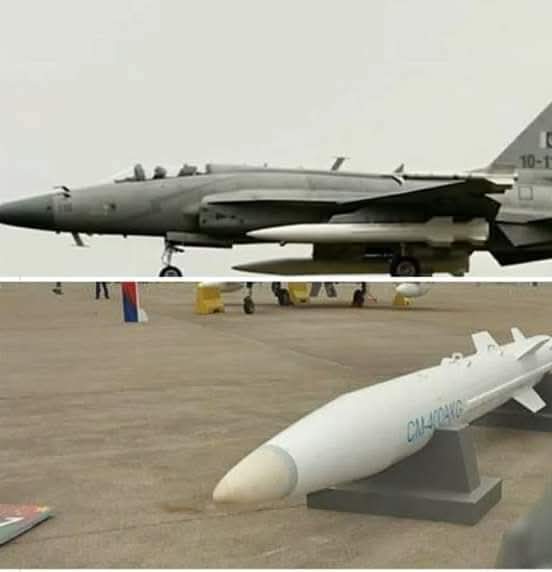
Serbia has purchased Chinese-made supersonic ballistic missiles, President Aleksandar Vučić confirmed, after photographs circulating online appeared to show Serbian fighter jets carrying the weapons, prompting concern from neighbouring Croatia and drawing attention to Belgrade’s deepening military ties with China.
The missiles, identified as the CM-400 series, make Serbia the first European country known to possess the system and only the second buyer globally after Pakistan.
Croatian Prime Minister Andrej Plenković said on Thursday that Zagreb would inform NATO allies about what he described as a “new element in the arsenal of the Serbian army.” Serbian officials say the weapons are intended as a deterrent and that the country has no intention of attacking its neighbours.
Belgrade has not disclosed how many missiles were purchased or their cost. Vučić described them as “extremely expensive,” adding that Serbia received a small discount from China.
REGIONAL CONCERNS
Military analyst Aleksandar Radić said the missiles represent a significant upgrade in Serbia’s strike capabilities.
“These systems have a long range and considerable destructive power, far beyond what the Serbian army previously had,” Radić said, adding that their range could approach that of Cold War-era ballistic missiles.
The CM-400 missile can reportedly reach targets up to 400 km away, though export versions such as the CM-400AKG — believed to be the variant used by Serbia — are estimated to have a range of about 250 km. At the final stage of flight the missiles can reach speeds of around Mach 5, making them difficult to intercept.
Radić said such weapons are generally considered a deterrent but their introduction could still raise questions in the region, where most countries are NATO members.
Serbia, which maintains military neutrality and is surrounded by NATO states, lacks the capacity to launch an offensive campaign against the alliance, Radić said, suggesting the missiles may have more psychological and political impact than practical military effect.
TENSIONS WITH CROATIA
Croatia was the first country in the region to react publicly to the purchase. Plenković said he did not expect the missiles to be used against neighbouring countries but described them as a serious capability.
Croatian Defence Minister Ivan Anušić earlier said he hoped the missiles would “remain in storage where they belong.”
Online discussions in Croatia focused on the missile’s range and whether it could reach the Croatian capital, Zagreb.
Vučić dismissed concerns from Zagreb, saying Serbia alone would decide what weapons it acquires. He also said Belgrade is preparing for possible security challenges, accusing Croatia, Albania and Kosovo of forming a defence partnership that Serbia views with suspicion.
Croatia, Albania and Kosovo signed a declaration on defence and security cooperation in March 2025, which Serbian officials have described as a potential threat to the country’s security.
DEEPENING MILITARY TIES WITH CHINA
China has become Serbia’s largest arms supplier in recent years. According to the Stockholm International Peace Research Institute (SIPRI), about 61% of Serbia’s imported weapons over the past five years have come from China, compared with 12% from France and 7% from Russia.
Serbia has already acquired Chinese CH-92 and CH-95 combat drones, as well as FK-3 and HQ-17 air defence systems. It was the first European country to introduce Chinese combat drones into operational service.
The confirmation of the missile purchase followed photographs posted on a military forum showing a Serbian Mikoyan MiG-29 apparently carrying a CM-400 missile. Analysts said the images were likely taken near the Batajnica air base outside Belgrade.
Vučić later confirmed that the Serbian military had successfully integrated the Chinese missile system with its Russian-made fighter jets.
The Serbian president also acknowledged that the aircraft were carrying Chinese LS-6 glide bombs, which can strike targets from distances of around 60–70 kilometres.
EU PRESSURE
Serbia has been negotiating membership of the European Union since 2014 but progress has stalled, with no new negotiating chapters opened since 2021.
Brussels has repeatedly urged Belgrade to align its foreign and security policy with EU positions, including reducing defence cooperation with China.
Radić said Serbia’s balancing between East and West is increasingly difficult as the country pursues closer ties with Beijing while seeking eventual EU membership.
“EU policy requires alignment in foreign and security affairs,” he said. “That creates a tension between Serbia’s ambition to move toward Europe and its desire to maintain offensive capabilities of Chinese origin.”