


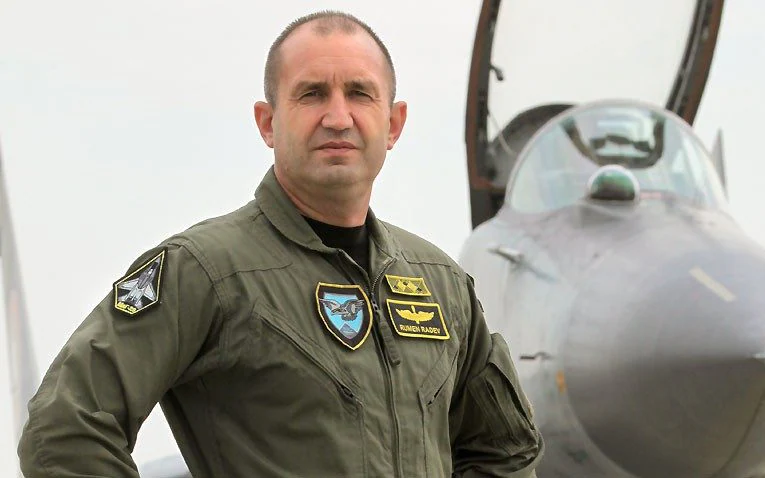
Long before he became the dominant figure in Bulgaria’s latest political upheaval, Rumen Radev was known for something far simpler: flying.
In the air force, colleagues recall a disciplined officer with a reputation for calm control under pressure. During training in the United States, he earned the call sign “Moses” — a nickname that, in hindsight, feels almost symbolic for a man who would later present himself as a guide through Bulgaria’s political wilderness.
A decade later, that same figure now stands at the centre of Bulgaria’s fractured political landscape, his newly formed alliance emerging as the strongest force in the country’s 2026 parliamentary elections.
From Cockpit to Command
Radev’s trajectory is unusual even by Balkan political standards. Rising through the ranks of Bulgaria’s air force, he became one of its most prominent fighter pilots before being appointed commander in 2014 — a position that brought him into the orbit of national power.
Two years later, he stepped into politics, winning the presidency in 2016 as an outsider figure promising order, sovereignty and institutional respect.
But the presidency did not soften him. If anything, it sharpened his confrontational style.
From his earliest speeches, Radev signaled he would not play a ceremonial role. His clashes with parliament became frequent, his tone often blunt. “Few words, but effective actions,” he once told lawmakers — a line that would become something of a personal credo.
The Crisis Years
His presidency coincided with one of the most turbulent periods in modern Bulgarian politics.
The protests of 2020 — triggered by corruption allegations and a deepening distrust in institutions — marked a turning point. When prosecutors targeted figures close to the presidency, the confrontation between state institutions spilled into the streets.
For many Bulgarians, Radev became more than a president; he became a symbol of resistance to what critics described as a captured political system.
But symbolism alone could not stabilise the country.
Between 2021 and 2026, Bulgaria spiraled through repeated elections and fragile coalitions, unable to produce lasting governments. Radev, as president, appointed a series of caretaker administrations — a role that expanded his influence but also drew criticism that he was quietly reshaping politics from above.
Crossing the Line
In early 2026, Radev made his boldest move: he resigned as president before the end of his term and stepped directly into party politics.
It was a gamble.
Presidents in Bulgaria traditionally remain above party competition. By entering the electoral arena, Radev risked transforming personal popularity into measurable political strength — or exposing its limits.
He formed a new alliance, positioning it as an alternative to what he described as exhausted elites. His message was simple: stability, anti-corruption, and a reset of the political system.
The electorate responded.
Preliminary results showed his bloc far ahead of its rivals, turning him overnight from influential former president into the central power broker of the new parliament.
A Divisive Figure
Yet Radev’s rise has never been universally embraced.
To supporters, he is a disciplined outsider — a man shaped by military hierarchy rather than party deals, someone who speaks plainly in a system often accused of duplicity.
To critics, he is something more ambiguous: a populist with strong executive instincts, sceptical of Western consensus on issues such as Russia and Ukraine, and comfortable operating in grey zones between institutional roles.
His calls for dialogue with Moscow, his opposition to sending arms to Ukraine, and his emphasis on national sovereignty have placed him at odds with parts of the European mainstream.
The Real Test
Now, with electoral momentum behind him, Radev faces the challenge that has defeated many before him: governing.
Bulgaria’s parliament remains fragmented. Even a strong electoral result does not automatically translate into a stable majority. Coalition politics — messy, transactional and often short-lived — still defines the system he seeks to reshape.
The question is no longer whether Radev can win public support.
It is whether he can convert that support into functioning power.
Beyond the Persona
What makes Radev’s story compelling is not just his rise, but the timing of it.
He arrives at a moment when Bulgarian voters are fatigued by instability, distrustful of institutions, and increasingly open to figures who promise clarity over compromise.
In that sense, his journey from cockpit to parliament is not only personal — it reflects a broader shift in how politics is imagined in Bulgaria.
Whether he becomes the leader who ends the cycle of crisis, or simply its latest protagonist, remains uncertain.
But one thing is already clear:
Rumen Radev is no longer just a former president.
He is now the man everyone else in Bulgarian politics must reckon with. (BV)