


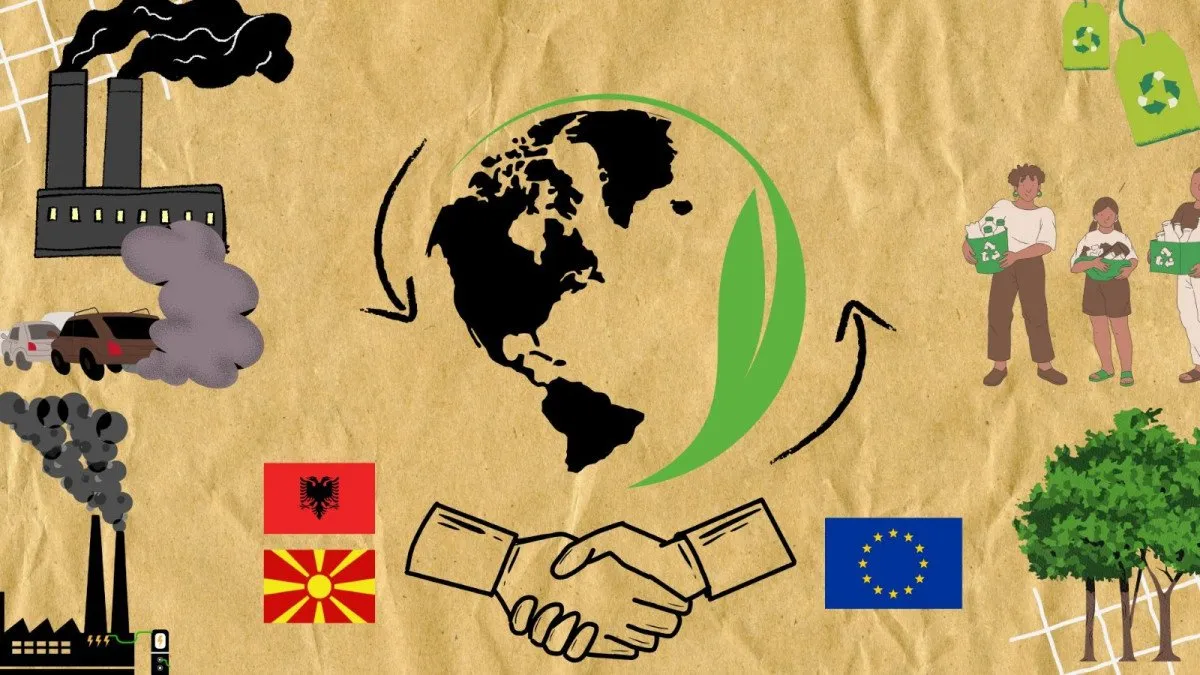
Albania and North Macedonia, which for years moved in parallel in the European integration process, today represent two different models of progress toward the European Union: Albania has consolidated its position as an active negotiating country, entering a phase of full legal and institutional alignment by opening all clusters (groups of chapters), while North Macedonia remains blocked in an earlier phase of negotiations due to political conditionality, bilateral barriers, and a lack of internal consensus over the years.
Authors: Xhelal Neziri (North Macedonia), Dallëndyshe Xhaferi Agolli, Valmora Gogo (Albania)
In March 2004, just one month before the early presidential elections, North Macedonia’s then–Prime Minister Branko Crvenkovski led a large delegation to Dublin, Ireland, to submit the country’s application for candidate status for integration into the European Union (EU). Ireland, holding the EU Council presidency at the time, welcomed with notable empathy this ambitious decision by a small and troubled Balkan state. Three years earlier, North Macedonia had emerged from an armed conflict that ended with the Ohrid Agreement, and just one month earlier, it had experienced an unprecedented tragedy: President Boris Trajkovski lost his life in a plane crash in the airspace of Bosnia and Herzegovina.
Seeing the positive atmosphere in the EU, Crvenkovski did not doubt that the country would receive candidate status. Already a central unifying figure in the country, he announced his candidacy for president, showing ambition to move from the prime minister’s office to the presidency. He was aware that to win, he would also need the votes of ethnic Albanians, who make up nearly one-third of the population. This was especially important because more than half of registered voters must cast ballots to elect a president—a threshold that has often been difficult to reach. Crvenkovski knew that the majority of ethnic Albanians strongly supported EU integration, so he addressed them with a specific promise: “If I win, Albanians from North Macedonia will be the first Albanians from the Balkans to become part of the EU.”
Veteran Macedonian journalist Zoran Ivanov clearly recalls that moment from 22 years ago. “Yes, what the presidential candidate said at the time about Albanians from Macedonia being the first group to enter the EU, if I remember correctly, was for pre-election purposes—to gain sympathy among Albanian voters,” says Ivanov, who at the time was head of media communications in Crvenkovski’s cabinet.
At that time, Montenegro was still part of a federation with Serbia as a remnant of the breakup of former Yugoslavia, Kosovo had not yet declared independence, and Albania and Bosnia and Herzegovina were far from obtaining EU candidate status. North Macedonia and Croatia were leading the integration process and were simultaneously in the group seeking NATO accession.
Vetos Toward Skopje and the Separation from Tirana
Crvenkovski won the election, but in 2008, he faced a veto from Greece, which conditioned the continuation of Skopje’s Euro-Atlantic integration on a change of the country’s name. The issue was resolved in 2018 with the signing of the Prespa Agreement, under which the state was renamed from “Macedonia” to “North Macedonia.” However, that was not the final obstacle. In 2019, France conditioned EU enlargement on a new negotiation methodology, and in 2020, Bulgaria demanded urgent implementation of the 2017 Good Neighbor Agreement. This conditionality was temporarily overcome with the French Proposal, archived as “Protocol 2” in the foreign ministries of Skopje and Sofia—a document drafted during the German presidency and finalized during the French presidency in 2022. Under this compromise document, approved by both parliaments, Skopje was allowed to continue the negotiation process, but on the condition that in the first phase it adopt constitutional amendments to include ethnic Bulgarians in the preamble. Since a two-thirds majority was not secured in the Assembly of North Macedonia to fulfill this obligation, the country has still not opened negotiations.
Albania, which until 2024 was grouped with North Macedonia, separated and moved forward—triggering numerous debates in Skopje.
“This separation is exclusively political in nature, namely due to Bulgaria’s demand for constitutional amendments,” says Dragan Tilev, former State Secretary at the Ministry for European Affairs in Skopje and one of the best-known experts on the European integration process. “The fact is that this demand has a bilateral character, stemming from Protocol 2, where for the first time the opening of the Constitution and inclusion of the Bulgarian community in our preamble is mentioned.”
With the transfer of Protocol 2 into the conclusions of the EU Council and the Negotiating Framework on June 18, 2022, this bilateral issue, according to Tilev, was transformed into a European condition. From that moment, the intergovernmental document became a European requirement and a political benchmark that, until fulfilled, does not allow the country to proceed with opening the first cluster, “Fundamentals.”
Drita Abdiu Halili, chief negotiator of North Macedonia with the EU until 2024, says the EU enlargement process has always been both technical and political. “This became even more evident after Russia’s aggression against Ukraine, when enlargement once again assumed a key role as a strategic instrument of European security. In this new geopolitical context, the EU sees enlargement as part of its stability architecture, not merely as an administrative process of legal alignment.”
Dimitar Nikolovski, director of the Skopje-based think tank “Eurothink,” agrees that external blockades are a real factor and cannot be relativized, especially since they shift the process from criteria to bilateral issues. However, he stresses, “if we want an honest analysis, stagnation cannot be explained solely by blockades.”
Journalist Zoran Ivanov says there are two main reasons why the country became stuck in EU integration. The first, he argues, is historical misunderstandings with neighbors, primarily Greece and Bulgaria. “Their policies toward the country not only slowed but at certain periods completely blocked Macedonia’s European integration movement,” he adds. The second factor, Ivanov emphasizes, is internal Macedonian politics. “Especially the pronounced populist, even nationalist policies of the party currently in power, VMRO-DPMNE.”
In fact, North Macedonia moved alongside Albania in the EU integration process until June 19, 2022. They jointly held their first intergovernmental conference, officially launching negotiations. However, the difference was that Albania held a full intergovernmental conference, while North Macedonia had a political intergovernmental conference. Though insufficiently discussed in Macedonian public discourse, the difference was that the Skopje–Brussels political conference was only a political opening of negotiations, not a substantive and genuine one as in Albania’s case.
“This was the result of Bulgarian opposition, which at that moment withdrew to allow negotiations to begin, but on the condition that constitutional amendments deriving from the Second Protocol with Bulgaria be made,” recalls Tilev.
After the first conference, both countries began the screening process together in 2022, completing it in 2023.
The separation occurred in October 2024, when Albania opened its first cluster after meeting preconditions such as the roadmap for rule of law and public administration reform.
“From that moment, Albania moved at lightning speed,” says Tilev. “Taking advantage of the positive aspects of the new methodology, which provides momentum, Albania, within 12 months, managed to open all six clusters and thus all 33 chapters.”
Former chief negotiator Abdiu Halili sees the issue in Skopje. The Negotiating Framework adopted in 2022 remains in force, and the EU has clearly indicated that the next step is fulfilling agreed conditions, including constitutional amendments linked to opening the “Fundamentals” cluster. “In procedural terms, the action must come from Skopje,” she adds.
This position has been consistently reiterated by EU institutions, including at the 19th meeting of the Stabilization and Association Committee in February this year.
From Partners to Competitors for the EU
The news that Albania opened all six clusters within one year sparked intense debate in North Macedonia over which country is actually closer to EU integration.
Prime Minister Hristijan Mickoski’s statement that his country remains ahead of Albania and just behind Montenegro in the EU integration process triggered mixed reactions. Mickoski leads VMRO-DPMNE, which came to power in 2024 by opposing constitutional amendments required under the French Proposal.
Abdiu Halili notes that EU integration is not measured solely by the number of aligned laws. It requires full legal harmonization, sufficient institutional and human capacities for implementation, and effective enforcement of the acquis.
Nikolovski agrees that while North Macedonia has relatively high technical preparedness in some parts of the acquis, “Albania is currently ahead in the very dynamics of negotiations.” He adds that claims of being “ahead” despite not moving in negotiations are more of a domestic political narrative than a measurable reality under the enlargement methodology.
Academician Abdylmenaf Bexheti stresses Albania’s speed of progress and North Macedonia’s stagnation. “When Macedonia had candidate status, Albania had not even signed a Stabilization and Association Agreement. Today the situation is diametrically opposite,” he says.
Financial and Environmental Consequences of Stagnation
While Mickoski’s government awaits guarantees from Bulgaria, the country faces serious environmental and financial consequences.
During the screening process, Chapter 27 “Environment and Climate Change” was analyzed rigorously. According to Abdiu Halili, legal, institutional, and financial gaps were identified, along with implementation capacities.
“If weaknesses are not sustainably addressed, they can become structural obstacles to membership,” she says.
North Macedonia faces numerous environmental challenges: winter air pollution records in Skopje and other cities, and unsystematic waste management.
Financially, the consequences could be more severe. “Once Albania becomes an EU member, even the few foreign investors we have will move there,” warns Bexheti.
Foreign direct investment figures show a stark contrast:
Foreign Direct Investment (in million USD)
| Year | North Macedonia | Albania |
|---|---|---|
| 2022 | 785 | 1,434 |
| 2023 | 625 | 1,622 |
| 2024 | 1,358 | 1,716 |
“The lost momentum, at a time when Europe has opened its doors for geopolitical reasons, will not be repeated quickly,” Bedzeti warns.
Malign Influences and Risk of Destabilization
Remaining distant from EU membership and rising Euroscepticism may create space for foreign influence. Russia, China, and some Middle Eastern countries have long been present in various spheres in North Macedonia.
However, Tilev believes there is no real risk of changing the country’s geopolitical trajectory. “Let’s not forget that we are a NATO member. That is a guarantee of security and defense.”
Still, stagnation could create vulnerabilities. Abdiu Halili warns that falling behind others risks losing position in the new architecture of European integration.
“If nothing changes substantially, there is a risk the country will fall behind long-term,” says Nikolovski, though he insists citizens should not accept such a fate.
Resolving the constitutional amendment issue could allow North Macedonia to quickly join the emerging group—Montenegro, Albania, Ukraine, and Moldova.
WELL AHEAD, BUT WHERE EXACTLY DOES ALBANIA STAND?
Albania officially opened accession negotiations with the European Union on October 15, 2024—31 years after holding its first pluralist elections. Nearly a year later, in September 2025, the country opened negotiations on one of the most challenging clusters, according to EU integration experts: the Green Agenda and Sustainable Connectivity cluster.
This cluster includes Chapter 27, “Environment and Climate Change.” According to an official response the Ministry of Tourism gave to Gogo.al, the Albanian state did not have to fulfill any opening benchmarks set by the European Union for this chapter.
“Based on the progress of legislative reforms and the implementation of environmental legislation, Albania did not have opening or interim benchmarks, only closing benchmarks. These closing benchmarks were officially submitted in September 2025 to the European Commission, and now Albania must undertake the necessary reforms and investments to fulfill them,” the Ministry of Environment stated. This indicates that Albania is currently in the phase of aligning its legislation and taking all necessary steps to ensure environmental protection in accordance with EU standards.
Officially, Albania has opened all clusters. However, according to EU integration expert and head of the European Movement in Albania, Gledis Gjipali, closing the main chapters related to the environment and food safety remains difficult.
“They are difficult to close because they require significant investments from both state institutions and businesses, as well as strong administrative capacities to ensure the implementation of the new standards,” Gjipali told Gogo.al. He added that Albania’s main challenges remain internal issues related to political dialogue, reform fatigue from the many reforms undertaken over the years, and the lack of consistency in implementing them.
“Externally, the EU decision-making mechanism and the possibility of member states using their veto remain a potential risk for delays,” Gjipali added. He considers closing Albania’s negotiations by 2027 to be very ambitious, but not unattainable.
In Albania, one of the projects providing substantial support for fulfilling Cluster 27 is “Sane27,” whose deputy director is expert Rezart Kapedani.
For Gogo.al, Kapedani offers a concise and understandable explanation of where Albania stands, what it must fulfill, the obstacles ahead, and a forecast of when it may be fully successful.
“Albania has made good progress regarding Chapter 27 ‘Environment and Climate Change.’ However, it should be noted that under the new enlargement methodology, negotiations take place at the cluster level rather than the chapter level, so progress is also linked to other chapters in Cluster 4 (mainly transport and energy),” Kapedani assesses.
According to him, one of the greatest difficulties is the sheer volume of the chapter. “Chapter 27, in terms of the main acquis acts to be monitored, includes 10 subchapters with 75 acts (46 directives and 29 regulations). If their implementing acts are included, the number exceeds 400. Moreover, 12 of these 75 acts were adopted in the last four years. Traditionally, the environmental sector has not received sufficient funding to meet European standards, so now a major qualitative leap will be required in improving Albanian legislation and its implementation on the ground. This does not translate only into obligations toward citizens, but also obligations for businesses and local government,” Kapedani emphasizes.
In his view, although Albania has spent around 20 years aligning its legislation and standards with the EU, a faster reform pace is now required. He lists key areas for progress, including revising the Criminal Code to align environmental crime provisions with the new directive, fulfilling obligations on environmental liability, revising the air law and related by-laws—including the strategy and action plan—to comply with new EU air quality standards, supplementing the waste law and extended producer responsibility framework with by-laws, and revising the waste strategy and master plan in line with the new waste management structure.
“All river basins will be completed with their management plans, most of them also with flood maps and measures plans. A marine waters strategy and monitoring plan will be prepared. The environmental permitting law will be revised according to directive changes, and a new law on industrial accidents involving hazardous chemicals will be drafted. New planning documents on climate change will also be prepared, containing targets aligned with the EU Green Deal and climate adaptation,” Kapedani adds.
In his forecast, the expert assisting Albania’s progress in environment and climate change underlines that the legal framework is expected to be completed within the next two years.
“…while by 2030, the main aspects of implementation enabling EU accession are expected to be fulfilled. Of course, regarding the environment, the Republic of Albania will negotiate certain transitional periods for directives whose implementation requires investments and standards extending beyond 2030,” Kapedani concludes.
BETWEEN POLLUTION AND THE DIFFICULTY OF ALIGNMENT WITH EU LAWS
According to the European Environment Agency (EEA) and the 2025 report published by the Health Effects Institute titled State of Global Air 2025, air pollution is one of the serious issues and a significant public health indicator that must be addressed.
According to the State of Global Air 2025 report, in 2023, Albania recorded 2,300 deaths closely linked to exposure to air pollution, resulting in a mortality rate of 56 deaths per 100,000 inhabitants—three times higher than the EU average of 21 deaths per 100,000 inhabitants.
Meanwhile, according to the European Environment Agency and long-term air monitoring conducted by Albania’s National Environment Agency, road transport is one of the main contributors to increased levels of nitrogen dioxide (NO₂) and particulate matter with a diameter of 10 μm or less (PM10) in the country’s cities.
However, reducing air pollution is not the only issue Albania must resolve to continue its path toward EU membership.
According to an official response from the Ministry of Environment, the country faces difficulties in aligning with European legislation.
“The difficulties are significant in terms of the large number of acquis legal acts that need to be transposed into Albanian legislation, the level of investments required to meet European standards, as well as the rapid changes in European environmental legislation,” the response states. It adds that implementation challenges extend across various environmental sectors.
“Albania has several urban wastewater treatment plants, but it is still far from the standards required to meet European benchmarks,” the ministry notes. Regarding waste management, it states that by 2027, a strategy with action plans will be drafted to bring this sector into compliance with EU standards.
Environmental Law Violations Causing Damage in Albania
| Number per year | Percentage of violations in industrial areas | Nature of violations | Nature of violations | Nature of violations | Nature of violations |
|---|---|---|---|---|---|
| 100–150 | 55–66% | 60% of cases are from the mismanagement of non-hazardous and hazardous waste | Around 20% of cases are due to air pollution | Around 25% of cases from untreated urban and industrial wastewater discharges into receiving water bodies and/or soil | Around 5% of cases involve noise pollution |
Beyond legislative changes, Albania continues to face challenges with individuals and entities violating the law and damaging the environment and natural monuments. According to official data provided to Gogo.al by the National Inspectorate for Environmental Protection, 100–150 entities violate environmental laws each year, 55–66% of them in industrial areas.
“Regarding the nature of the violations identified, in around 60% of cases pollution was caused by mismanagement of non-hazardous and hazardous waste, around 20% from air pollution, around 25% from untreated urban and industrial wastewater discharges into receiving water bodies and/or soil, and around 5% from noise pollution, a phenomenon more pronounced in inhabited urban areas,” the official response states.
* This text was produced within the framework of the PULSE Thematic Networks, a European initiative supporting transnational journalistic collaborations.