


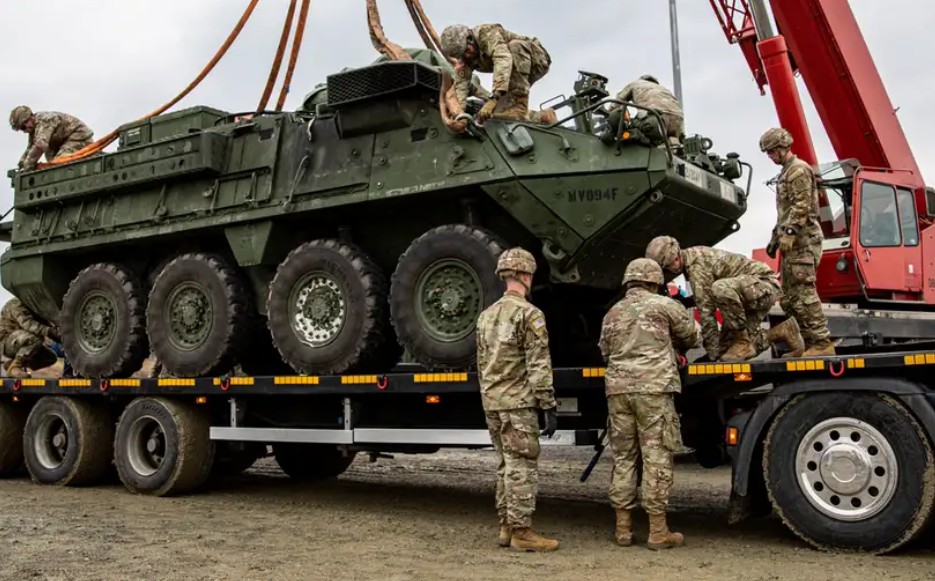
North Macedonia has received 17 U.S.-made Stryker light armoured vehicles as part of efforts to modernise its armed forces, officials said on Wednesday, amid a broader rise in defence spending and arms imports across Europe and the Western Balkans.
The delivery is part of a wider programme under which a total of 42 vehicles are expected, with the remaining units due by mid-summer.
Prime Minister Hristijan Mickoski said the new equipment would improve operational capability and mobility.
“This significantly enhances our readiness and makes us more competitive compared to other armies,” he said, adding that the government would continue investing in defence within budget limits.
He described the country’s security situation as stable and under control despite global tensions.
The vehicles were presented at a military facility near Skopje, attended by Defence Minister Vlado Misajlovski, who called the acquisition one of the largest recent defence projects.
A U.S. embassy official, Nicole Varns, said the delivery marked an important step in strengthening North Macedonia’s military and interoperability within NATO.
According to data from the Stockholm International Peace Research Institute, the move comes as Europe becomes the world’s largest arms-importing region, accounting for 33% of global imports in 2021–25, with volumes more than tripling compared with the previous five-year period.
SIPRI data shows that Serbia has been the largest arms importer in the Western Balkans in recent years, with imports rising sharply and its share of global arms imports increasing to about 0.6% in 2021–25 from 0.2% previously.
Belgrade has sourced weapons from multiple suppliers, including China, Russia and Western countries, importing complex systems from at least 13 countries over the past five years.
Across the region, countries are increasing defence spending and procurement in response to shifting security dynamics, even as a post-Dayton subregional arms control framework covering Bosnia, Croatia, Montenegro and Serbia formally remains in place.
Globally, the volume of arms transfers rose by 9.2% in 2021–25 compared with 2016–20, driven largely by increased demand in Europe, SIPRI said.