


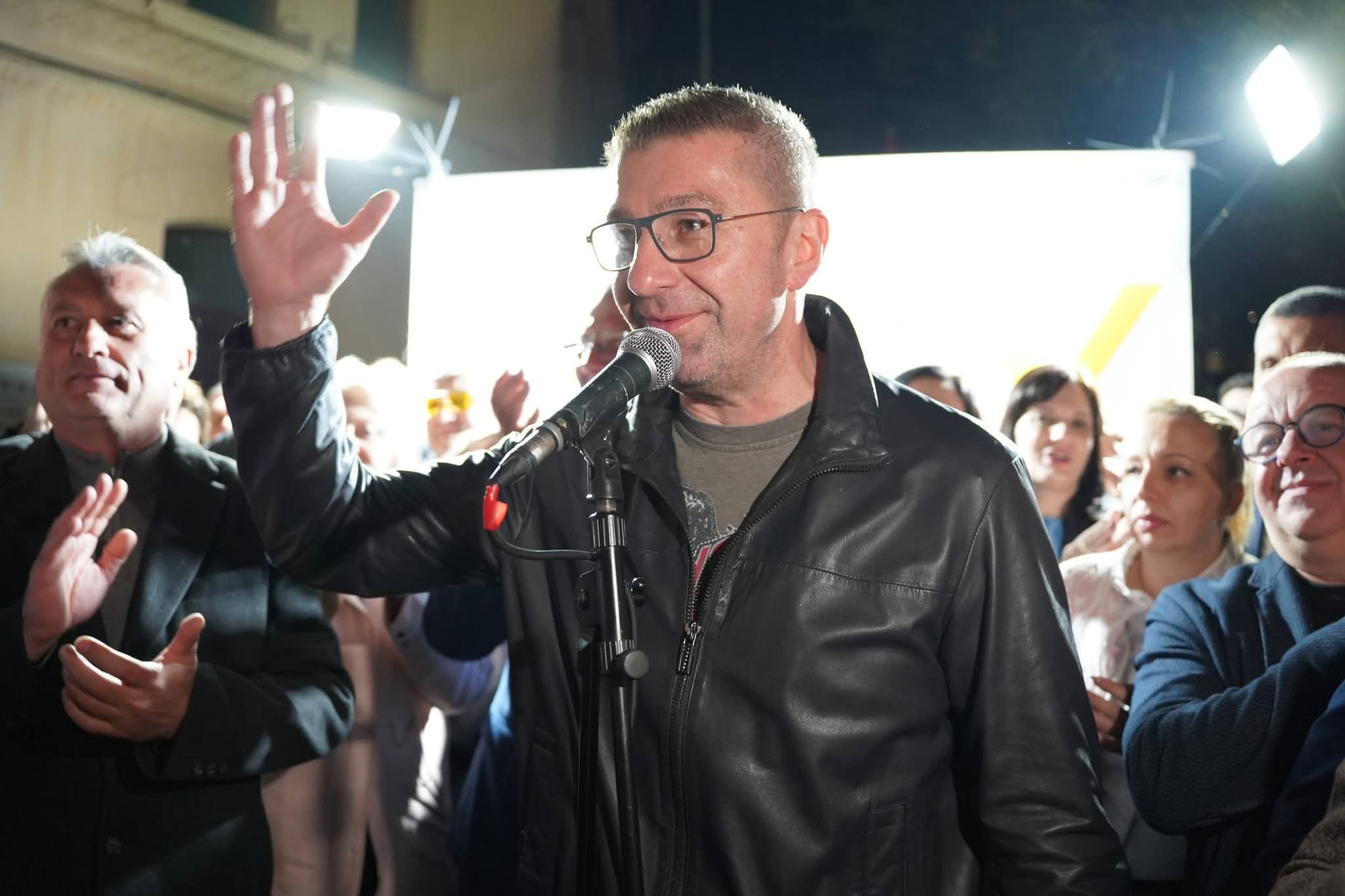
North Macedonia closed 2025 under the firm political dominance of the conservative VMRO-DPMNE, following local elections that consolidated the ruling party’s control and exposed the weaknesses of a fragmented opposition, while the country’s European Union ambitions remained stalled.
Parliamentary elections in May 2024 had already delivered a decisive victory for the centre-right VMRO-DPMNE coalition under Prime Minister Hristijan Mickoski, relegating the Social Democratic Union of Macedonia (SDSM) to its weakest position in decades. That result set the stage for political control ahead of the 2025 local polls.
Local elections confirmed VMRO-DPMNE as the dominant force.
The 19 October 2025 local elections (with runoffs on 2 November) saw VMRO-DPMNE and its allies win the majority of mayoralties and municipal councils. After both rounds, VMRO-DPMNE candidates are set to govern in roughly 54 of 81 municipalities, including the capital Skopje, marking an increase from 42 in 2021. Its junior coalition partners among ethnic Albanian parties also secured seats in several municipalities, while the SDSM trailed significantly behind in both rounds.
Turnout was modest — below half of registered voters — underscoring a broader public disengagement from local politics.
Political analysts say the results highlight VMRO-DPMNE’s organisational discipline and voter mobilisation, contrasting with a divided opposition that has yet to present a coherent alternative platform. Levica, a left-wing party, marginally outperformed SDSM in some contests, especially in Skopje’s runoffs, signalling shifting opposition dynamics.
Public confidence in institutions was further shaken by the Kochani tragedy, a deadly incident that drew nationwide attention and sparked renewed debate over state oversight, safety standards and accountability. The tragedy triggered public anger and criticism from civil society groups, who accused authorities of systemic failures in enforcement and governance, adding social pressure to an already polarised political environment. The criminal trial has begun in Skopje, with 35 individuals and three legal entities on trial over the March 2025 nightclub fire that killed 63 mainly young people, and all defendants have so far pleaded not guilty to charges including serious crimes against public safety. Prosecutors are also pursuing separate investigations into additional officials related to the case. In meanwhile, North Macedonia’s parliament has adopted amendments to ban the indoor use of pyrotechnics and significantly increase fines and penalties for violations, a legislative response aimed at preventing similar disasters.
EU integration remained stalled.
European integration continued to be a formal priority of the government, but tangible progress toward accession was limited throughout 2025. North Macedonia remains a candidate country, but negotiations have not advanced materially toward opening substantive chapters, largely due to a protracted dispute with Bulgaria over historical, linguistic, and minority rights issues — including implementation of constitutional protections related to Bulgaria — which have been embedded into the EU accession process.
Analysts and EU observers described the situation as having “no clear path forward” without fresh diplomatic compromise or changes to conditions imposed by Brussels and Sofia. This stalemate persists despite occasional expressions of support by some EU officials for North Macedonia’s bid.
Economic conditions offered stability without broad relief for households.
North Macedonia’s economy grew modestly in 2025, with GDP expansion around 3.3‒3.4 percent, driven by domestic demand and public investment, while inflation rates eased after earlier peaks but remained a concern tied to core and food prices. Wage growth lagged relative to price increases, and structural challenges like unemployment persisted.
While macroeconomic indicators suggested relative stability, many citizens reported ongoing pressures from high living costs, underscoring a disconnect between headline growth figures and everyday consumer experience (e.g., food, housing, energy). (Consumer sentiment is reflected in local reporting and social commentary, even when formal data are mixed.)
Coalition politics remain transactional.
The ruling coalition, which includes VMRO-DPMNE and ethnic Albanian blocs such as VLEN and leftist ethnic Macedonian ZNAM, operated more on pragmatic power sharing than on coherent ideological agendas. Analysts observed that ethnic Albanian parties increasingly acted as political brokers, focused on access to government positions in lieu of unified policy platforms. This approach has helped maintain coalition stability despite periodic tensions.
Foreign policy and strategic alignment.
North Macedonia sustained its strong alignment with NATO and Western positions, including ongoing support for Ukraine and participation in EU and NATO political-security forums. Its contributions to international missions and cooperation on security issues remained active through 2025.
Looking ahead to 2026, the political landscape is dominated by a ruling party with reinforced local authority, a weakened but evolving opposition, and transactional coalition politics that show limited ideological coherence. The key unresolved question is whether the long-promised reforms and EU accession prospects will regain momentum or remain confined by both internal political resistance and external diplomatic bottlenecks. The ongoing EU integration challenge, especially that linked to Bulgaria and constitutional amendments, continues to shape the country’s strategic trajectory.