


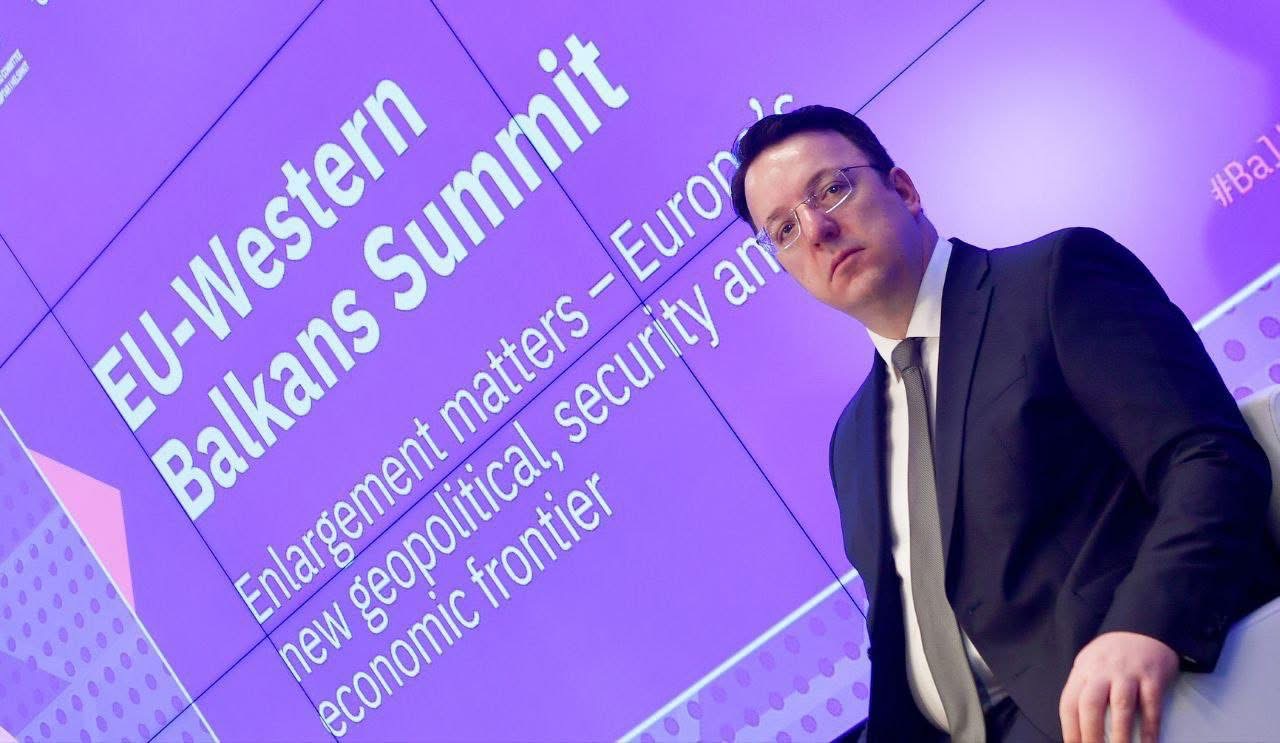
North Macedonia has long struggled to align with European values, and membership in the European Union (EU) and NATO remains the region’s only viable path, Deputy Prime Minister Aleksandar Nikoloski said on Thursday at a panel discussion in Brussels. The event, titled “Enlargement Issues: Europe’s New Geopolitical, Security and Economic Frontier,” was organised by the Friends of Europe think tank.
“Being a NATO member is important, but EU delivery is still lacking,” Nikoloski said, highlighting the need for clear and fair signals from key EU actors on whether the country and the broader region will be admitted.
Nikoloski noted that North Macedonia has made significant sacrifices over decades to advance its EU accession, yet political will remains uneven. “The country is transforming from within, using domestic resources and seeking international support, whether through cooperation with the EU or the United States. We signed a strategic partnership agreement with the United Kingdom, the first in the Western Balkans, which I had the honour to sign in May this year. This shows we are working, trying, and seeking partners where we belong – in the Western civilisation,” he said.
He stressed that EU enlargement is inherently political. “No EU enlargement has ever been purely technical – from Greece and Portugal in the previous century to the major expansions in the early 2000s, and Romania and Bulgaria more recently – it has always been political. What is missing for this region is political will,” Nikoloski said.
Expressing concern over regional dynamics, Nikoloski warned that powerful actors are waiting to exploit opportunities to seize influence, potentially undermining the EU accession process. “The reasons differ across countries, but the lack of political will is clear. It is only fair to tell the people of the region what is possible and what is not, and to implement what can be done. Otherwise, we remain trapped in a cycle of waiting for the next summit, and time passes. My fear is what this could mean for the region’s future,” he said.
Against this backdrop, Nikoloski highlighted economic cooperation as the most effective tool for regional development. He cited government plans for large-scale infrastructure projects aimed at enhancing connectivity with neighbouring countries.
“We need to cooperate economically, which we are already doing, and connect the region. Despite being landlocked, North Macedonia sits on two European transport corridors: Corridor 10 from Peraea in Athens to Finland, and Corridor 8 from the Adriatic to the Black Sea. We are investing heavily in roads and railways, which can reshape our economic future and the region’s,” Nikoloski said.
He added that talks with Greece are underway to create 13 additional border-crossing lines to expedite transport, and discussions with Bulgaria are focused on railway connections and opening new border points. “This is how we open ourselves to each other while trying to keep political games aside,” he said.
Nikoloski also said public support for EU membership remains strong in the region, citing Slovenia-Croatia cooperation as a model for resolving bilateral issues. However, he noted that North Macedonia remains open to cooperation while counterparts in some neighbouring countries show limited interest.