


And above all, to stand with science means to stand with the person – because in the end, every true reform in healthcare has only one test of its meaning: whether it has protected human dignity at the moment when it was most vulnerable.
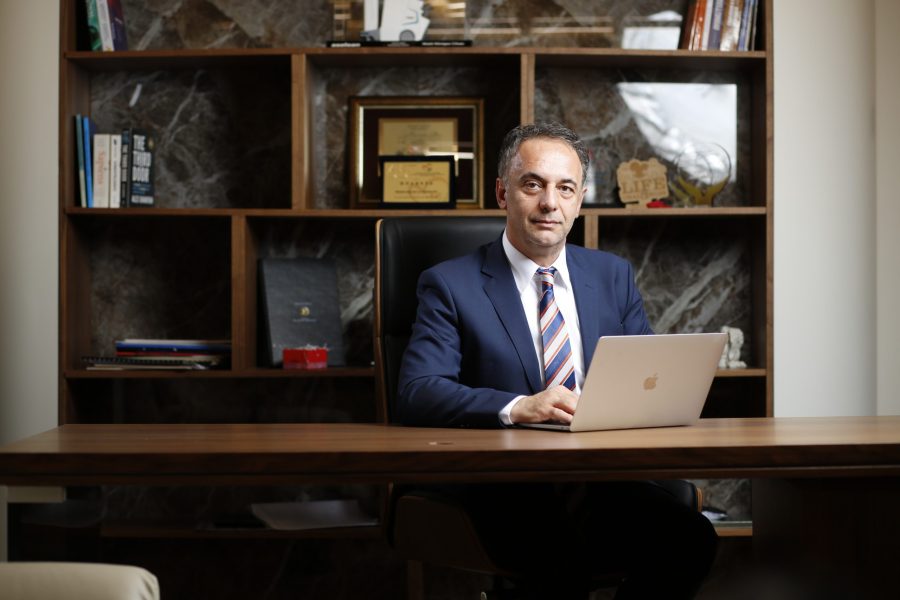
By Azir Aliu
On the eve of April 7, World Health Day, it is worth pausing on the message sent this year by the World Health Organization: “Together for health. Stand with science.” Technological progress, the exponential growth and development of artificial intelligence and its penetration into science, give this message the weight of one of the most important civilizational messages of our time. The WHO began 2026 by placing scientific knowledge, cooperation among institutions and the One Health approach at the center – the awareness that human health is inseparably linked to the health of animals, plants and the environment.
In an era in which everyone feels entitled to their own opinion about science, medicine and public health, this message sounds almost like a moral obligation. To stand with science does not mean to defend some distant laboratory, but to defend the human right to truth, to an accurate diagnosis, to timely therapy, to a system that does not decide according to misinformation, but according to the strength of evidence. Science in healthcare is its conscience. Without it, politics easily turns into improvisation, and improvisation in healthcare is paid for by people with their time, their pain, and sometimes with their lives.
That is precisely why, when I speak about reforms in Macedonian healthcare, I do not want them to be reduced merely to bureaucratic changes, to new forms or administrative shifts. My conviction is that the healthcare system can become fairer and more efficient only if it becomes more scientific. And that means something very concrete, such as orderly data, verifiable pathways, protocols, electronic records, institutional and digital memory, developed capacities to learn from facts. In this context was also the idea to prepare legislative changes under which medical documentation, referrals, prescriptions, reports and registers should be maintained digitally, with a single electronic health record for each patient. In this direction, telemedicine, already successfully tested in the triangle Skopje–Debar–Delchevo, is not seen as technological exoticism, but as a way for knowledge to travel faster than the patient and to bring specialist care closer to the place of residence.
Today, the scientific approach also has another important dimension – the awareness that health can no longer be viewed in isolation, as a closed relationship between doctor, patient, clinic and hospital. This is precisely why the WHO this year strongly emphasizes the One Health approach, which understands health as a connection between people and the rhythms of life in nature. This approach responds to the realities of our time: new infectious threats, antimicrobial resistance, the impact of climate on health, and the need for systems to learn how to anticipate. The more interdependent the world becomes, the more healthcare must become scientifically interconnected and institutionally coordinated.
From this perspective, to stand with science does not only mean to be “for” medicine, but to be for a state that decides on the basis of verifiable knowledge. In its global digital health strategy, the WHO states that digital health initiatives can deliver results only if they rely on a robust strategy that connects financial, organizational, human and technological resources. This is an important lesson for us as well: technology alone does not save. But when placed in the service of medical protocols, knowledge, institutional memory and accountability, it becomes a tool for the system’s efficiency and effectiveness, as well as for its value-driven intention to be fair. In this sense, the processes of digitalization we have initiated in our healthcare system are not an ornament of modernity, but a necessary precondition for the system to learn to measure, monitor, compare and decide with more reason and less improvisation.
The most developed healthcare systems have long since ceased to be satisfied with merely recording what has happened to the patient. They are moving toward better predicting what may happen. That is why the European Union today invests in initiatives such as Virtual Human Twins, within the broader vision of the European Health Data Space, where health data, interoperability, supercomputing and artificial intelligence are not treated as technological play, but as a foundation for more precise, personalized and predictive medicine. For Macedonia, this is not a subject for today’s self-deception, but for tomorrow’s orientation: to know what kind of system we should move toward, even as we still address the fundamental weaknesses of the present.
Here begins true modernization, which, beyond more screens, also implies more traces, more records of processes. Healthcare can earn greater trust only if it has a system that remembers, connects and verifies. And such a system can be built only if it stands on the foundation of science and its achievements.
Of course, it would be dishonest to claim that Macedonia’s healthcare system does not have its serious material weaknesses. It does, and they are real. We face a shortage of staff, a need for better infrastructure, more order, more discipline and greater predictability. But that is precisely why today we need a higher reference in science, so that we do not remain trapped in the present. Healthcare cannot forever be merely reactive and based on temporary solutions; it must move toward a system capable of anticipating, comparing, analyzing and learning from its own data. That is the essence of modern healthcare, and that is why the scientific approach is a necessity for states that want to break out of the cycle of improvisation.
Science, however, does not gain meaning only when it becomes a grand European strategy. It also gains meaning when it becomes a human achievement in a specific operating room – an achievement of the hands of a team filled not only with knowledge, but with dignity. That is why it is worth saying that in Macedonia there are already examples where scientific and professional potential is not merely a vague aspiration, but a reality. The successfully performed 16 cornea transplants, in cooperation with experts from the United States, are proof that when knowledge, international cooperation and domestic expertise meet in a shared goal, our system can take steps that until yesterday seemed distant. In that moment, science is the restoration of sight. It is the restoration of possibility, a reminder that even a small state can develop human and scientific resources if there is direction and institutional persistence.
As a computer scientist by education, and today as Minister of Health, I deeply believe that the future of healthcare will not be determined only by how many hospitals we build, but also by how we learn to turn science into policy. I am not close to a logic in which technology is an end in itself. But I am close to a logic in which digitalization becomes a form of justice: when the person receives faster service, when the doctor gets a clearer picture, when the system gains a trace, and the state gains the ability to decide more responsibly.
And perhaps it is precisely here that lies the deepest meaning of this year’s WHO message. To stand with science means to accept that there is no dignified healthcare if the system is not grounded in knowledge, evidence and the ability to learn. Science protects humanity from arbitrariness, ignorance and chance. And a state that truly stands with science, in fact stands with the most vulnerable person at the moment when they most need certainty and truth. In this lies the ethical and civilizational weight of this message: healthcare must not be a space where a person is left alone before illness, but a system in which knowledge stands on their side.
Therefore, on the eve of April 7, I do not want to read the message “Together for health. Stand with science.” as yet another symbolic sentence that we will repeat and forget. I want to read it as an obligation. To stand with science means to stand with a healthcare system that will be calmer, more precise, fairer, more responsible, and grounded in evidence. And above all, to stand with science means to stand with the person – because in the end, every true reform in healthcare has only one test of its meaning: whether it has protected human dignity at the moment when it was most vulnerable.
The author is Minister of Health of North Macedonia