


Kosovo has operated without an active lobbying contract in the United States for almost two years, raising concerns among analysts about the country’s ability to influence U.S. policy, according to RFE/RL analysis published on Sunday.
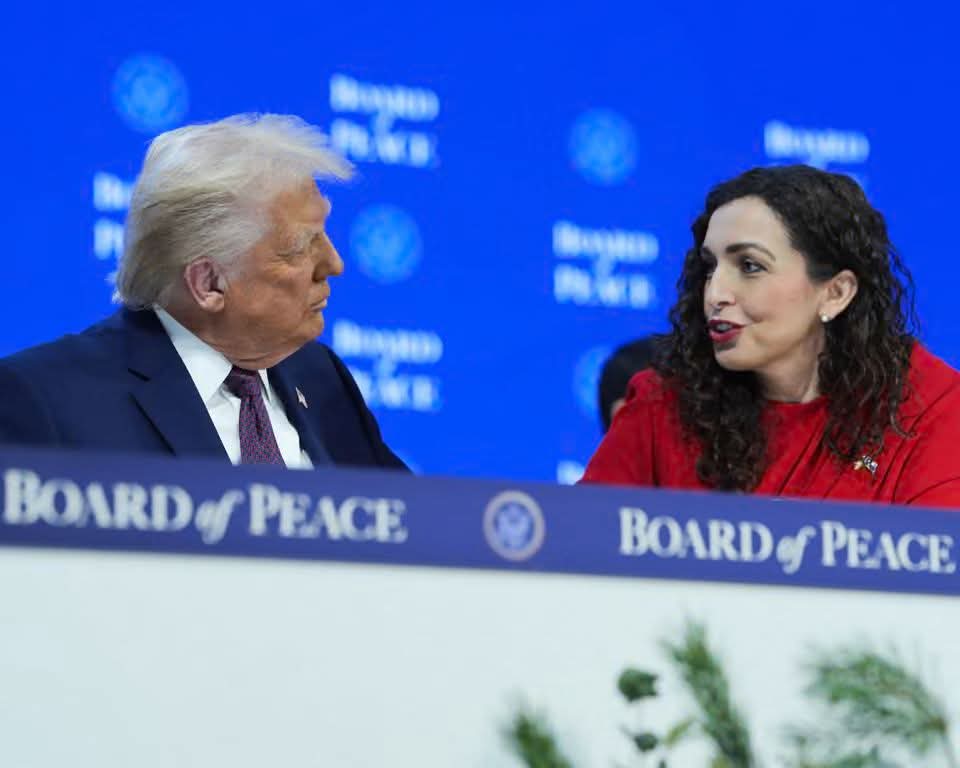
President Vjosa Osmani has remained one of Kosovo’s most visible figures on the international stage in recent months, attending the signing of the Peace Board Charter for Gaza and meeting U.S. President Donald Trump in private discussions that drew global media attention. Kosovo, with a population of about 1.5 million, has demonstrated that active diplomacy can maintain visibility, even without formal lobbying support.
“It is a historic initiative, with a clear vision: to bring more peace and security to the world,” Osmani said after signing the Peace Board Charter on Jan. 22 in Davos.
However, the initiative faced skepticism. France and Germany declined to participate, warning it could undermine the United Nations’ role and open doors for authoritarian leaders such as Russian President Vladimir Putin. Domestically, opinions were divided between those viewing it as a boost to Kosovo’s international profile and those seeing it as a risky alignment with autocratic regimes, including Belarus.
Amid this debate, Kosovo’s lack of formal lobbying in Washington has gone largely unnoticed. Donika Emini, a Balkans policy analyst, said Kosovo has had very few active voices in U.S. political circles since June 2024, not due to lack of issues, but due to a lack of structure. The country currently has no registered Foreign Agents under the U.S. Foreign Agents Registration Act (FARA), a mechanism that allows foreign states to legally advocate their interests in Washington.
“Individual engagement cannot replace a professional lobbying structure, especially in the United States,” Emini told Radio Free Europe/Radio Liberty’s Expose program. “In the U.S., nothing happens by chance. Everything goes through lobbying.”
Kosovo historically employed U.S.-based lobbying firms such as Podesta Group and Ballard Partners, spending hundreds of thousands of dollars to promote its international agenda. Under President Osmani and Prime Minister Albin Kurti, only three contracts were signed in 2023, all of which have since expired.
Requests for comment from the Presidency, Government, and Ministry of Foreign Affairs and Diaspora on why Kosovo currently has no active lobbying contracts went unanswered. Foreign Minister Donika Gërvalla has previously stated that continuation of contracts with two firms contracted in 2023 is being “considered,” but nearly 18 months later, no action has been taken.
Experts say Kosovo risks misunderstanding U.S. priorities and receiving limited support if it relies solely on sporadic visits or individual engagement. Vesko Garčević, a professor of international relations at Boston University, said lobbying compensates for small states’ limited economic, military, or strategic weight. He noted that Serbia currently has six active FARA-registered lobbying contracts, while Bosnia has 14, Albania four, and Montenegro and North Macedonia none.
“Without active lobbying, Kosovo risks being overlooked and allowing others to shape its narrative,” Garčević said. “Continuous engagement ensures the U.S. perceives and supports your priorities.”
Kosovo’s relations with Washington have experienced tension over the past two years due to government decisions affecting the Serbian community, culminating in public warnings from U.S. officials and temporary measures such as the suspension of immigrant visas for Kosovo citizens, alongside others from the Western Balkans except Serbia.
Emini said the new government, likely led again by Albin Kurti, should prioritize long-term lobbying networks in Washington rather than relying on official visits or ad hoc communication.
“In a small state like Kosovo, alliances are essential,” she said. “Even with full sovereignty and NATO membership, building relationships in Washington remains critical.”
While President Osmani emphasized that “when America leads, peace is always safer,” analysts say Kosovo’s challenge will be translating visibility into sustained influence beyond handshakes and media coverage.