


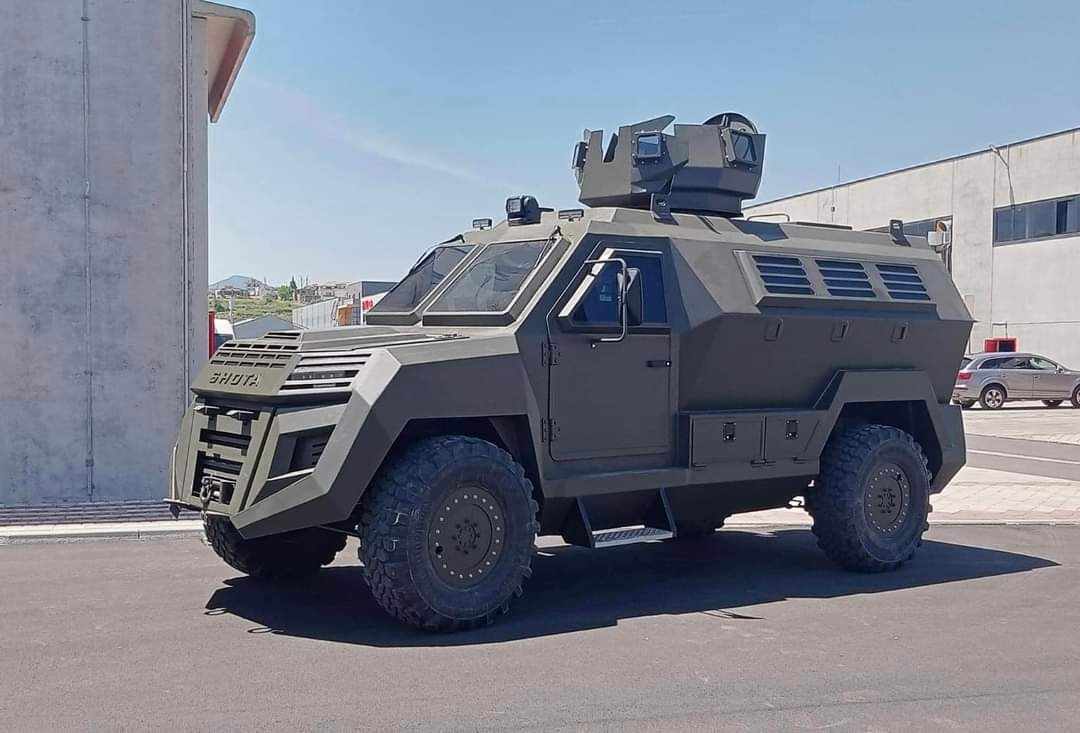
Kosovo, Albania, and Croatia plan to jointly produce the Shota armored vehicle, marking the first trilateral military manufacturing project in the Balkans, Kosovo’s Acting Defense Minister Ejup Maqedonci said. The initiative is part of a regional military alliance signed by the three countries in March 2025.
Maqedonci told local media that the countries have agreed in principle to co-develop the vehicle, with final terms expected to be formalized in a bilateral agreement with Albania, and later expanded to include Croatia. The project will supply the armies of all three countries and is expected to support exports.
“Part of the production will take place in Kosovo, part in Albania, and part in Croatia,” Maqedonci said, highlighting the potential for regional collaboration.
The Shota is a 13-ton mine-resistant armored personnel carrier (MRAP) designed by the Albanian company Timak. It can carry up to 10 personnel, including the driver, and is available in 4×4 and 6×6 variants. The vehicle meets STANAG 4569 Level 2 protection standards, able to withstand 7.62×39mm armor-piercing rounds and explosions of up to 6 kilograms under the wheel or floor.
The MRAP features a V-shaped hull, mine-resistant seats, a roof gunner turret, camera monitoring, and air conditioning. Some armor sections are angled to enhance protection.
Maqedonci also said Kosovo has strengthened its military capabilities beyond the 2018 Comprehensive Transition Plan, with more than 23 weapon types acquired since 2021, including anti-drone systems. The government plans further acquisitions next year to complete the operational capacity of the Kosovo Security Force, including air defense systems and a helicopter fleet.
Kosovo is negotiating with the Pentagon for Blackhawk helicopters, with the United States and Turkey identified as key partners for military procurement, alongside cooperation with Germany, Italy, the United Kingdom, Croatia, and the Czech Republic.
The minister noted that Kosovo’s active force currently numbers 4,460 personnel, approaching the 5,000 target set for 2028.